TL;DR: Restaurant groups usually need a culinary data platform to structure recipes and costs, an ERP or back-office system for purchasing and finance, and a data warehouse or integration layer for analytics. meez acts as the culinary data layer, can sync recipe and cost data with Restaurant365, and can deliver structured data into customer-owned data infrastructure for BI, reporting, and AI workflows.
For multi-unit restaurant groups, recipe data rarely needs to live in just one system. Culinary teams need recipes for production and training, finance needs accurate costs, operations needs visibility across locations, and data teams increasingly want recipe, ingredient, menu, and costing data available alongside POS, purchasing, inventory, labor, and financial data.
That creates a bigger question: which culinary data integration tools can actually connect recipe data with an ERP or data warehouse?
The answer depends on what you are trying to connect. For most restaurant groups, the architecture is easier to understand as four layers:
- A culinary data platform that structures recipes, yields, conversions, ingredients, menus, and costs.
- An ERP or back-office platform that manages purchasing, inventory, accounting, and financial reporting.
- A data warehouse or BI layer that combines information from multiple systems for analytics.
- An integration or AI access layer that lets other tools securely use the same structured restaurant data.
The mistake is expecting one system to do all four jobs. The stronger approach is to give each layer a clear role and make sure the data can move reliably between them.
What Is Culinary Data Integration?
Culinary data integration is the process of connecting structured recipe, ingredient, costing, menu, nutrition, allergen, and production data with the other systems a restaurant group uses to operate the business.
Instead of exporting recipe costs into spreadsheets or rebuilding the same information in multiple platforms, structured culinary data can flow into ERP, BI, analytics, AI, and other operational systems.
For example, a restaurant group might have:
- Recipes and yields managed in meez
- Purchasing and accounting in Restaurant365
- Sales data in Toast or another POS
- A cloud data warehouse containing information from across the company
- Power BI, Tableau, Looker, or another analytics tool sitting on top of that data
The goal is not to put every workflow into one application. It is to make sure every system is working from reliable underlying restaurant data. For a deeper look at why that starts with recipes, see why accurate recipe management is the missing link to profitability.
Why Is Recipe Data Hard to Integrate?
A recipe is not simply a list of ingredients. In a professional restaurant environment, recipe data can include:
- Ingredient IDs and SKUs
- Vendor items and prices
- Location-specific costs
- Prep yields
- Unit-of-measure conversions
- Sub-recipes
- Batch sizes and portions
- Menu prices
- Allergens and nutrition
- Recipe versions and production instructions
That complexity matters when recipe data reaches another system. If an ERP receives an ingredient cost without the correct yield, for example, theoretical food cost can be wrong even when the ERP itself is performing its calculation correctly.
This is particularly important for Actual vs. Theoretical (AvT) food cost reporting. The theoretical side depends on accurate yields, conversions, sub-recipes, portions, and location-level costs before the information ever reaches the financial system. Learn more about why accurate food cost reporting starts before data reaches Restaurant365.
That is why a culinary data connection needs to start with the quality and structure of the recipe data itself.

Which Tools Can Connect Culinary Data With ERP and Data Warehouses?
There is no single category of software that handles every part of the job. Restaurant groups generally need to think about four types of tools.
1. Culinary and Recipe Data Platforms
This is the system where recipes are created, maintained, costed, scaled, and operationalized. For restaurant groups, meez serves as the culinary data layer.
Chefs can work with recipes using yields, conversions, scaling, prep logic, and production workflows while keeping that information structured for use by other systems. This is different from simply storing a PDF or recipe card: the recipe becomes connected data that can support costing, menu engineering, compliance, reporting, and AI. See the 2026 guide to menu engineering and food costing software for more on what structured costing systems should support.
For example, meez standardizes yield calculations, unit conversions, ingredient mappings, scaling logic, and location-level costing before passing recipe information into Restaurant365.
2. Restaurant ERP and Back-Office Systems
Restaurant ERP platforms handle a different part of the technology stack. Systems such as Restaurant365 are built for accounting, purchasing, inventory, and financial reporting. A recipe management integration connects the culinary layer to those financial workflows.
With the meez + Restaurant365 integration:
- Restaurant365 → meez: Ingredient costs flow from Restaurant365 into meez.
- meez → Restaurant365: Structured, yield-adjusted recipe information flows back into Restaurant365 for inventory and food cost reporting.
The chef does not have to maintain recipes inside the accounting system, while finance still gets the structured information it needs. Explore the meez + Restaurant365 integration.
3. Data Warehouses and Business Intelligence Platforms
A data warehouse becomes the destination for data from multiple systems. Depending on the restaurant group, that may include Snowflake, BigQuery, Azure-based infrastructure, Amazon S3, or another cloud environment. BI tools such as Power BI, Tableau, or Looker can then analyze the combined data.
The important distinction is that the warehouse is not replacing the recipe system or ERP. It gives the business a place to combine their outputs and analyze them together.
4. Integration and AI Access Layers
Some restaurant groups also use APIs, ETL/ELT tools, secure data shares, or model context connections to make operational data available to internal applications and AI tools. This layer becomes especially useful when the company wants to build custom analysis instead of relying only on reports inside individual software products.
What Is the Difference Between ERP Integration and Data Warehouse Synchronization?
An ERP integration connects operational systems for a defined workflow. A data warehouse connection makes a broader set of data available inside the company's own data infrastructure.
CapabilityERP integrationData warehouse synchronizationPrimary purposeKeep two operational systems alignedMake data available for analytics and downstream useTypical scopeDefined data such as ingredient costs, recipes, or inventoryBroader structured data setDestinationA specific ERP or back-office platformCustomer-owned warehouse, storage, BI, or analytics environmentBest forOperational workflow consistencyCross-system analysis, custom BI, internal apps, and AI
For example, the meez Restaurant365 integration and the meez Data Warehouse Share solve different problems. The Restaurant365 integration keeps recipe and cost information aligned between those two applications. The Data Warehouse Share makes meez data available in the customer's own data environment, where it can be queried, joined with other sources, used in BI tools, or incorporated into other applications. Larger operators may use both.
What Does a Culinary Data Warehouse Connection Look Like?
A data warehouse is most useful when a restaurant group wants to analyze culinary data alongside information from other software used by the business.
Recipes + POS + inventory + purchasing + labor + finance + customer data
Instead of reviewing each source independently, the data can be analyzed together.
meez's Data Warehouse Share provides automated access to structured meez data in a customer-owned data warehouse or through SFTP. For supported environments, data can be delivered into infrastructure including Snowflake, Azure, Google Cloud, or Amazon S3 and refreshed on a recurring basis.
That gives a restaurant data team more flexibility than a predefined report because the team can decide which questions, metrics, and workflows it wants to build on top of the data.
What Can Restaurant Groups Do With Connected Recipe Data?
Once culinary data becomes part of the broader restaurant data stack, the use cases expand quickly.
Build Custom Food Cost Dashboards
Bring theoretical recipe costs together with live POS sales and purchasing information to monitor food cost across concepts or locations.
Create More Detailed AvT Analysis
Combine recipe and inventory information with purchasing and sales data to investigate differences between what food should have cost and what it actually cost.
Compare Ingredient Pricing Across Concepts
Use common ingredient identifiers to compare the price of similar products across vendors, concepts, or locations.
Monitor Ingredient Changes
Identify when costs, vendors, ingredients, or recipe components change and determine which recipes or locations are affected.
Analyze Menu Profitability Across Locations
Join recipe cost with menu sales data to understand how individual items perform across the organization.
Build Company-Specific BI
Create reporting around the metrics and definitions the organization actually uses instead of relying only on vendor-provided dashboards.
Connected recipe data is especially valuable for menu profitability because a sales number alone does not explain how ingredient cost, yield, portioning, and pricing affect contribution margin. See how smart recipe costing drives restaurant profitability.
How Does meez Intelligence Use Connected Culinary Data?
Connecting culinary data to an ERP or data warehouse solves an important problem: getting accurate recipe information into the rest of the restaurant tech stack. But moving the data is only part of the opportunity.
Once recipes, ingredients, yields, costs, menus, locations, and sales are connected, the next question is: what should we actually pay attention to?
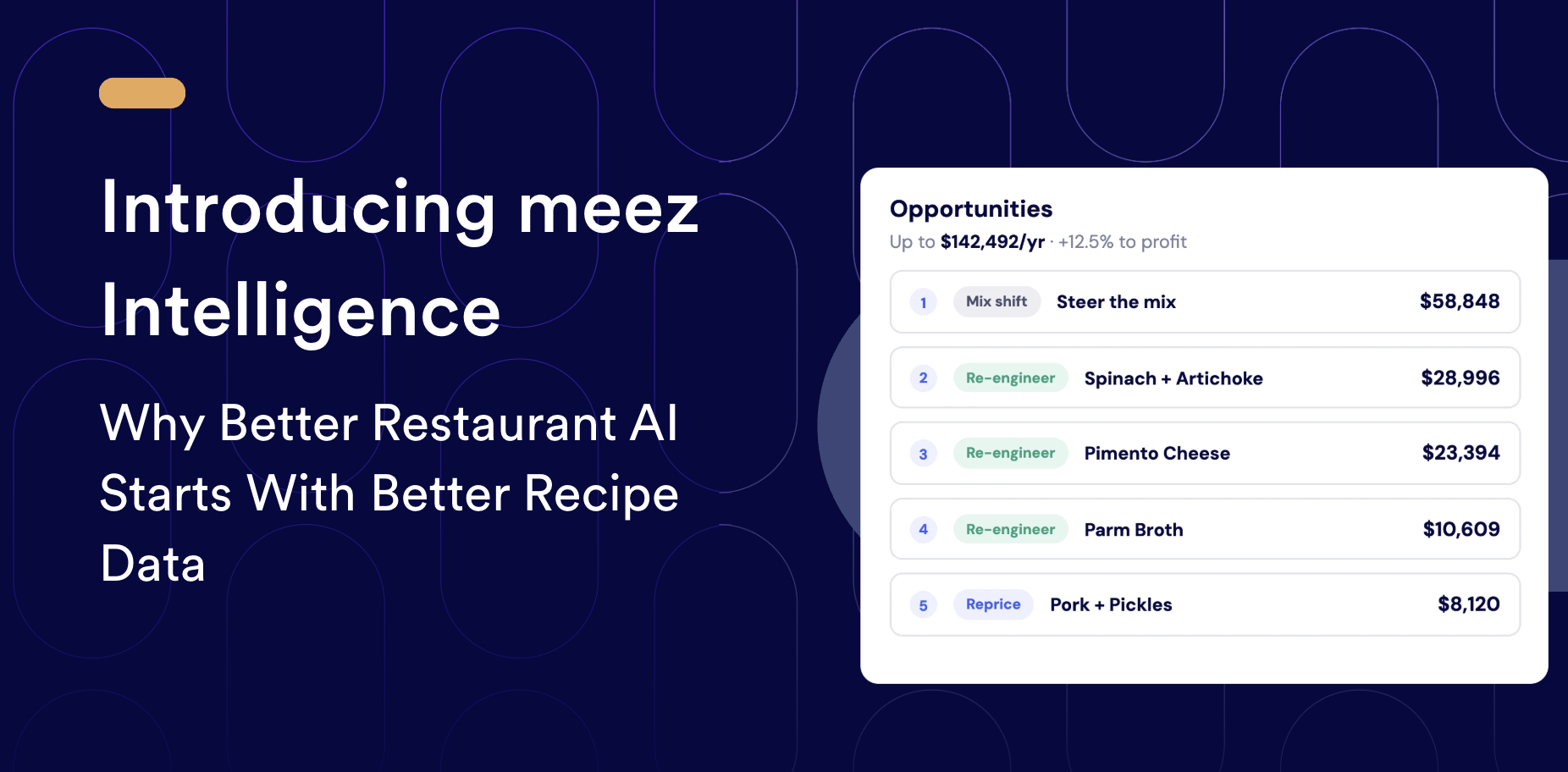
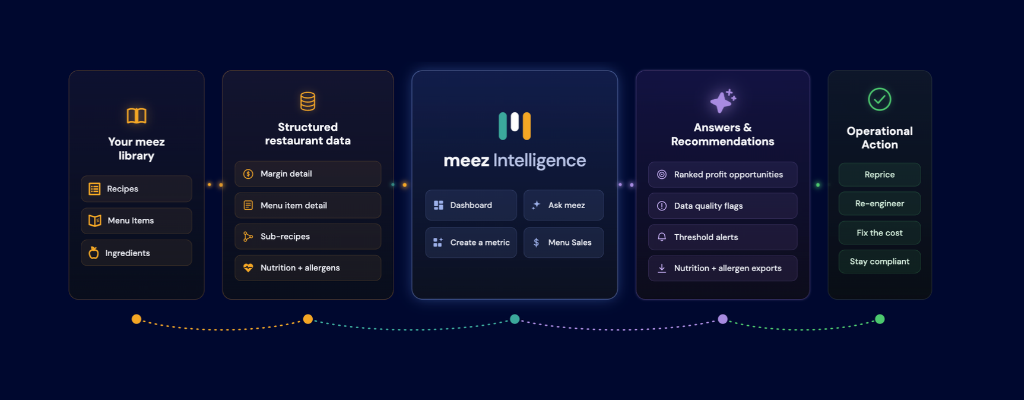
That is where meez Intelligence comes in. It is an AI-powered menu analysis platform built on the structured recipe data already managed in meez. It connects ingredients, recipes, sub-recipes, yields, costs, nutrition, allergens, menus, concepts, locations, and connected sales data so teams can analyze the business with restaurant context behind the numbers.
Instead of starting with a fixed report, teams can use that data to:
- Find and rank profit opportunities across the menu by estimated annual impact
- Catch probable costing errors and trace them back to ingredients, recipes, or sub-recipes
- Monitor important changes in ingredient cost, food cost, margin, pricing, and other metrics
- Build custom reports and metrics around the way their restaurant group actually operates
- Ask questions in plain English about recipes, ingredients, costs, menus, allergens, nutrition, and connected sales data
- Compare menu performance across locations, concepts, menus, and time periods
The distinction is useful:
- ERP integration helps systems stay aligned.
- Data warehouse synchronization makes culinary data available across your infrastructure.
- meez Intelligence helps teams understand what that data is telling them.
The AI layer only becomes useful when the underlying data has enough context. An ingredient price increase, for example, means more when the system also understands which recipes use it, the applicable yields and conversions, which menu items contain those recipes, what those items sell for, and how frequently they sell. Read the meez Intelligence announcement for the full product point of view.
One Culinary Data Foundation, Multiple Destinations
Restaurant groups increasingly do not want to rebuild the same culinary data for every reporting platform, AI tool, or internal system. With meez, the same structured foundation can be used in several ways:
- meez Intelligence for menu analysis, opportunities, Data Quality, custom metrics, alerts, and Ask meez
- ERP integrations for operational workflows such as food cost and inventory reporting
- Data Warehouse Share for BI, reporting, internal applications, and company-specific analytics
- meez MCP to make structured restaurant data available to compatible AI tools and custom workflows
Build and maintain the culinary data once. Use it wherever the business needs it.
How One Multi-Concept Restaurant Group Connects Recipe Data to the Rest of Its Stack
One multi-concept restaurant group uses meez as part of a broader data stack that also includes systems for POS, labor, purchasing, customer feedback, and forecasting.
Rather than reviewing those systems separately, the team brings the data together in a custom BI environment.
They use meez data to:
- Combine theoretical food costs with live sales data for more current food cost tracking
- Bring recipe, inventory, invoice, and sales data together for Actual vs. Theoretical analysis
- Match ingredient IDs to purchasing data to compare pricing across concepts
- View data from multiple restaurant systems in one reporting environment
The value is not simply having another dashboard. It is having structured recipe and cost data available alongside the rest of the business data so the team can analyze food cost, purchasing, and performance with more context.
Without that culinary layer, a restaurant group may have plenty of operational data but still be missing the recipe logic behind what food should cost.
When Does a Restaurant Group Need Data Warehouse Synchronization?
Not every restaurant needs this architecture. For a smaller operation, adding a data warehouse can create more complexity than value. Data warehouse synchronization becomes more relevant when a business has:
- Multiple locations or concepts
- Dedicated culinary operations, finance, IT, or data teams
- An existing BI or analytics environment
- Enterprise restaurant systems already in place
- Complex ingredient and vendor management
- Location-specific pricing
- Large recipe libraries
- Teams manually combining information from several systems
A useful qualifying question is: Where do you want your recipe data to go?
If a company's data or operations team can immediately name Snowflake, BigQuery, Power BI, Tableau, or an internal analytics environment, there is probably a real integration use case.
When Is a Data Warehouse Not Necessary Yet?
A direct integration or standard reporting may be enough when a restaurant group:
- Needs only one additional report
- Has not finished building its recipe database
- Does not yet have a BI or analytics environment
- Has no team responsible for using the exported data
- Operates a single location with limited system complexity
The quality of downstream analytics can only be as good as the culinary data feeding it. If recipes, costing, ingredient structures, and yields are incomplete, establishing that foundation is usually the more important first step.
What Should You Look For in a Culinary Data Integration Tool?
Do not stop at asking whether a vendor “has an API.” Ask what actually moves between systems, how it is structured, how often it updates, and whether the data remains useful outside the original application.
Recipe Structure
- Recipes and sub-recipes
- Ingredient relationships
- Yields and units of measure
- Portions and scaling logic
Costing
- Ingredient costs
- Vendor pricing
- Location-specific costs
- Yield-adjusted recipe costs
Data Identity
- Stable identifiers for recipes, ingredients, locations, and other records
Update Frequency
- Automated updates
- A refresh schedule that matches the downstream use case
Destination
- Direct ERP connection
- API or file-based access
- Structured data delivered into a data warehouse
Data Ownership and Flexibility
- Ability to use culinary data in BI, internal applications, analytics, and AI workflows
The Best Restaurant Data Architecture Starts With the Recipe
Modern restaurant groups already have systems for accounting, POS, labor, purchasing, inventory, and business intelligence. What many stacks have historically been missing is a structured culinary data layer connecting what happens in the kitchen with everything happening around it.
Recipes are where theoretical cost begins. They contain the ingredients, quantities, yields, conversions, portions, and preparation logic that determine what a menu item should cost and how it should be executed.
Once that information is structured, it does not have to stay trapped inside recipe software. It can flow into an ERP for more accurate food cost reporting, move into a data warehouse alongside sales, inventory, labor, and purchasing, and become part of the data foundation operators use for analytics and AI.
The goal of culinary data integration is not to add another system to the restaurant tech stack. It is to make the systems you already have work from the same culinary truth.
FAQ
What is culinary data integration?
Culinary data integration connects structured restaurant data, including recipes, ingredients, yields, costs, menus, nutrition, and allergens, with systems such as ERP, POS, inventory, business intelligence, and data warehouses.
Can recipe management software integrate with an ERP?
Yes. When both platforms support the required data exchange, recipe management software can send or receive structured ingredient, cost, recipe, and inventory data. The exact direction and scope depend on the integration.
What is the difference between ERP integration and data warehouse synchronization?
ERP integration typically keeps two operational systems aligned for a defined workflow. Data warehouse synchronization makes a broader data set available in a company-owned analytics environment where it can be combined with other sources.
Can recipe data be sent to Snowflake or another data warehouse?
Yes, depending on the platform. meez can provide structured culinary data to supported cloud environments including Snowflake, Azure, Google Cloud, and Amazon S3, with SFTP available for file-based delivery.
Why is yield-adjusted recipe data important for ERP integration?
Theoretical food cost depends on accurate yields, conversions, sub-recipes, and portions. If those inputs are wrong before they reach the ERP, the resulting food cost reporting can also be wrong.
Does every restaurant group need a data warehouse?
No. Data warehouses are most useful for multi-location or multi-concept operators that already have several systems, an analytics or BI environment, and teams that need to combine data across the business.
How does meez Intelligence relate to ERP and data warehouse integrations?
ERP integrations keep operational systems aligned, while data warehouse synchronization makes culinary data available for broader BI and analytics. meez Intelligence uses structured recipe, ingredient, menu, cost, and connected sales data to surface opportunities, identify probable errors, build custom analysis, and answer questions about the business.
What should restaurant groups look for in a culinary data integration tool?
Evaluate the actual data model and workflow: recipes and sub-recipes, yields, units of measure, ingredient IDs, location-level costs, update frequency, destination, and whether the data can be used outside the original platform.


Liz Van Hoose is the Marketing Director at meez, the recipe operating system helping multi-unit restaurant and foodservice teams standardize recipes, manage costs, train teams, and run more profitable kitchens. She has 12+ years of experience building and leading growth marketing programs for startups and growing companies, with expertise across demand generation, positioning, lifecycle, paid media, content, and SEO.