Most restaurants decide what they want to serve, then figure out how many people it will take to execute it. Birdie's co-owner Arjav Ezekiel and chef Tracy Malechek-Ezekiel approached it differently.
Before they finalized their menu, they first decided how large a team the restaurant could realistically support.
The target was about eighteen people: seven on the dining room floor, five cooks, one kitchen manager, and one dining room manager.
From there, they asked a simple question: What kind of restaurant can this team actually run?
That decision shaped nearly everything that came after, from the menu and service model to labor costs and the volume Birdie's needed to make the business work.
According to Ezekiel, the restaurant paid back the majority of its build cost in roughly ten months, something meez CEO Josh Sharkey said he had never encountered before.
"We worked backwards from that idea. This is what the menu has to look like to be able to execute at that level. This is what our labor costs have to look like. This is the kind of volume we need to do to make sense."
Birdie's did not start with an ambitious menu and then build an operation around it. Ezekiel and Malechek-Ezekiel started with the business they believed they could run sustainably, then designed the menu to fit that model.
Ezekiel broke down that thinking on The meez Podcast, including how labor constraints ultimately influenced Birdie's menu, service style, and production planning.
Start With the Constraint You Can't Avoid
Birdie's opened at a time when restaurant operators were rethinking the economics of the business.
Labor costs were rising, experienced workers were harder to find, and operators were reconsidering everything from wages and benefits to tipping and service models.
Ezekiel had already seen one alternative model up close while working under Union Square Hospitality Group's Hospitality Included program. He ultimately decided it was not the right answer for the restaurant he and Malechek-Ezekiel wanted to build.
Instead, they started with a more basic question: What would make this restaurant sustainable over the long term?
For Ezekiel, that meant making sure the business could support both its owners and its team. He uses the oxygen-mask analogy: if the people running the restaurant cannot take care of themselves, it becomes much harder to build a healthy workplace for everyone else.
From there, they focused on what they believed would be the biggest long-term pressure on the business: labor.
"The only thing that we have to solve for really to be successful over the long term is labor, the cost of labor continuing to rise. And if we could figure out a solution to that while taking really good care of our team, then we had an opportunity to be successful."
That thinking directly influenced how Birdie's was designed. The restaurant could not depend on a large brigade or a menu that required more prep labor than the business could realistically support. It needed to handle significant volume with a team of roughly eighteen people.
Only once that operating model was clear did Ezekiel and Malechek-Ezekiel decide what the restaurant should serve.
That approach is especially relevant as labor remains one of the biggest pressures facing restaurant operators. Restaurant Dive's 2026 outlook reports that operators expect labor costs to keep rising while the available labor pool continues to shrink, making retention increasingly important.
Ezekiel's approach was to account for that reality from the beginning. Rather than building the restaurant first and trying to reduce labor costs later, Birdie's was designed around the team it could sustainably support.
Most Restaurants Build in the Opposite Direction
Most restaurants follow a familiar development process:
- The concept comes first
- The chef develops the menu
- The operations team figures out hiring
The risk is that the menu gets built for an ideal kitchen rather than the kitchen the business can realistically afford to staff.
A dish may work perfectly on paper, but that does not mean the restaurant has the labor to produce it every day. As meez's guide to menu development explains, a concept that requires five skilled prep cooks and twelve hours of daily production is not sustainable if the restaurant can only staff three.
That does not necessarily mean the food is too ambitious. It means the menu and labor plan do not match.
And there is not much room for that kind of mismatch.
In the National Restaurant Association's 2026 State of the Industry report, 42 percent of operators said their restaurants weren't profitable in 2025, while 60 percent said business conditions had deteriorated.
Ezekiel's approach forces those operational decisions to happen earlier. A chef may love a dish, but if producing it consistently requires more labor than the restaurant can support, it may not belong on the menu.
The goal is not to make the food less ambitious. It is to build a menu the restaurant can actually execute and sustain.
Prix Fixe Wasn't Really a Menu Decision
Birdie's originally opened with an à la carte menu. As the restaurant got busier, however, that service model became harder for the kitchen to manage efficiently.
In April, Birdie's moved to a six-course, $79 prix fixe menu. Guests still do not need reservations; they can walk in and get in line.
Ezekiel said the decision was far from easy.
"When we moved to prix fixe in April, that was really scary. It was one of the scariest moments you had as a business. But we decided to do it because we're like, we don't want to be this busy and be doing à la carte. This doesn't make sense anymore."
The issue was not a lack of demand. Birdie's was already busy.
The challenge was producing that volume efficiently with a small team.
Why Prix Fixe Simplifies Production Planning
With an à la carte menu, the kitchen has to forecast both how many guests will arrive and what each of those guests will order. A prix fixe menu removes much of that second variable.
If the team expects to serve 100 guests, it can plan for roughly 100 portions of each course. That makes several parts of production easier to manage:
- Purchasing can be based on a more predictable quantity of each ingredient
- Batch prep can be planned around expected covers
- Prep lists become easier to build and execute
- The kitchen is less likely to overproduce items that guests may not order
Other operators have made similar changes in response to labor, cost, and supply pressure.
Restaurant Business reported on one chef producing roughly fifty portions of each item and prepping close to exactly what service required, resulting in very little waste.
The publication has also pointed to lower-priced tasting menus as a format that can give chefs creative flexibility while making costs and production more predictable.
Birdie's $79 menu follows a similar logic. It also makes prep scaling especially important, because the kitchen needs to produce the right quantity of each component for the number of guests it expects to serve.
For diners, prix fixe is a menu format. For the kitchen, it also creates a much more predictable production plan.
Five Cooks and Twelve Menus a Year
Running a small kitchen does not mean Birdie's serves the same menu all year. Malechek-Ezekiel changes the entire menu every month.
That means five cooks are responsible for executing twelve full menu changes each year.
In Ezekiel's view, the fixed service structure actually makes that level of creativity possible. By making service more predictable, the team can spend more time developing new dishes without adding the labor demands of a much larger fine dining kitchen.
"The menu changes every month, top to bottom."
Changing the menu that often creates a different kind of operational challenge. Every few weeks, the team has to update much of the production system behind it.
What Changes With Every New Menu
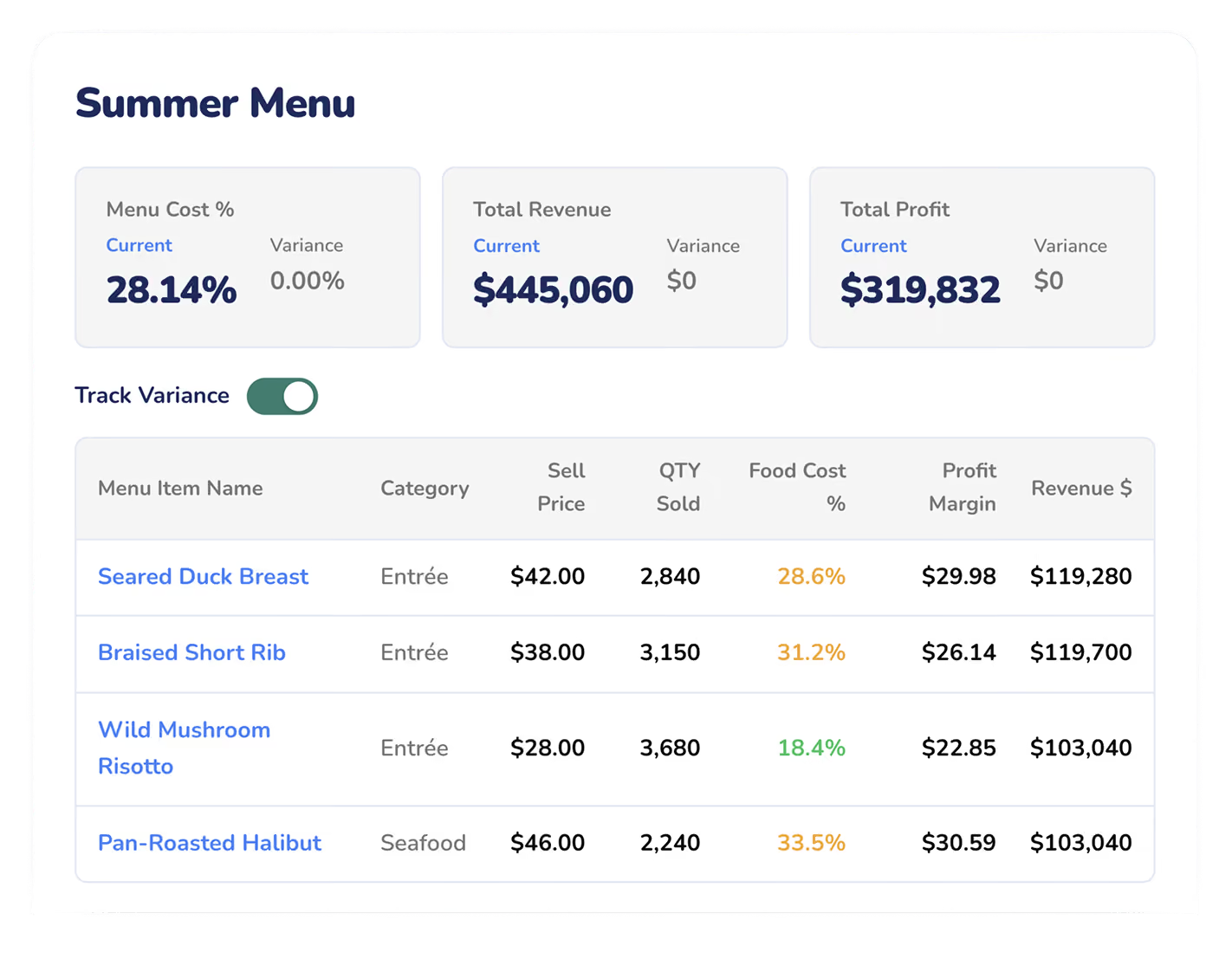
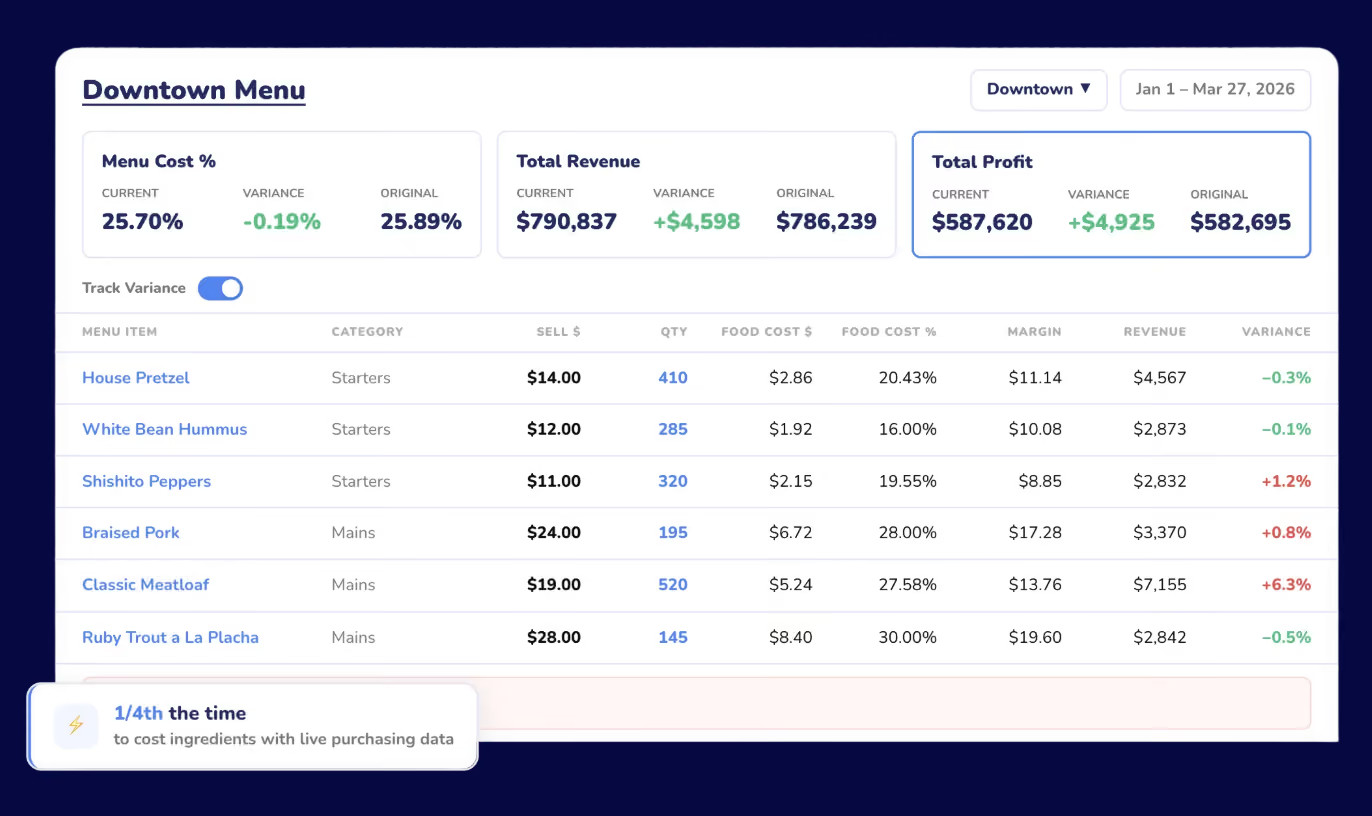
- Re-cost each dish using current ingredient prices
- Set prep methods and production quantities for six new courses
- Test yields at the volumes the kitchen will actually produce
- Update purchasing requirements for the new menu
- Train five cooks to execute the dishes consistently within days rather than weeks
That is a significant amount of change for any restaurant. With a five-person kitchen, it only works if the information the team needs is easy to access and stays current.
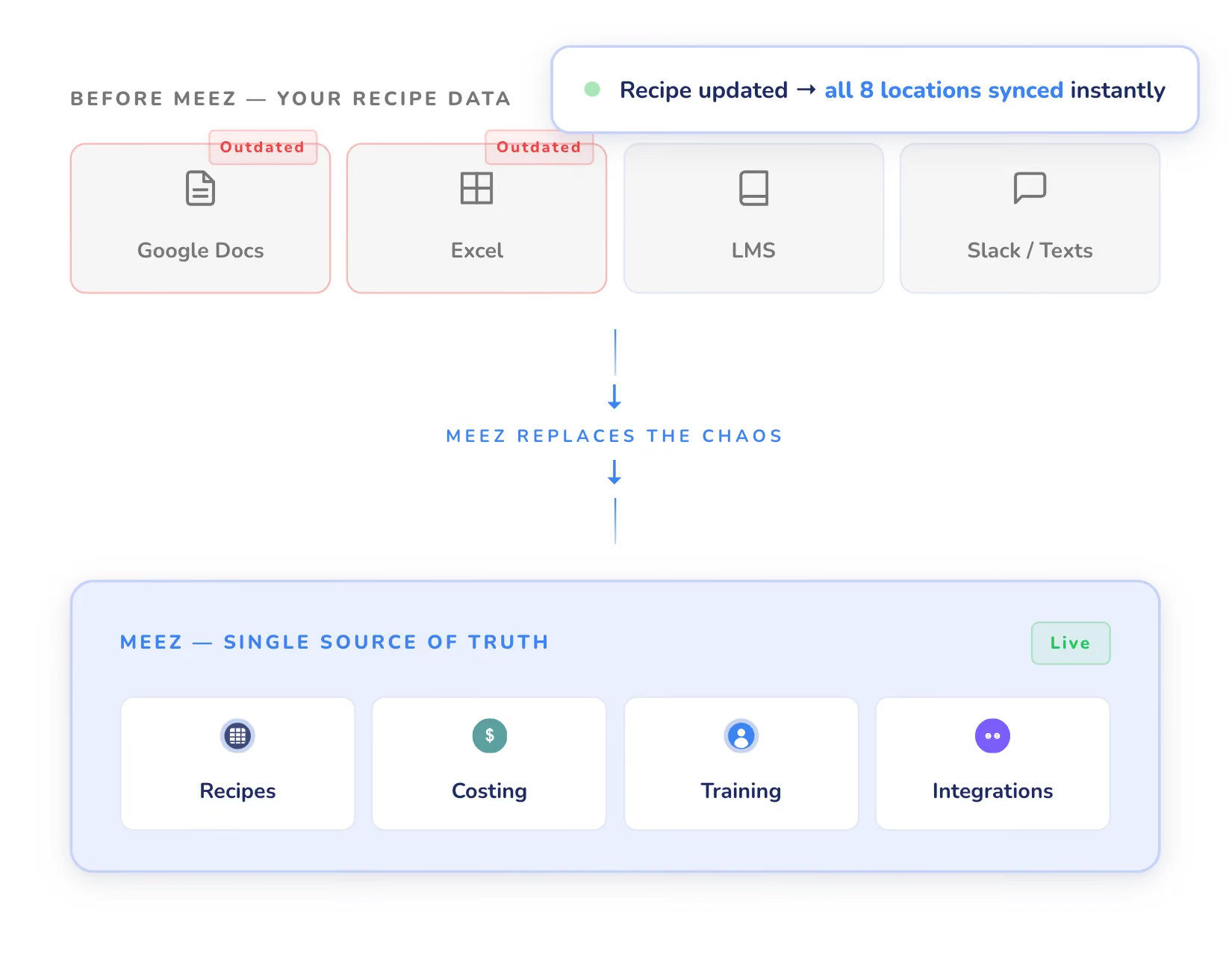
Recipes cannot live only in the chef's memory, and prep instructions cannot depend on someone being available to explain them. As meez explains in its guide to menu changes and recipe data, every new or modified dish also creates work around training, prep, costing, and execution.
The team needs to be able to pull up the current recipe and prep specification, see what changed, and execute it correctly without relying on one person to walk them through it.
That is what makes Birdie's monthly menu cycle possible. Guests see a restaurant that is constantly creating new food. Behind the scenes, that creativity depends on a production system that keeps a small team aligned.
Labor Is Part of the Cost of a Dish
Designing a restaurant around a smaller team only works if labor is accounted for realistically. Reducing headcount does not make the work disappear.
For Birdie's, that means looking beyond ingredient cost when deciding whether a dish makes sense for the menu.
The True Cost of Prep Labor
An ingredient can look inexpensive on an invoice and still be expensive to produce.
meez's menu engineering matrix article uses sauerkraut as an example.
Roughly 400 pounds of cabbage may need to be sliced and seasoned by hand, taking a full day of production. The raw cabbage might cost around twenty cents per pound, but once yield loss, prep time, and the amount of usable finished product are considered, the true cost can be closer to two dollars per pound.
That difference matters in a small kitchen.
Two recipe components may have similar ingredient costs, but if one takes six hours to prep and the other takes forty-five minutes, they place very different demands on the team.
A larger kitchen may have enough extra labor to absorb an inefficient prep process, but a five-cook kitchen has much less room for it.
The industry is also starting to think about menus this way.
Nation's Restaurant News has argued that restaurants need flexible menus that can absorb volatility through decisions around sourcing, substitutions, and portions rather than treating the menu as something that changes only a few times a year.
At Birdie's, those decisions are built directly into menu development.
For that model to work, operators need to understand more than the ingredient cost of a dish. They also need to know its yield, prep requirements, and the amount of labor required to produce it.
Profitability Made the People Decisions Possible
The goal of Birdie's labor model was not simply to employ fewer people. Ezekiel and Malechek-Ezekiel wanted to build a profitable restaurant that could also provide a better long-term environment for the team they did hire.
Birdie's opened with healthcare benefits. Ezekiel has explained that he and Malechek-Ezekiel needed health insurance themselves, so they decided their employees should have access to it as well. They have also been evaluating 401(k) options as they think about what it would take to make restaurant work a more sustainable career.
The restaurant also pools tips based on hours worked rather than position points. And although Texas allows restaurants to use the tipped minimum wage, Birdie's does not take the tip credit.
Ezekiel is also clear that Birdie's is not necessarily the highest-paying restaurant job in Austin. Even so, many employees have stayed with the restaurant for three years or longer.
That matters in an industry where annual turnover averages roughly 78 percent, according to Toast data, and Cornell research has estimated replacement costs at nearly $5,864 per employee.
For Birdie's, retention is not separate from the business model. A more efficient operation creates room to invest in the team, and keeping experienced employees reduces the cost and disruption of constantly hiring and retraining replacements.
Don't Copy Birdie's. Copy the Order of Operations.
Ezekiel is not suggesting that every restaurant should adopt Birdie's exact model.
Counter service will not work for every concept. Neither will prix fixe. And eighteen employees is not a target every restaurant should try to match.
The broader lesson is that operators do not have to accept the traditional restaurant structure as the only way to run the business.
"The innovation has to be around labor. We need to continue to innovate. I think restaurants haven't changed since antiquity in their structure and their model."
Ezekiel sees useful lessons in both fine dining and fast casual. Fine dining is built around craft, hospitality, and culinary ambition. Fast casual is often better at throughput, repeatability, and labor efficiency.
Birdie's combines elements of both.
The most useful part of the model is not the $79 tasting menu or the line outside the restaurant. It is the order in which the founders made their decisions:
- Decide what labor model the business can sustainably support
- Design a service structure that works with that team
- Build a menu the team can produce consistently
- Translate each recipe into yields, batch quantities, prep requirements, and labor needs
- Use daily production planning to make sure the model continues to work in practice
The last two steps are where the plan becomes part of day-to-day kitchen operations.
Recipes, yields, costs, and prep quantities need to stay current so the team can answer a practical question: Can the people we have produce this menu consistently and profitably?
Ezekiel and Malechek-Ezekiel asked that question before Birdie's opened. Many restaurants do not confront it until the menu is already in place and the labor problems have started to show.
Listen to the full episode: Is Counter Service the Future of Fine Dining? Plus Hospitality Included, the Labor Crisis, and Birdies' $79 Tasting Menu
FAQ
What is food production planning in a restaurant?
Food production planning is the process of forecasting how much of each component a kitchen needs for a given service period and organizing the prep labor required to produce it. It connects expected covers with recipes, batch quantities, and prep lists, so kitchens produce what they need without routinely running short or creating unnecessary waste.
Should restaurants design the menu around the labor plan?
Ezekiel's experience suggests operators seeking a sustainable model should understand their realistic labor capacity before finalizing the menu. Birdie's established a headcount ceiling first, then developed a restaurant and menu that could operate at high volume with that team. A concept consistently requiring more skilled prep hours than the operation can staff has a structural problem regardless of how good the food is.
Why can prix fixe menus reduce labor and waste?
Prix fixe reduces the number of variables a kitchen has to forecast. Instead of estimating both guest count and the mix of dishes those guests might order, the kitchen forecasts covers against a known sequence of courses. That makes purchasing, batching, and prep quantities more predictable, and reduces the amount of product held for orders that may never come.
How often can restaurants change their menus?
Many restaurants make two to four major seasonal changes per year, because each change requires new costing, prep specifications, purchasing, and staff training. Birdie's demonstrates much higher frequency is possible, changing the entire menu monthly with a five-cook kitchen, but doing that consistently depends on maintaining recipes, yields, prep information, and training documentation in a system rather than relying on individual memory.
What does a menu change require operationally?
More than developing new dishes. Kitchens need to re-cost recipes against current ingredient prices, establish prep specifications, test yields at production volume, update purchasing requirements, and train the team on new methods and service standards. That operational workload is often the real constraint on how frequently a restaurant can change its menu.
How does prep labor affect plate cost?
Significantly, and it's routinely underestimated. An inexpensive raw ingredient can become much more expensive once trimming, yield loss, and hours of preparation are included, so costing dishes from invoice prices alone can materially understate what they cost to produce. For a small brigade, that labor burden matters even more, because there aren't extra hands available to absorb inefficient prep.
What should a small kitchen track for production planning?
At minimum, expected versus actual covers, completion against daily prep lists, yields for high-volume components, and the prep hours consumed by individual menu items. Those numbers help distinguish a dish that's inexpensive to purchase from one that's efficient to produce. meez covers the wider metric set in its guides to kitchen management and menu engineering.
Is counter service viable for higher-priced food?
Birdie's suggests it can be in the right market. The model removes some of the labor associated with seating, ordering, and settling checks while preserving the culinary elements guests value, and Ezekiel has observed other fine dining operators exploring similar approaches as leases come up for renewal. Whether it works depends on the market, guests' willingness to queue, and the restaurant's ability to deliver hospitality without traditional tableside service.


Liz Van Hoose is the Marketing Director at meez, the recipe operating system helping multi-unit restaurant and foodservice teams standardize recipes, manage costs, train teams, and run more profitable kitchens. She has 12+ years of experience building and leading growth marketing programs for startups and growing companies, with expertise across demand generation, positioning, lifecycle, paid media, content, and SEO.