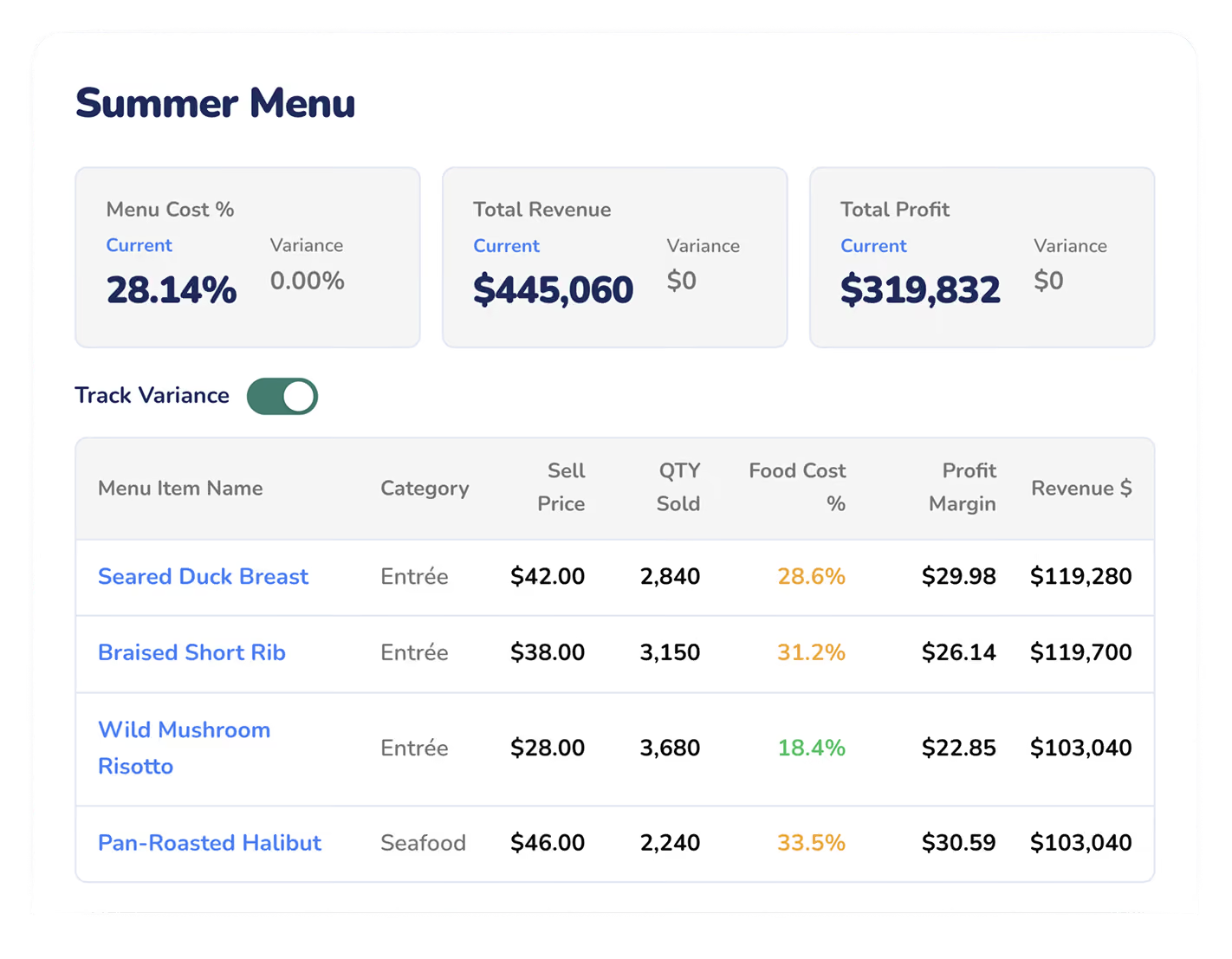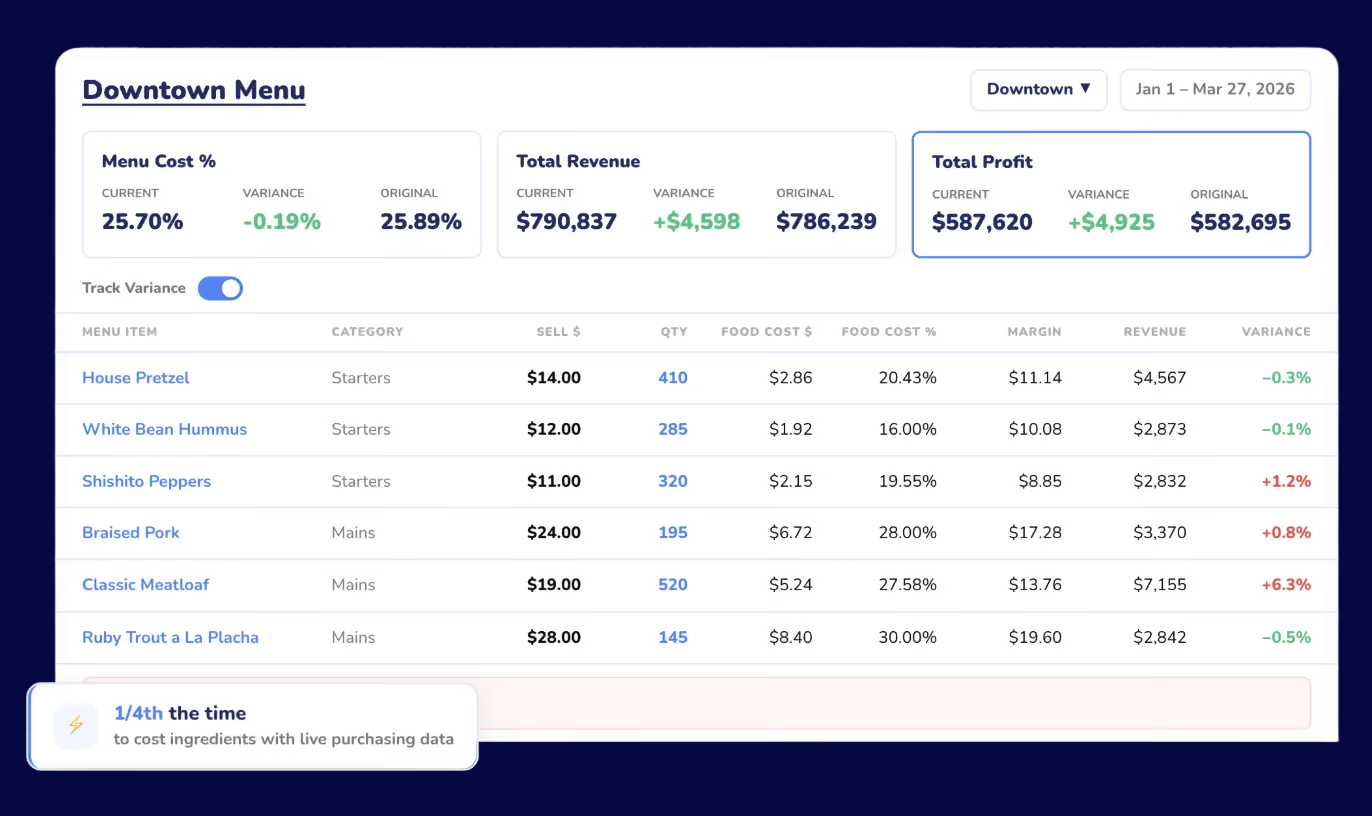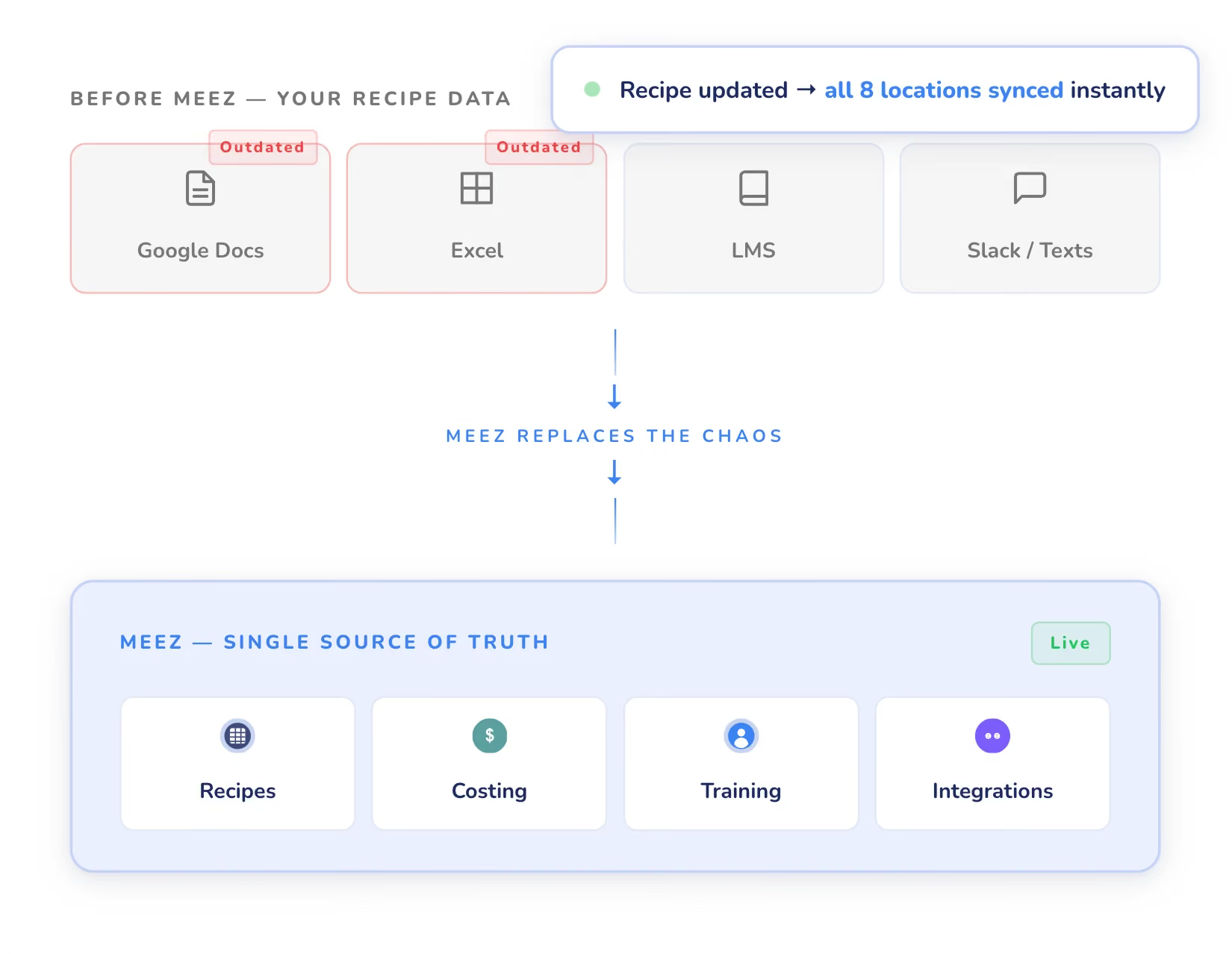

It's Monday morning, and your F&B team is preparing for a weekly menu review.
You've got an all-day restaurant, a lobby bar, room service, a pool grill, and a 400-guest gala on Saturday.
The POS can tell you what sold last month. But figuring out what actually made money means matching those sales to recipe costs, some of which haven't been updated since last quarter.
By the time the spreadsheet is ready, you're already wondering whether the numbers are right. That's the problem hotel menu engineering software should solve: bringing sales and accurate recipe costs together so you can spend less time preparing reports and more time deciding what to change.
The short answer: Menu engineering software helps hotels compare each dish's popularity with its contribution margin, classify items as Stars, Plowhorses, Puzzles, or Dogs, and identify opportunities to reprice, promote, redesign, or retire dishes.
The most useful systems connect that analysis to current recipe and ingredient data, rather than a static plate-cost spreadsheet.
What Is a Dog-Star Analysis?
A dog-star analysis is another term for the menu engineering matrix developed by Michael Kasavana and Donald Smith in 1982. It looks at two questions: How often does an item sell, and how much does it contribute after food cost?
The answers sort menu items into four categories.
CategoryHotel exampleWhat to doStar: popular, high marginSignature burger in the all-day restaurantProtect quality and visibilityPlowhorse: popular, lower marginClub sandwich on the room-service menuReview portion, ingredients, or pricePuzzle: less popular, high marginSeared scallops in the lobby barTry better placement or a server recommendationDog: less popular, lower marginSeasonal grain bowl with little demandRework or reconsider, not automatically remove
The matrix helps identify which items deserve a closer look, but the final decision should account for the guest experience, too.
Not every Dog needs to come off the menu. Some dishes serve a purpose beyond profitability, whether to accommodate dietary restrictions, meet brand standards, or offer familiar options for families.
For a deeper look at the quadrants and tactics for each one, read our menu engineering matrix guide.
How Do You Calculate a Menu Engineering Matrix?
You'll need menu-item sales volumes, selling prices, and reliable portion costs for the same reporting period. From there, calculate:
- Contribution margin = selling price − portion cost.
- Menu mix % = units sold of an item ÷ total units sold × 100.
- Popularity benchmark = (1 ÷ number of menu items) × 70%.
- Profitability benchmark = total contribution margin dollars ÷ total units sold.
The last figure is a sales-weighted average. A dish that sold 400 times should influence your menu-wide benchmark more than one that sold twice.
A Hotel Room-Service Example
Imagine a 10-item room-service menu that sells 1,000 dishes and generates $8,200 in total theoretical contribution margin during the month. The popularity threshold is 7%, and the weighted average contribution margin is $8.20 per item.
A burger priced at $22 costs $6.60 to produce and sells 140 times. Its $15.40 contribution margin and 14% menu mix put it firmly in Star territory. If the true portion cost is actually $9.10, its margin drops to $12.90.
It is still a Star in this example, but less profitable than the report suggested. On an item closer to the threshold, a cost error could change its classification. All figures are illustrative.
For more on the math and menu strategy, see the full guide to menu engineering.
Why Hotel Menu Optimization Needs a Different Approach
A standard restaurant menu matrix assumes one menu with a relatively consistent service model. Hotels rarely have that luxury. The same ingredient may appear across four outlets, while each outlet has different prices, portions, guest expectations, and service costs.
Run the Analysis by Outlet, Not Just by Property
A burrata dish served in the lobby bar might have different sides, portions, and selling prices from the version served poolside. Combining both into one property-wide matrix can hide an underperforming outlet.
“Analyze each menu separately first, then use portfolio reporting to spot patterns across properties.”
Treat Banquet Costing Differently From À la Carte Sales
For a plated 400-person event, sales mix is not a useful signal of popularity: guests are often choosing from a preselected menu. The meaningful questions are cost per guest, contribution at the quoted price, and what changes when the event scales from 40 to 400 covers.
“Yield-adjusted recipes are especially important before the banquet event order is finalized.”
Costs Are Impacted by Service Format
Room-service packaging and delivery supplies can make an otherwise healthy-looking margin less attractive. Similarly, a dish that takes unusually long to prep may be harder to justify than its ingredient margin suggests.
“Traditional contribution margin is a useful starting point, but it is not the same as net profit after labor and overhead.”
Why Hotel F&B Profitability Demands a Closer Look
Hotel food and beverage revenue is growing, but that doesn't necessarily mean operators are keeping more of what they earn.
According to CBRE Hotels Research, F&B revenue per occupied room grew 3.8% in the first half of 2025, outpacing overall hotel revenue growth of 3.0%. Profit margins improved slightly, from 28.7% to 29.1%, but operating costs remained significant. Labor accounted for 59.4% of F&B expenses, while cost of goods sold represented another 24.0%.
For hotel F&B leaders, that leaves little room for inaccurate recipe costs or menu items that aren't pulling their weight. A popular entrée might bring in plenty of revenue, but rising protein prices, inconsistent portions, or an outdated selling price can quietly eat into its profitability.
That's where menu engineering makes a difference. Instead of waiting for month-end reports to reveal a margin problem, teams can identify which dishes are underperforming, understand what's driving their costs, and make adjustments while there's still time to protect profitability.
Why Spreadsheets and Free Menu Calculators Fall Short
A spreadsheet can build a matrix and a free food cost calculator can help test an idea. But neither solves the ongoing problem of keeping costs reliable across an entire hotel operation.
- Ingredient price changes need to make their way into every affected recipe
- Sub-recipes matter: a change to a shared sauce or stock can affect several dishes
- Yields and unit conversions affect what a finished portion actually costs
- Separate files for each outlet make comparisons slow and hard to audit
- Rebuilding the analysis each month leaves less time to decide what to do about it
That does not make free tools useless. They are helpful for learning the method or reviewing a small menu. The challenge comes when hotel teams want repeatable restaurant menu analysis across several concepts, events, and properties.
What Should Hotel F&B Leaders Look For in Menu Engineering Software?
Start with your workflow, not with a dashboard. A polished four-quadrant menu engineering chart is only useful if the plate costs can be trusted by both culinary and finance teams.
- Recipe-level costing that accounts for preparation yields, conversions, portions, and sub-recipes
- Updated ingredient pricing through supported purchasing or back-office data connections
- Sales data imports or POS integrations to measure item popularity
- Separate menu views by outlet, with the ability to compare across properties
- Banquet and catering recipe scaling for different guest counts.
- Scenario modeling for portion, ingredient, volume, and selling-price changes.
- A practical connection between culinary decisions and existing accounting tools.
“See how meez food costing software handles yields, ingredients, and recipe-level cost updates.”
How meez Helps Hotels Turn Menu Data Into Better Decisions
Accurate menu analysis starts with knowing what each dish actually costs to make. But when ingredient prices change, portions get adjusted, or the same sauce appears on menus across multiple outlets, keeping those costs current can become a project of its own.
meez connects recipe management, costing, and menu analysis so hotel F&B teams can make decisions using the same data their kitchens work from every day.
Chefs can organize approved recipes by property or concept, account for yields and conversions, and build menus directly from their recipe library. As costs change, teams have a clearer picture of how those changes affect profitability across outlets.
Keep Recipe Costs Accurate as Ingredients and Menus Change
Supplier prices rarely stay the same for long, especially for proteins, seafood, and produce. When those changes aren't reflected in recipe costs, it's easy to overestimate how profitable a dish really is.
With meez, ingredient price updates from supported connected sources flow through the recipes that use them, including shared sub-recipes. Culinary teams can also test ingredient substitutions, adjust portion sizes, and compare selling prices to understand the potential impact on margins before making changes.
For banquet teams, the same recipes can be scaled from a small private dinner to a 400-person event, with ingredient quantities and theoretical costs calculated for the new guest count.
Explore meez menu engineering to see how hotels can build menus, analyze contribution margins, and model pricing changes without relying on spreadsheets.
See Which Menu Items Are Helping or Hurting Profitability
Accurate recipe costs tell you what a dish should cost to produce. Sales data adds another important piece: whether that dish is actually contributing to the business.
For hotel groups looking for deeper menu profitability analysis, meez Intelligence brings recipe, menu, cost, and connected sales data together to help identify opportunities across menus and outlets.
Its AI-powered menu engineering matrix helps teams evaluate dishes based on profitability and popularity, making it easier to spot items that could benefit from a price adjustment, recipe change, or additional promotion.
Instead of simply identifying a popular dish with a low contribution margin, F&B leaders can investigate the costs behind it and evaluate what to change. Advanced analysis requires the appropriate enterprise setup and data integrations.
Learn more about meez Intelligence and how it helps restaurant groups turn culinary data into actionable insights.
Connect Culinary Data With the Rest of Your Hotel Operations
Most hotels already rely on multiple systems to manage sales, inventory, accounting, and property operations. The challenge is that those systems don't always have access to the detailed recipe information needed to explain what's happening with food costs.
meez fills that gap by providing a centralized source of recipe, ingredient, yield, and costing data that can be used across culinary and financial workflows.
Rather than replacing the systems hotel teams already use, meez can work alongside them. For example, hotels using Restaurant365 can connect culinary and financial workflows through supported integrations, helping both teams work from more consistent cost information.
See how meez and Restaurant365 work together.
What Better Recipe and Menu Visibility Looks Like in Practice
For hotel and hospitality groups, the benefits extend beyond identifying which dishes belong in each menu engineering quadrant. Having reliable recipe data also reduces the time spent maintaining costs, preparing menus, and keeping kitchens aligned.
RMD Hospitality, for example, reported a 4–5% reduction in menu costs per venue and more than 60 hours saved on manual costing. The team also identified a 10-percentage-point food cost spike at one location, giving them visibility into a problem that needed attention.
Across meez customers, the company reports average improvements of:
- 3–5% reduction in cost of goods sold
- 30% less food waste
- 70% faster team training
These are reported customer outcomes rather than guaranteed results, but they illustrate why accurate recipe data matters beyond a quarterly menu review.
When recipes, costs, and preparation standards are organized in one place, hotel teams can spend less time reconciling spreadsheets and more time managing food quality, consistency, and profitability across their properties.
Explore meez for Hotels & Resorts to see how hospitality teams manage recipes, costing, and execution across multiple outlets.
Make More Profitable Menu Decisions With Data You Trust
Hotel F&B teams don't need another report telling them what sold last month. They need to understand which dishes are making money, where margins are slipping, and what changes are worth making.
Dog-star analysis helps identify which menu items deserve attention, while accurate recipe costing provides the information needed to do something about them. Together, they make menu reviews more useful and help teams move from identifying problems to improving profitability.
With meez, hotel culinary and F&B leaders can manage both without maintaining separate spreadsheets for every menu, outlet, or property.
See what more accurate menu costing could mean for your hotel.
Book a demo to explore meez with your team, or calculate your potential ROI to estimate the opportunity across your operation.
FAQ
What is menu engineering software?
It combines menu item costs and sales performance to show which dishes are popular and which contribute the most money after food cost. More advanced tools help teams test pricing and recipe changes without rebuilding spreadsheets.
What is dog-star analysis?
It is a name for the familiar Stars, Plowhorses, Puzzles, and Dogs menu engineering matrix. The categories compare popularity with contribution margin and suggest where to protect, improve, promote, or reconsider a dish.
How often should hotels run menu engineering?
Quarterly is a practical baseline, with more frequent reviews for seasonal menus, fast-changing ingredient prices, or high-volume outlets. Connected sales and cost data can make those reviews easier to repeat.
Should a hotel remove every Dog?
No. A dietary option, a brand-standard dish, or a familiar room-service item may have value beyond its sales mix. Review the recipe, positioning, guest expectations, and cost before removing it.
How is banquet menu analysis different?
A fixed banquet menu is typically analyzed through cost per guest, quoted selling price, and event contribution rather than item popularity. Recipe scaling and accurate yields are especially important.
Does contribution margin matter more than food cost percentage?
For a traditional dog-star matrix, contribution margin is the key profitability measure because it shows dollars per sale. Food cost percentage is still useful for cost control; the two answer different questions.
Does meez connect to hotel accounting and POS systems?
meez supports connected workflows, including certain back-office integrations and sales-data connections for advanced analytics. Exact POS, accounting, and data-warehouse requirements should be confirmed for each hotel environment.


Liz Van Hoose is the Marketing Director at meez, the recipe operating system helping multi-unit restaurant and foodservice teams standardize recipes, manage costs, train teams, and run more profitable kitchens. She has 12+ years of experience building and leading growth marketing programs for startups and growing companies, with expertise across demand generation, positioning, lifecycle, paid media, content, and SEO.