Imagine hiring ten of the greatest chefs in the world to build your restaurant's menu.
There's just one problem: they know almost nothing about your operation.
They don't know the size of your kitchen, the equipment you have, the skill level of your team, which ingredients you already use, your customer demographics, your pricing bands, your beverage program, your competition, or what you've learned after years of serving your guests.
They may be incredibly talented. But without that context, even great chefs can give you the wrong answer.
AI works much the same way.
Restaurant AI is moving quickly.
But the more we talk with operators about it, the more one thing becomes clear: restaurants and foodservice brands don't simply need access to smarter models or more software.
They need AI that understands the context of their business.
That means being able to answer questions like:
- Which menu items have the biggest profit opportunity?
- Why did food cost suddenly move?
- Which ingredient is driving the change?
- Is one location outperforming another?
- Where is something wrong in the recipe data?
- What should someone actually pay attention to today?
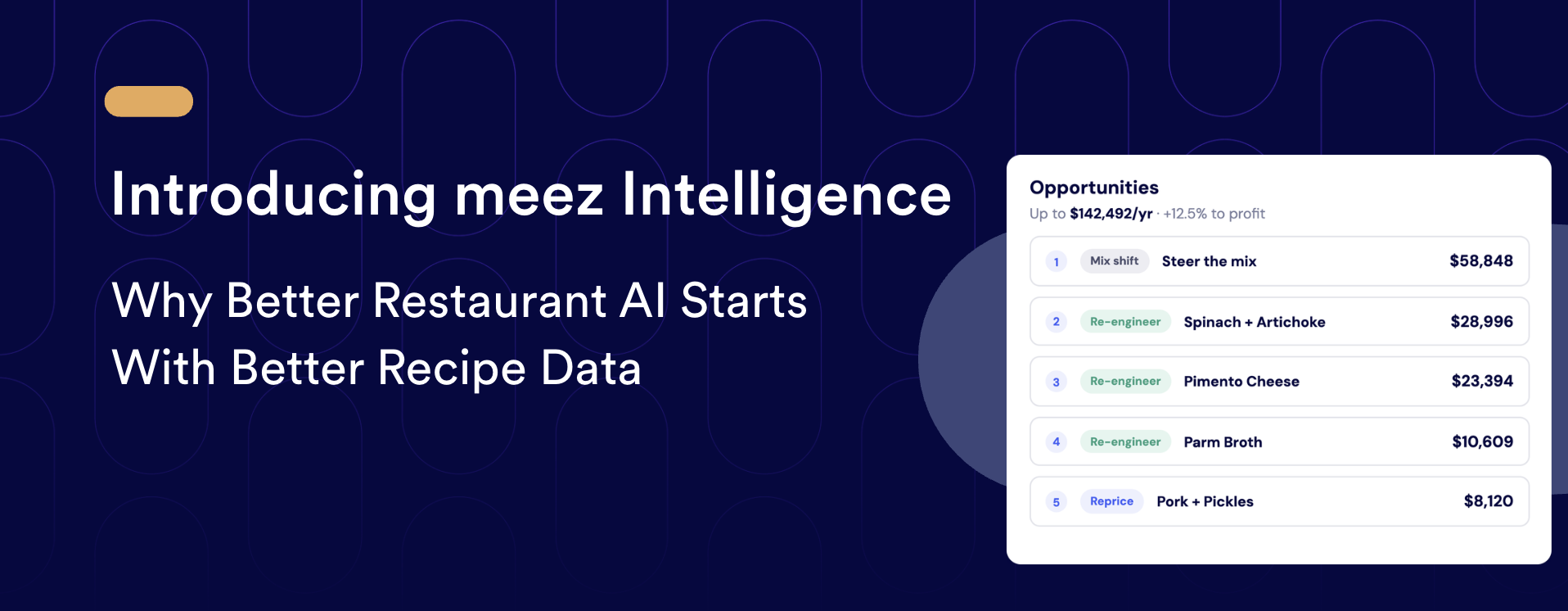
Those are the questions behind meez Intelligence, our new AI-powered menu analysis platform built on the recipe data you already manage in meez.
It takes the ingredients, recipes, sub-recipes, yields, costs, nutrition, allergens, menus, concepts, locations, and sales data connected to your recipes and turns them into analysis your team can actually act on.
AI Needs Context, Not Just Access to Data
Giving an AI model access to restaurant data is not the same as giving it an understanding of the restaurant.
Think about something as seemingly simple as an ingredient.
Knowing the price of a case of chicken is useful. But to understand what that number means to your business, a system may also need to know the usable yield, the unit conversions, which recipes and sub-recipes use it, which menu items those recipes appear in, what those items sell for, how often they sell, and whether that ingredient differs by location or distributor.
Nutrition and allergen data add another layer.
A generic ingredient match may not be enough when two brands of the "same" ingredient have different formulations. One Worcestershire sauce may contain soy, and another does not. One distribution center may stock a different product than another.
The more consequential the question, the more restaurant context matters.
AI also needs guardrails to know what constitutes an unusual cost change, which margin thresholds matter to your business, when a team member should be alerted, and which assumptions should be questioned.
That combination of structured data, business context, and guardrails is what turns AI from a generic answer engine into something that can become useful inside a restaurant operation.
The Problem Isn't Access to More Data
You've already created an enormous amount of information in meez.
- Culinary teams maintain recipes
- Purchasing teams track ingredient costs
- POS systems capture sales
- Finance sees margin and food cost
- Compliance teams need nutrition and allergen data
- Operations wants to understand what is happening across locations
The challenge is connecting it all in a way that makes the answer easier to find.
Traditional reporting usually starts with a fixed dashboard: here are the metrics we decided you should see, presented the way we decided you should see them.
But businesses operate a little differently.
One team may care about ingredient-cost exposure, and one may want food cost by concept. Another needs to compare two locations running the same menu, while another one wants alerts when a particular margin threshold is crossed.
Everyone in foodservice and restaurants might have similar data, but they don't always ask the same questions of it.
That's why we built meez Intelligence to start with the question, not the report.
What Can You Actually Do With meez Intelligence?
The current meez Intelligence experience combines built-in restaurant analytics with AI-powered tools that let teams create their own analysis.
Today, you can use meez Intelligence to:
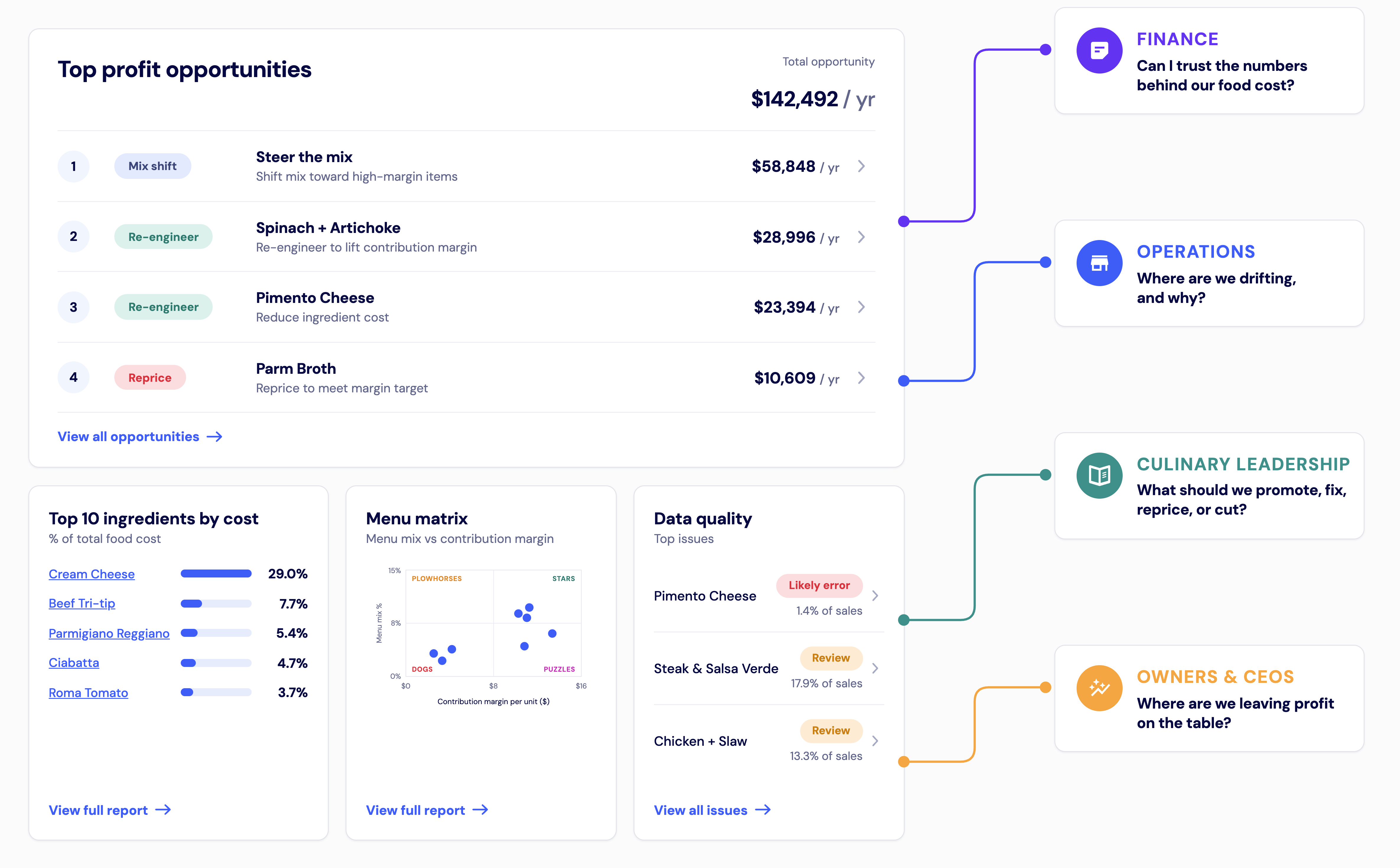
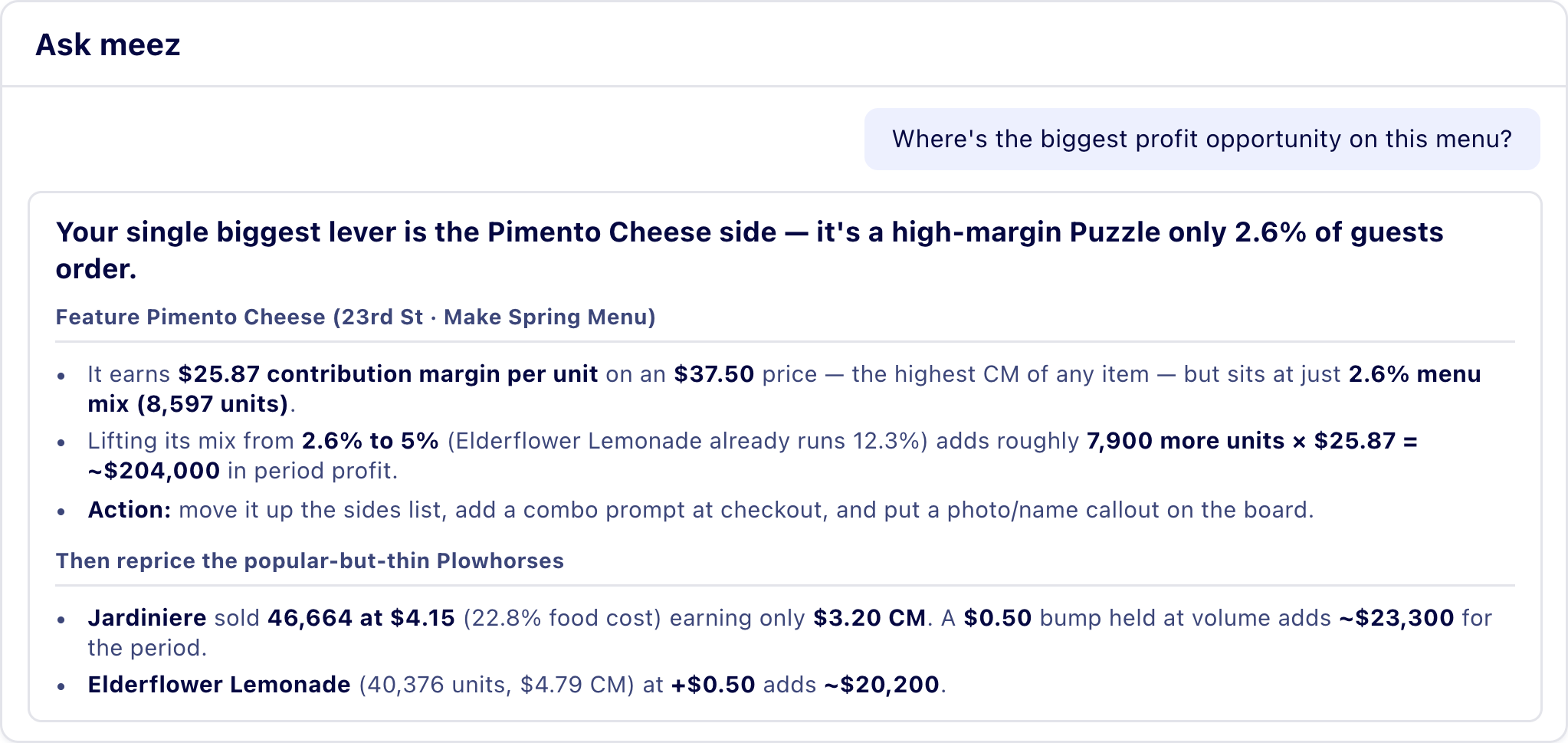
- Find and rank profit opportunities. Identify the highest-impact moves across your menu, from repricing and re-engineering to shifting menu mix, with the math behind each recommendation.
- Catch probable costing errors. Surface numbers that look wrong and trace the issue back to the ingredient, recipe, or sub-recipe causing it.
- Monitor the changes that matter. Set thresholds around ingredient cost, food cost, margin, pricing, and other metrics so your team can focus on meaningful exceptions.
- Build custom metrics and reports. Describe what you want to analyze in plain English or build the exact view your team needs.
- Ask questions about your data. Use Ask meez to turn questions about recipes, ingredients, menus, costs, nutrition, allergens, and sales into answers, metrics, charts, and reports.
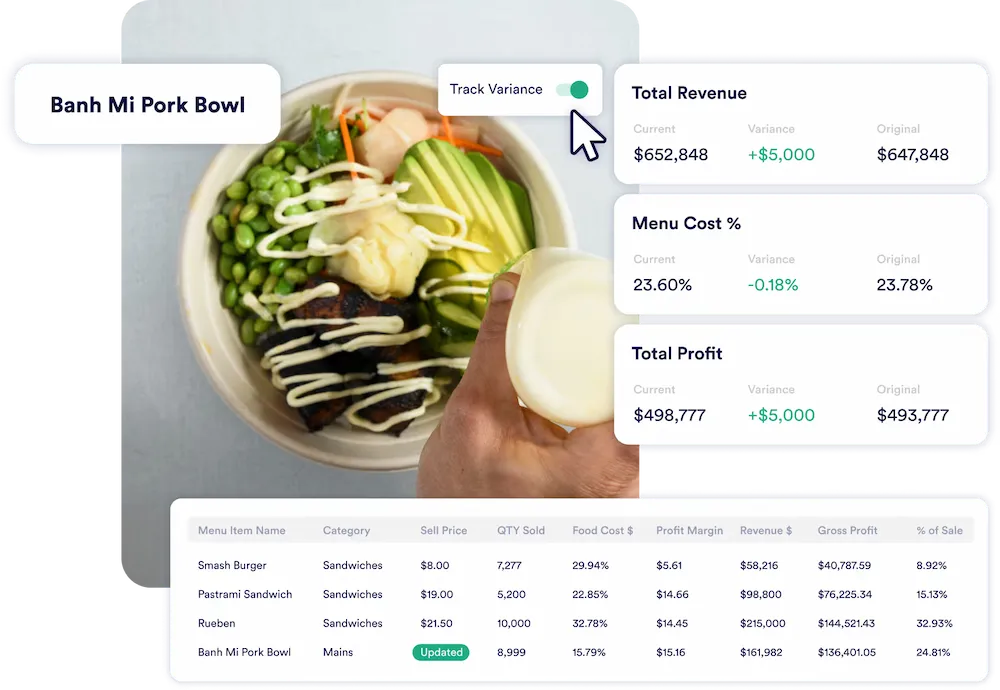
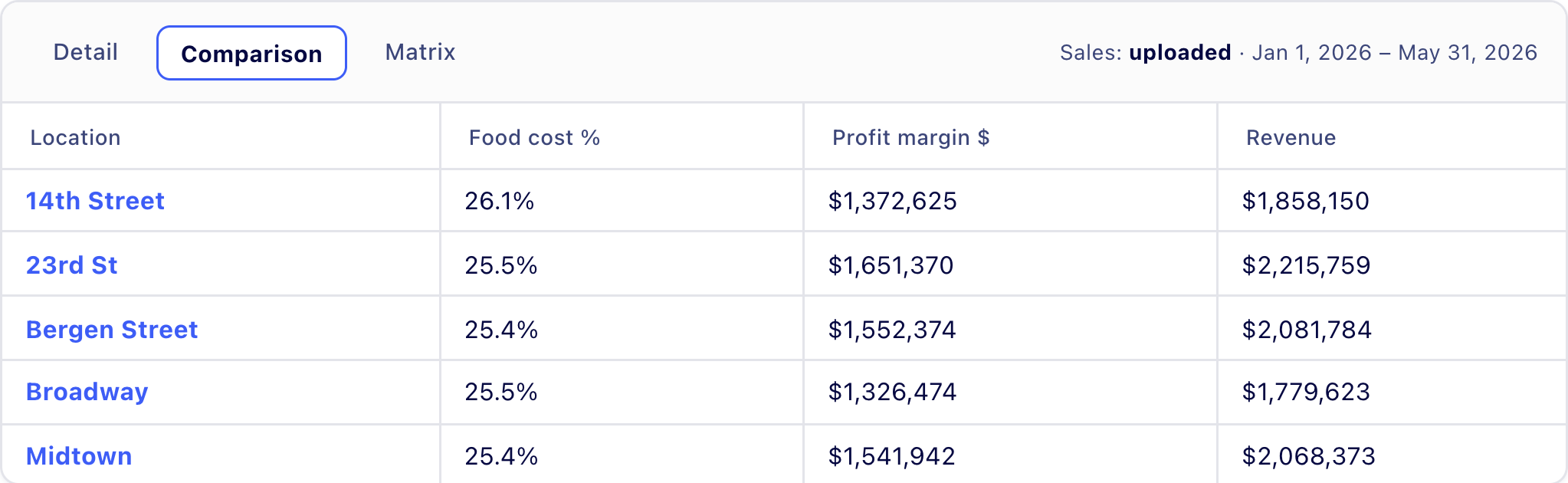
- Analyze menu performance. With sales connected, compare price, volume, revenue, food cost, margin, and sales mix across locations, concepts, menus, and time periods.
- Work with nutrition and allergen data at scale. Review information across entire menus, trace results back to ingredients, and export info other teams need.
The goal is to move from "Here's what happened" to "Here's what matters, why it happened, and where should I look next?"
Why Starting With Recipe Data Matters
There are plenty of AI tools that can generate an answer. The harder part is giving AI enough menu and restaurant context to generate an answer you can actually use.
Consider a single ingredient price change.
Knowing that tomato went up in price is one data point. But understanding the impact that price increase has requires:
- Knowing which recipes use that ingredient
- Whether it appears inside sub-recipes
- How much each recipe uses and its yield
- Which menu items those recipes belong to
- How much those menu items sell for
- How frequently they sell and where they are sold
The relationships matter.
That's why meez Intelligence starts with the structured recipe data culinary teams are already creating.
Ingredients connect to recipes. Recipes connect to sub-recipes and menu items. Costs, yields, nutrition, and allergens move with them. And menu items connect to concepts, locations, pricing, and sales.
Unlike a simplified recipe record created purely for finance or reporting, the underlying recipe can contain the operational detail required to actually produce the food: yields, conversions, sub-recipes, instructions, ingredients, nutrition, allergens, and more.
Instead of giving AI access to a collection of disconnected numbers, meez gives it the restaurant context behind those numbers.
At Scale, You Can't Investigate Everything
This becomes even more important as restaurant groups grow.
When you operate a handful of restaurants, someone may still be able to dig through individual reports, recipes, conversions, and variances to figure out what went wrong.
At 10, 20, 50, or more locations, that gets much harder to do.
The problem is no longer simply getting access to information. It is knowing where to look first.
If red onion shows an unusual variance across several restaurants, someone can manually dig through the recipes, conversions, purchasing data, and inventory setup until they find the problem.
But repeat that process across 20 potential issues and hours disappear.
That's why a major part of meez Intelligence is built around managing by exception.
Instead of expecting someone to review every recipe, ingredient, menu item, and location, Intelligence can help surface the outliers:
- A recipe cost that suddenly looks wrong
- A conversion that may be creating a distorted cost
- A menu item that crosses a food-cost threshold
- An ingredient whose price moved materially
- One location behaving differently from the rest of the group
- A high-volume menu item quietly losing margin
The goal isn't to replace the investigation.
It's to tell you which three things are worth investigating instead of making you dig through three hundred.
Know Which Menu Move to Make First
Most restaurant teams don't have a shortage of things they could change. There are always items that could be repriced, recipes that could be reworked, ingredients that could be sourced differently, or dishes that could use more promotion.
The harder question is which move is actually worth making first.
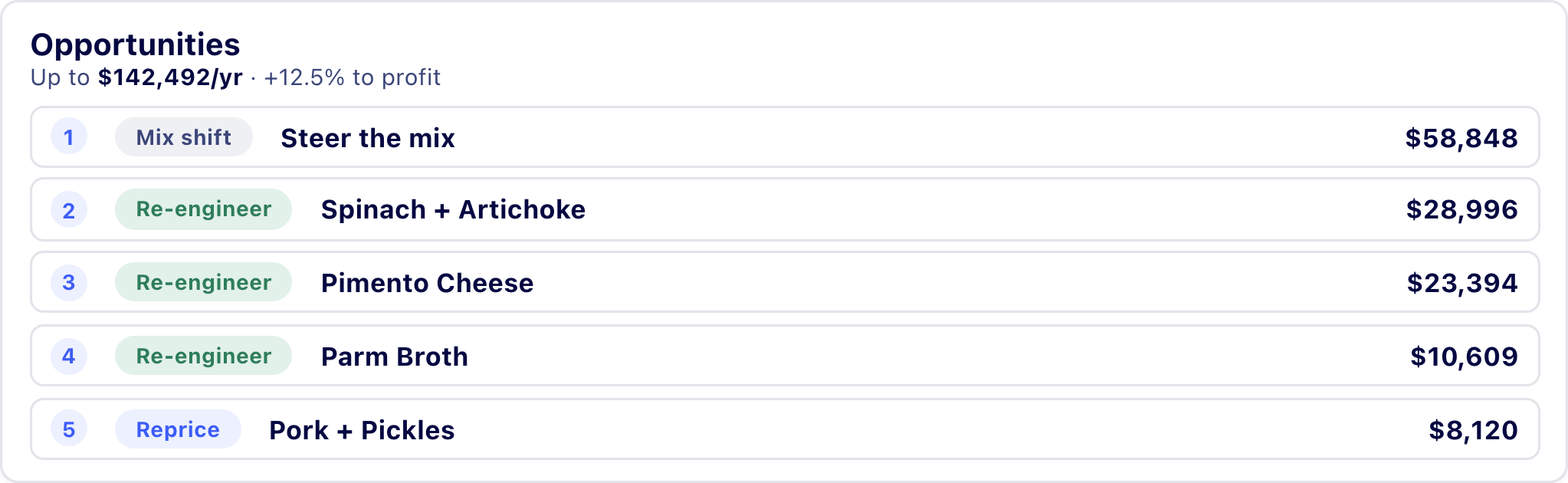
That's what the Opportunities section in meez Intelligence is designed to answer.
Instead of handing you a menu engineering report and leaving your team to interpret it, meez Intelligence analyzes the menu and ranks potential opportunities by estimated annual impact. It can surface moves such as:
- Repricing an item with strong demand but weak margin
- Re-engineering a recipe whose cost structure is holding back profitability
- Shifting sales toward items with stronger economics
- Identifying high-performing items that deserve more promotion
- Leaving an item alone when the data doesn't support a change
Each opportunity includes the math behind the recommendation, so your team can understand what is driving it and evaluate the potential impact before making a decision.
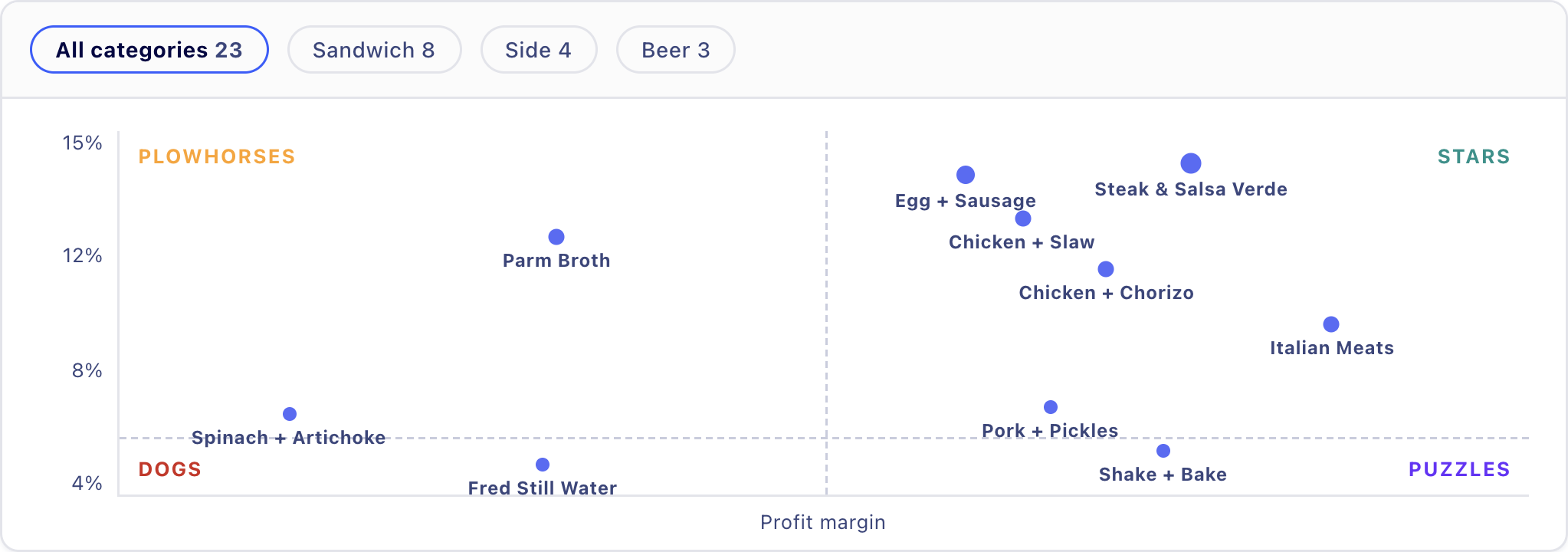
That matters because traditional menu engineering often stops at categorizing items as Stars, Plowhorses, Puzzles, or Dogs. Useful, but it still leaves an operator asking: What should I actually do about it?
meez Intelligence is designed to take that next step.
For example, if an item has healthy demand but an ingredient-cost increase has quietly eroded its margin, meez Intelligence can surface the opportunity and help connect that recommendation back to the recipe and cost data underneath it. If another item has strong margin but low sales mix, the better move might be promotion rather than repricing.
The goal is not to automate the operator's judgment. It's to narrow hundreds of possible decisions down to the ones most likely to matter.
Instead of asking, "What does this report tell me?" the question becomes:
"What should we do next, and how much can it help my margins?"
Build the Metric Your Restaurant Actually Uses
No two restaurant groups manage their business exactly the same way.
One culinary leader may want to know every menu item that crossed a 26% food-cost threshold this week. A CFO may care about annual margin exposure by ingredient. And an operations leader may want to know why one region is running a higher aggregate food cost than the others.
Historically, restaurant software has handled this by giving everyone roughly the same set of reports and adding a handful of filters.
meez Intelligence takes a different approach.
It includes ready-made metrics for common restaurant questions, but your team can also build the exact analysis you need.
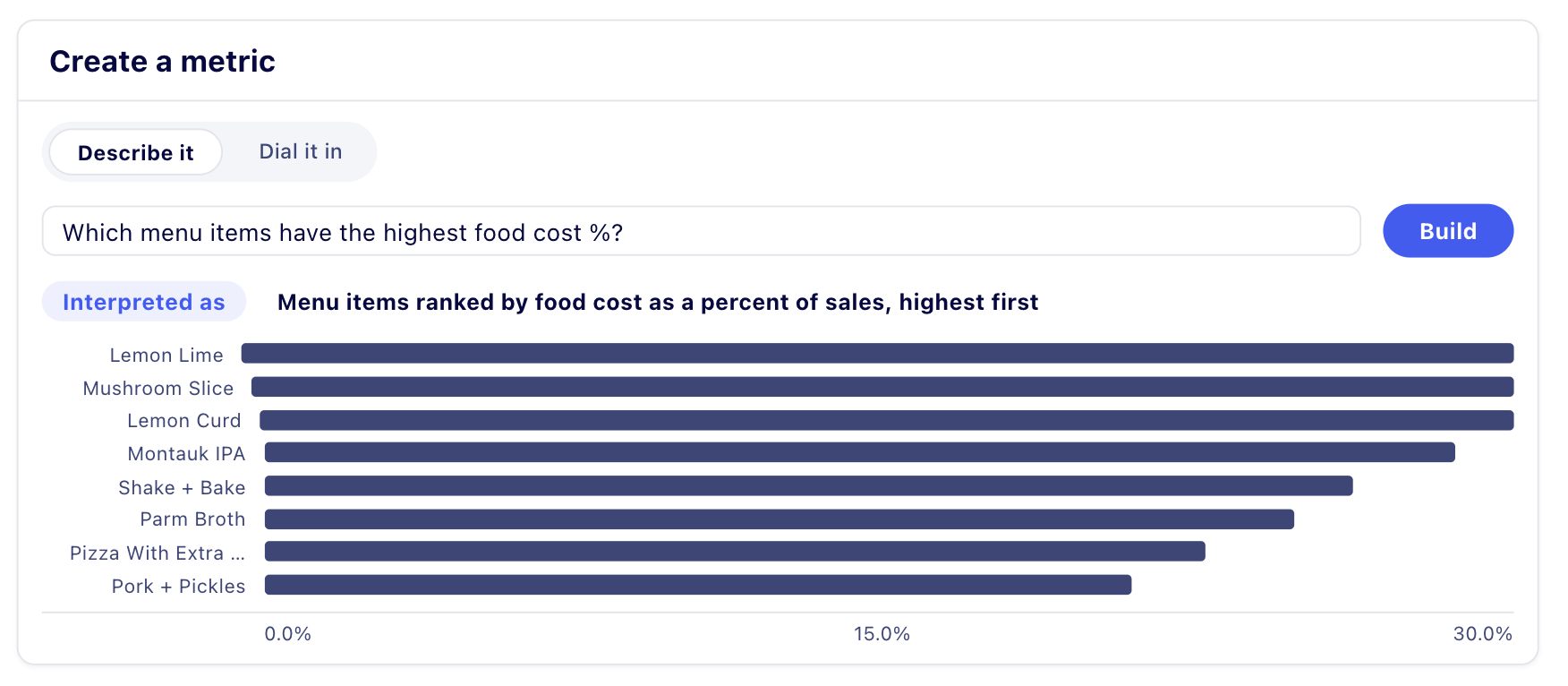
You can describe what you want in plain English or build it visually by selecting the metric, grouping, filters, and time period.
That means a user could ask for things like:
- Top 20 ingredients by cost across the group
- Food cost by concept over the last 90 days
- Menu items below a target margin
- Ingredient spend by menu
- Average margin by location
- Items with the largest cost increase this quarter
Then choose how to view the result, filter it by location or concept, and save the metric for future use.
A report can also become something your team monitors repeatedly rather than rebuilds every time. If the question matters every week, the goal is for the relevant information to be there every week.
The important shift is that the restaurant no longer has to adapt its questions to whatever reports happen to exist.
The reporting can adapt to the way the restaurant actually operates.
That same philosophy carries into Ask meez.
Sometimes you don't even need to build a dashboard first. You can simply ask the question you're trying to answer and have meez Intelligence turn the underlying recipe, ingredient, menu, cost, nutrition, allergen, and connected sales data into an answer, table, metric, or visualization.
For restaurant groups with multiple concepts, locations, and teams, that flexibility becomes especially important. The CFO, culinary leader, operations team, and general manager can all be looking at the same underlying data while asking completely different questions of it.
And that is really the broader idea behind our Build a Metric capability: Your business shouldn't have to fit the dashboard. The dashboard should fit your business.
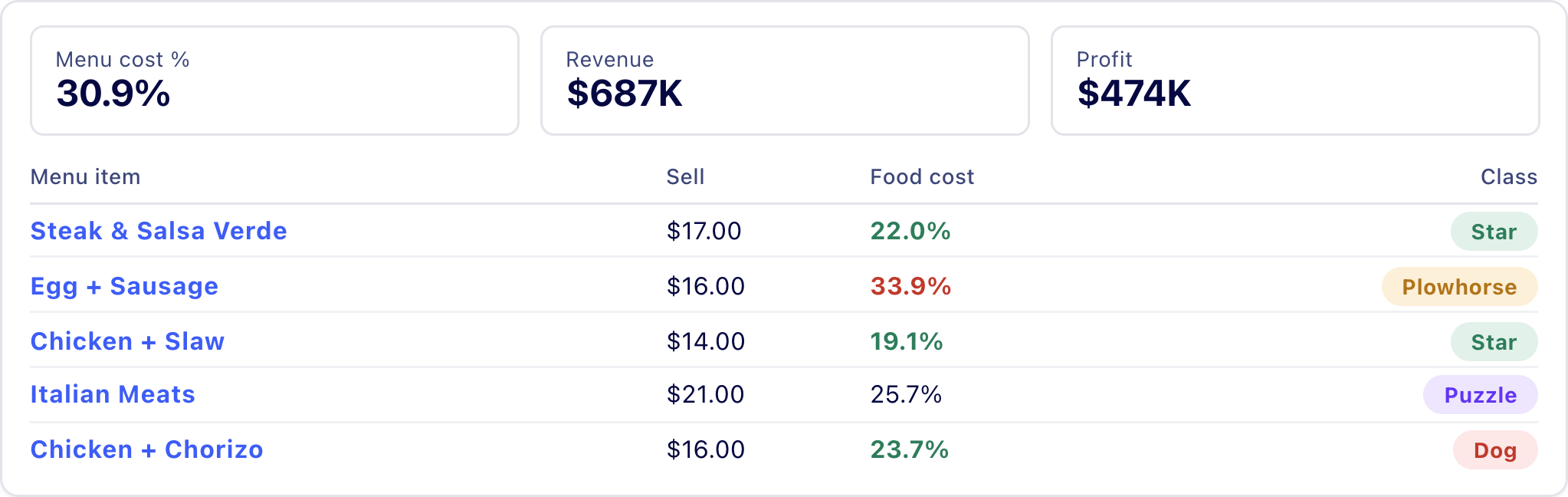
From Spotting a Number to Understanding What Caused It
meez Intelligence is particularly useful when something goes wrong.
Imagine a menu item suddenly showing an unusually high food cost.
A traditional report can tell you the number changed, and someone has to start investigating:
- Was an ingredient cost entered incorrectly?
- Did a conversion change?
- Is a sub-recipe causing the problem?
- Did a vendor price jump?
- Is the issue isolated to one location?
Because meez Intelligence connects menu performance back to the recipe data underneath it, the report becomes the beginning of the investigation instead of the end.
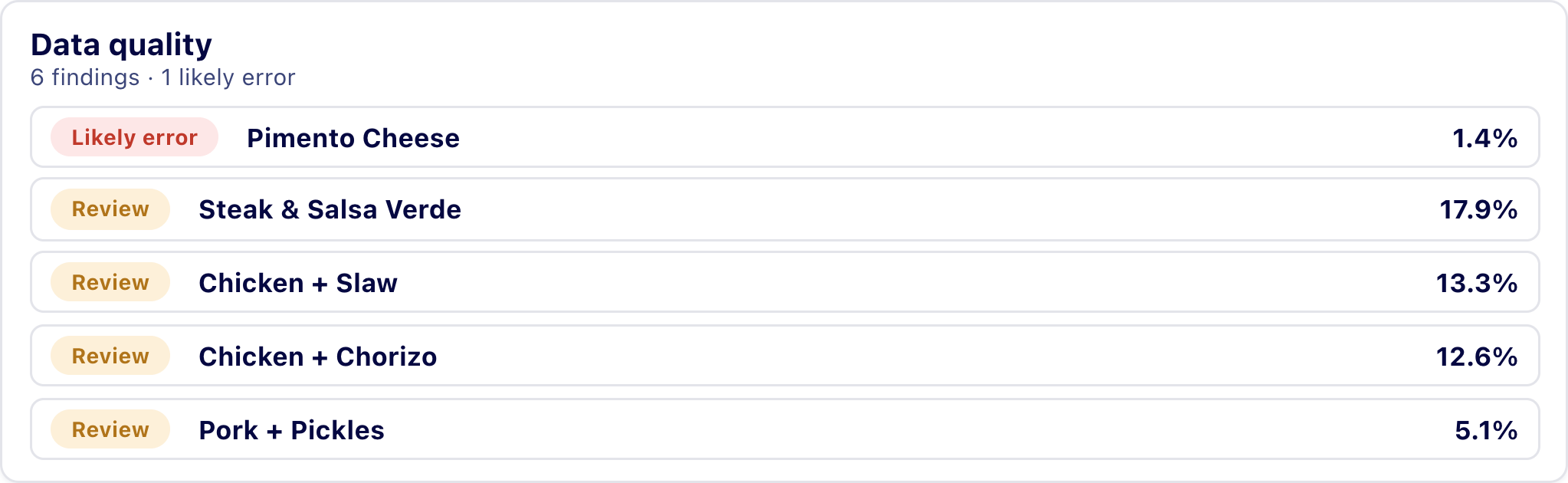
Data Quality goes a step further by looking for probable anomalies before someone knows there is a problem.
With our Data Quality feature, a strange conversion, missing yield, unexpected ingredient cost, or impossible food cost can be surfaced for review and traced back toward the source.
For teams managing hundreds or thousands of recipes, that changes the job from manually checking everything to managing by exception.
And over time, those exceptions can become guardrails.
Your business might decide that a menu item crossing a certain food-cost percentage deserves attention, while another team may care about an ingredient moving more than a specific percentage.
The point isn't for meez to decide which threshold matters.
It's to give your team a way to define what matters to your operation and make those changes easier to see.
What Restaurant Operators Are Saying
The most useful part of building meez Intelligence has been putting early versions in front of restaurant groups and foodservice teams and seeing where they take the conversation.
And the reactions haven't focused on AI for AI's sake.
They've focused on making everyday restaurant decisions easier.
One multi-unit operator manages roughly 1,300 recipes. As we walked through Data Quality and the ability to proactively surface issues, he immediately saw the value of not having to search for every missing yield, strange cost, or recipe problem himself.
His response: "Just tell me."
A few minutes later, he put a number on it: "You've already made my life 20% better knowing I can do this now."
For him, the value wasn't simply that the information existed. It was that the system could tell him when something deserved his attention.
Another multi-unit operator described the same challenge from a different angle: scale.
"Once you become a chain and you have more than a handful of restaurants, you just don't have as much time to dig."
Today, when his team sees an unusual variance across locations, someone has to work backward through the recipes and conversions to figure out what is causing it. One issue may not take long to investigate. But when there are 20 of them, he pointed out, "you're talking about multiple hours."
Seeing Intelligence proactively flag a recipe that likely had an issue immediately clicked.
"That's amazing."
For him, anything that can highlight outliers or potential problems before an operator has to go looking for them is valuable. It shifts the job from reviewing everything to focusing on the exceptions that actually deserve attention.
Another operator saw the same feature flag an ingredient whose cost had become unrealistic because of a unit or conversion problem.
She recognized it immediately. "It's probably a conversion issue. I've had that happen a few times already."
Seeing meez Intelligence identify that kind of issue also made her reconsider the quality of the recipe data underneath her existing reporting. Better data improves the analysis, and the analysis can help uncover where the data still needs work.
For another restaurant group, the biggest reaction was accessibility.
Their managers already had access to restaurant data, but getting an answer could mean navigating a spreadsheet or digging through a multi-page report. After seeing meez Intelligence, one operator described it as "much more approachable for a manager" because managers could ask questions and get answers directly.
She summed up the opportunity well: "The data is already there."
That may be the most important customer reaction of all.
The goal isn't necessarily to create more data. It's to help teams know what deserves their attention, understand why, and actually use the data they already have.
The Questions Get Bigger Very Quickly
Once recipe, menu, cost, and sales data are connected, one question naturally leads to another.
A food-cost variance can lead to an ingredient issue. Menu performance can lead to a location comparison. And those insights can start informing purchasing, forecasting, production, and other systems across the business.
Some of those workflows extend beyond what meez Intelligence does today. But they all depend on the same foundation: accurate, structured restaurant data.
- What did we sell?
- What did it cost?
- Why did margin change?
- Which ingredient caused it?
- What should we change?
- Where is the biggest opportunity?
- What should we be watching next?
That's the difference between simply storing restaurant data and making it useful across the business.
Your Recipe Data Should Go Beyond meez
meez Intelligence is also only one part of the larger data strategy.
Restaurant groups shouldn't have to recreate their culinary data every time they adopt another AI tool, reporting platform, or internal system.
And increasingly, they don't want to.
Operators are starting to build their own AI workflows, internal tools, agents, reporting environments, and applications around the way their particular business operates.
The limiting factor often isn't access to AI.
It's whether that AI has access to clean, structured restaurant data with enough context to be useful.
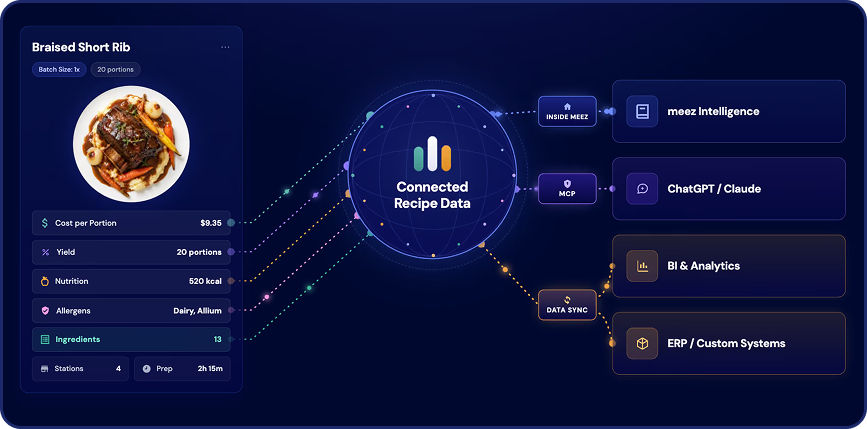
The same structured recipe, menu, and ingredient foundation in meez can now be used in multiple ways:
- Use meez Intelligence for menu analytics, ranked opportunities, Data Quality, custom metrics, alerts, nutrition and allergen reporting, and Ask meez.
- Connect your own AI through meez MCP so compatible tools like ChatGPT and Claude can work with the same structured restaurant data and context.
- Sync meez data into other systems for BI, reporting, purchasing, internal applications, and other operational workflows.
You don't have to choose one destination for the data.
The principle is straightforward: Build and maintain the data once. Use it wherever your business needs it.
The Next Evolution of Recipe Management
meez started by helping culinary teams solve a very specific problem: build, cost, organize, and execute recipes across a growing restaurant organization. And improve profitability, precision, and consistency along the way.
That work isn't going away. It's becoming more valuable.
Every recipe your chefs build creates structured data that can help Culinary understand costing, Operations compare locations, Finance investigate margin, Compliance manage nutrition and allergens, and leadership see where attention matters most.
And as AI gets more capable, the quality of that underlying context matters even more.
The best AI in the world can still give you the wrong answer if it doesn't understand how your restaurant actually works.
That's what meez Intelligence puts to work: the recipe and menu data your team is already building, connected in a way that helps you find what matters, understand why, and act faster.
And with meez MCP, that same foundation can power the tools and systems you choose to build around it.
The future isn't more restaurant software. It's restaurant software that actually understands your business.
See what your recipe data can tell you
Explore meez Intelligence to see how connected recipe data can power better decisions across your restaurant group.
Or book a demo to see what Intelligence could look like with your own data.
FAQ
What is meez Intelligence?
meez Intelligence is an AI-powered menu analysis platform built on the structured recipe data already managed in meez. It helps restaurant groups and foodservice organizations analyze menu performance, identify profit opportunities, catch likely costing errors, build custom metrics, monitor important changes, and ask questions about their restaurant data in plain English.
What data does meez Intelligence use?
meez Intelligence starts with the ingredients, recipes, sub-recipes, yields, costs, nutrition, allergens, menus, concepts, and locations maintained in meez. When sales data is connected, teams can also analyze revenue, volume, food cost, margin, and sales mix across locations and menus.
Why does structured recipe data matter for restaurant AI?
AI needs more than isolated numbers to understand a restaurant operation. Structured recipe data connects ingredients to recipes and sub-recipes, yields and conversions, menu items, costs, nutrition, allergens, locations, pricing, and sales. Those relationships give AI more of the context behind the numbers it is analyzing.
Do I need sales data connected to use meez Intelligence?
No. Sales data unlocks deeper menu-performance analysis, including revenue, volume, margin, sales mix, and location comparisons. But teams can still use recipe-based capabilities such as Data Quality, ingredient-cost monitoring, custom metrics, nutrition and allergen analysis, and other recipe-data reporting without sales connected.
Can I build my own reports and metrics?
Yes. meez Intelligence includes built-in restaurant metrics, but teams can also create their own. You can describe what you want in plain English, build metrics visually, customize how information is grouped or displayed, and save the analysis your organization actually needs.
What is Ask meez?
Ask meez lets you query your recipe, ingredient, menu, cost, nutrition, allergen, and connected sales data using natural language. Instead of searching through reports, you can ask a question and generate an answer, metric, table, chart, or visualization from the underlying data.
Does meez Intelligence replace the core meez recipe platform?
No. The core meez platform remains where culinary teams build, cost, organize, standardize, and maintain recipes. meez Intelligence builds on that foundation to help Operations, Finance, Culinary leadership, and executives analyze the data those teams create and turn it into better business decisions.
Can we use our meez data outside of meez Intelligence?
Yes. meez Intelligence is one way to use your structured restaurant data, but it isn't the only one. Restaurant groups can also connect compatible AI tools through meez MCP or securely sync recipe, menu, and ingredient data into BI tools, internal applications, reporting systems, and other parts of their tech stack.
What is meez MCP?
meez MCP gives compatible AI tools a way to work with the structured recipe, ingredient, menu, and related restaurant data maintained in meez. It allows restaurant groups that want to build their own AI workflows or applications to use the same underlying data foundation outside the meez Intelligence interface.
Can meez Intelligence forecast sales or tell us how much to prep?
Advanced forecasting and automated prep recommendations are areas customers are already asking about, but they should be considered future opportunities rather than current meez Intelligence capabilities. Today, meez Intelligence focuses on making connected recipe, cost, menu, sales, nutrition, allergen, and data-quality information easier to analyze and act on.
Who is meez Intelligence built for?
meez Intelligence is designed for multi-unit restaurant groups and foodservice organizations that want to get more value from the recipe data their culinary teams are already managing. While chefs continue working in the core meez platform, meez Intelligence gives Operations, Finance, culinary leadership, and executives a way to analyze that data across the broader business.


Liz Van Hoose is the Marketing Director at meez, the recipe operating system helping multi-unit restaurant and foodservice teams standardize recipes, manage costs, train teams, and run more profitable kitchens. She has 12+ years of experience building and leading growth marketing programs for startups and growing companies, with expertise across demand generation, positioning, lifecycle, paid media, content, and SEO.