
"Having owned independent restaurants, it feels like cheating. Like it really does."
After years of running independent restaurants, Michael Jacober opened his first Jersey Mike's in Lake Bluff, Illinois and discovered how much of the work had already been figured out for him.
On The meez Podcast, Jacober joined Josh Sharkey and Matthew Conway to discuss what makes the franchise model so effective. It wasn't just the brand recognition or the sandwiches. It was the systems, training, and operational playbooks that eliminated much of the guesswork.
For independent restaurant operators, there's a lesson here. You don't need to buy into a franchise to build a more repeatable business. You just need to stop solving the same problems twice.
What Does a Restaurant Franchise Fee Actually Buy?
Jacober described a process in which the franchisor helps turn a signed lease into a working restaurant. Its design team determines the kitchen layout and recommends an architect and general contractor. The contractor had already built many similar locations, making the project far more predictable than the typical independent buildout.
According to Jacober, construction takes roughly 13 weeks. His development agreement called for another store about six months after the first and a third roughly six months later. He acknowledged that the schedule was aggressive, but the larger point was how much of the opening process was already mapped out.
In a standalone restaurant, owners often have to assemble that knowledge themselves: whom to hire, how to lay out stations, which equipment to buy, what to teach first, and how to know whether a new team is ready for service. A franchise offers a defined answer to many of those questions before opening day.
"Really, it's the marketing and it's the support. That's really what you're paying for."
The franchise fee is only one component of the initial investment, but much of the value lies in the accumulated knowledge behind the brand. That support can reduce the number of problems a new operator has to solve from scratch.
The Training System Impressed Him More Than the Buildout
A standardized construction process gets the doors open. But training determines what happens once customers walk in. The week of on-site opening support shows how much of the new-team learning process can be built into the operating model.
"Their training is insane. They've got a whole team that comes in. It's three people that are with us for a week."
That kind of on-site support matters because a restaurant does not become repeatable just by giving employees a binder. People need to know how to execute standards under the pressure of service. The strongest training programs connect written instructions with demonstrations, practice, feedback, and a clear definition of what good looks like.
For independents, that starts with recipe-based kitchen training: accurate quantities, prep methods, portion sizes, and visuals that employees can access without waiting for the chef to explain them again.
Six Employees Can Have the Same Training Problem as Six Hundred
The same challenge exists on a much smaller scale. At an independent burrito shop with a six-person team, staffing, training, and maintaining a high level of hospitality can be just as demanding as they are in a larger business.
"I've got six people on my team and it's just difficult to keep people hired and trained and motivated to go out and like deliver a high level of hospitality."
A six-person team may seem easier to manage than a large restaurant group, but small teams are often more exposed when one experienced employee leaves. The person who knows the opening routine, the exact portion, or the workaround for a tricky prep task may also be the person everyone else relies on to learn it.
That knowledge gap shows up gradually. One cook portions a little differently. Another skips a step that was never written down. A manager teaches a new hire the way they personally learned the task, rather than the current standard. Individually, the differences can be small. Together, they change the guest experience and the economics of the operation.
This is why restaurant training SOPs matter even in a single-location business. The goal is not to replace judgment, but to make essential knowledge accessible to every shift.
The Real Product Is a Repeatable Business
"The product isn't just the food, it's this whole repeatable business that they hand you."
The food is what guests come to buy. The operational system is what allows a new location, manager, or employee to deliver it consistently. A useful restaurant operations manual is therefore much more than a set of rules. It records how the restaurant works, from the line to the back office, and makes those practices teachable.
What Belongs in an Operational Playbook?
A practical playbook should give employees clear answers to the decisions they make every day. For most restaurants, that includes:
- Standardized recipes with ingredient quantities, methods, yields, portions, and plating references
- Prep and station specifications, including batch sizes, setup, storage, and handoffs
- Opening, closing, cleaning, and food safety procedures
- Role-based onboarding and training sequences with clear checkpoints
- Ingredient and menu-item cost targets, plus rules for updating them
- Escalation procedures for substitutions, shortages, service problems, and exceptions
The key is to connect the documents rather than scatter them across spreadsheets, printed recipes, message threads, and binders. When a recipe changes, related prep and training instructions should change with it.
A well-written recipe is a strong foundation. This guide to recipe training explains how consistent measurements, language, preparation details, and visuals reduce room for interpretation.
What Independents Can Copy From Franchises, and What They Cannot
Independent operators cannot simply recreate the consumer recognition, national advertising, purchasing leverage, or years of trial and error behind an established franchise. They also may not want the reduced creative control that comes with operating under someone else's brand and menu.
What they can copy is the discipline of documenting decisions. A restaurant can define one method for a signature dish, make a station setup repeatable, and turn its best trainer's explanations into instructions every new hire can use. None of that requires joining a chain.
The same thinking drives recipe standardization across locations: the objective is not to erase a restaurant's personality, but to make its best work reproducible when the original chef is not standing at the pass.
Standardization and creativity are not opposites. When teams have reliable foundations, they can spend less time correcting preventable mistakes and more time improving food and hospitality.
Why Documentation Becomes More Valuable at Location Two
At one restaurant, an owner can sometimes keep standards intact by being physically present. A cook has a question, walks across the kitchen, and asks. The method depends on proximity and the availability of someone who knows the answer.
But a second location makes that model harder to sustain. The chef cannot answer every question in two kitchens, and the stores may quietly start using different recipes, portions, or prep processes. Changes made at one location may never reach the other.
That is why recipe consistency across locations depends on shared standards and clear ownership of updates. Teams need to know not just how a recipe is made, but which version is current and who can change it.
A centralized restaurant knowledge base also turns local improvements into company-wide improvements. If one kitchen discovers a better yield, clearer instruction, or more efficient prep sequence, the change can become the new standard rather than remaining one employee's workaround.
Start With the Decisions Your Team Keeps Repeating
The biggest obstacle to documenting restaurant operations is often time. When tonight's service is understaffed or an order has not arrived, writing SOPs feels less urgent than finishing prep. But a playbook does not have to be built all at once.
Start with the work that creates the most repeat questions, training delays, or cost variance:
- Document your five highest-volume recipes with weights, yields, portion sizes, methods, and photos
- Identify prep components shared across dishes and establish one approved specification for each
- Write down the opening and closing steps that new hires regularly miss
- Capture techniques and troubleshooting knowledge currently held by only one experienced employee
- Assign an owner to review standards whenever ingredients, suppliers, methods, or menu prices change
Prioritize accuracy over volume. Ten useful standards that employees actually follow are more valuable than a hundred files no one trusts.
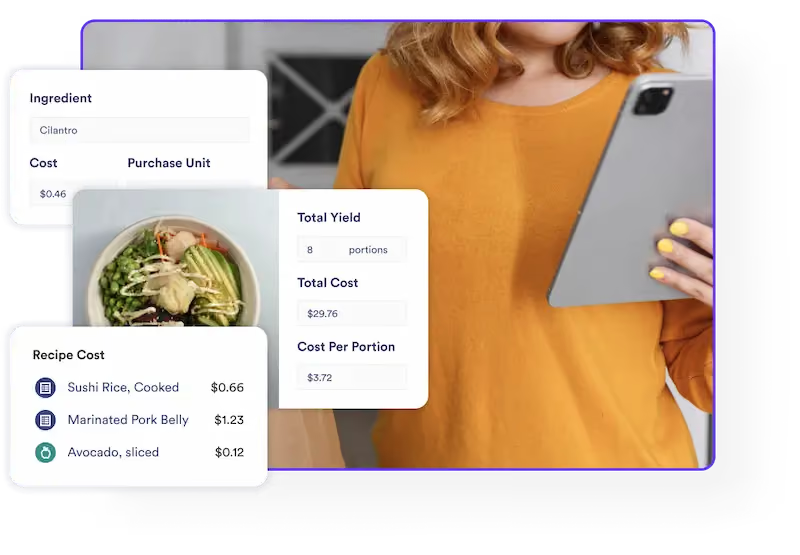
As those standards mature, connect them to accurate recipe costing. A consistent portion or prep yield is not only a training detail; it also affects what the plate actually costs.
For an example of how a growing operator can make this work, see how Kaldi's Coffee standardized recipes and costing across 14 locations.
A Great Playbook Protects What Makes a Restaurant Different
Jacober's franchise experience and Conway's independent operation sit on opposite ends of the restaurant business, but they point to the same operational truth. If a standard lives only in someone's head, the business depends on that person being there to repeat it.
A franchise has the advantage of an established support system, while an independent has the advantage of choosing exactly what is worth preserving. Both need a way to turn knowledge into consistent execution.
The goal is not to make every independent restaurant behave like a chain. It is to make sure the dishes, techniques, and hospitality that make a place distinctive survive staff changes, busy nights, and growth.
Listen to the full episode of The meez Podcast for the complete conversation with Michael Jacober, Matthew Conway, and Josh Sharkey.
FAQ
What is an operational playbook for a restaurant?
It is a documented collection of the recipes, procedures, training steps, and standards a restaurant uses to operate consistently. It should explain both what employees need to do and how to do it.
What is the difference between a restaurant operations manual and a recipe SOP?
An operations manual covers broader workflows such as opening, closing, sanitation, service, and staff responsibilities. A recipe SOP covers how to prepare a specific dish, including ingredients, methods, yields, portions, and plating.
Can an independent restaurant build franchise-style operating systems?
Yes. An independent can document recipes, training, stations, and cost standards even without a national brand or purchasing network. The main requirement is to capture decisions in a shared system and keep them current.
What should a restaurant document first?
Begin with high-volume recipes, repeated training questions, shared prep components, expensive mistakes, and tasks only one employee knows. Build outward once employees are routinely using the first set of standards.
Why do playbooks matter more when a restaurant opens multiple locations?
With more than one kitchen, operators cannot rely on direct supervision and verbal instruction. Shared documentation makes approved methods visible and helps improvements reach every location.
Do operational playbooks limit creativity?
Not necessarily. Standardizing execution gives teams a reliable baseline, while chefs and operators remain free to develop new dishes and improve processes deliberately.


Liz Van Hoose is the Marketing Director at meez, the recipe operating system helping multi-unit restaurant and foodservice teams standardize recipes, manage costs, train teams, and run more profitable kitchens. She has 12+ years of experience building and leading growth marketing programs for startups and growing companies, with expertise across demand generation, positioning, lifecycle, paid media, content, and SEO.