

How to Build Restaurant R&D Into Your Operating Model
This week, at a glance:
🤔🌶️ Hot Take
4 Takeaways on Innovation from Noma and the World's Best Bar
1. Creating constraints and boundaries is the cure for quicker (and often better) innovation.
At wd~50, Rosio could put virtually anything in a dish. At Noma, she couldn't even use lemons or wine vinegar because neither grows in Scandinavia. For her, it was a relief. Constraints made it easier to decide what to work on, and what not to. They kill analysis paralysis.
Every restaurant already works within the same basic constraints: food cost, vendors, labor, space. That isn't enough to set you apart. So add your own. Cap the number of menu items or SKUs. Limit the steps to finish a dish. No refined sugar. Induction only. Animal fats only. No foods that start with B. Whatever it is, you can change them later. Instead of thinking a little about a million variables, you go deep on a few.
Time is a powerful constraint too. Parkinson's law: work expands to fill the time you give it, like a gas filling whatever container it's in. Give your team six months to develop a menu, and it'll take six months. Give them six weeks, and you'll be surprised what shows up.
2. You have to understand the original before creating your adaptation
Rosio opened a Mexican restaurant in Copenhagen where "people didn't know how to eat a taco." Literally. Arielle helped her in the beginning as well and said: "We actually had to make a poster about how to eat a taco with your hands."
They had a similar challenge when they wanted to serve a Mole negro sauce. They changed course and did a mole verde, very traditional, with Scandinavian wild herbs and a little Jerusalem artichoke. Creative enough to keep the kitchen fired up, familiar enough that the guest has something to hold on to. Nine years in: "I finally am feeling like maybe we can do a little more."
You would never want a cook to create some 'deconstructed hollandaise' before they understand how to make a great classic hollandaise. It likely will not turn out well. (Also, probably just don't make a deconstructed hollandaise)
I just never thought about how this impacts the guest the same way until Rosio said it. And it goes for your team too.
Arielle told a story about a cook in the Noma fermentation lab who kept trying to make berry vinegar. He copied what he'd seen the lab do: berry juice, a splash of vinegar, an airstone bubbling oxygen through it. Batch after batch, nothing happened. Every vinegar starts as alcohol: red wine vinegar as wine, malt vinegar as beer, etc. The bacteria eat the alcohol, not the juice.
He never learned how vinegar actually works, so he skipped the original and went straight to the adaptation. Starting that cook off by learning the basics of vinegar first would be time well spent.
Whether it's a cook or a customer, they have to understand the original before your version can work.
3. Creativity only happens if it's on the calendar (and on the P&L)
The whole group doubled down on this. Being creative is a job; it's hard work. Rosio especially shared that running a higher-volume restaurant group and being a chef/owner meant it needed to be baked into her day. "I'm going to work on this between two and four," because the rest of the day is meetings and the restaurant.
It goes on the calendar, or it doesn't happen.
There is a cost to this when you run a business. I love how Rosio went about this given the size of her business and, of course, not having a full-on dedicated R&D department. She tracks all the hours she spends on it.
At the end of the year, she looks back at how much time went to R&D and books it to administration costs. It runs 20 to 30 percent of her time, and it's lumpy: almost none in summer when she's on the floor, all of February. "It's never enough," in her words. But it's a line item in the P&L, and it's what it takes to take innovation seriously in your business.
Eminem writes lyrics every day religiously and throws out 99% of them. Jerry Seinfeld has scheduled 2 hours every day consistently for decades to do nothing but sit with a pen and write, no matter the outcome. Keeping the habit is the point.
Innovation needs to be on your P&L just as much as it needs to be on your calendar. We measure what matters. Put the hours in your labor model, give the product its own line so it doesn't wreck your food cost, and review it like anything else you pay for.
4. Consistency creates the revenue that pays for innovation.
Rosio learned this the hard way. In her first year at the taqueria, she tried to change the menu every day. "Then I thought, no one's coming every day. Why am I changing the menu every day, for who?" Her team didn't want it either. "We're changing the menu again? We just got used to it." Now the taquerias barely change, and the new ideas live at the restaurant.
Your consistent core is what guests come back for because they know exactly what they're getting. It's almost always your profit driver, and it funds everything else you try. The best experiments eventually graduate into the core, and when they do, you engineer them like everything else in it: spec'd, costed, trained, and executed the same way every day. Then the core funds the next round.
If all you do is innovate, the balance is off. Guests can't rely on you, your team never masters anything, and the business can't sustain it. Nail the core every day, and it earns you the money and the trust to take the next swing.
🎙️ The meez Podcast
Innovation & Menu Development w/ Rosio Sanchez, Arielle Johnson, Ryan Chetiyawardana & Thomas Frebel
Recorded live at The Chef Conference in Philadelphia. Four people who do R&D at the highest level in the world, on how they actually run it: when a dish is done, why boundaries make you more creative, and how to pay for it.
- When is a dish actually done?
- Why boundaries make you more creative
- The chef's way vs. the scientist's way
- Paying for R&D without an R&D team
Recipe:
Pickled Starfruit
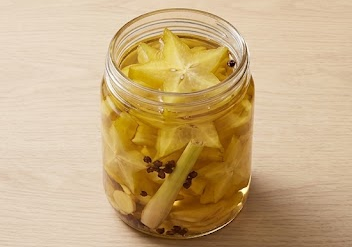
It's the tail end of the season for starfruit from Florida. If one of your constraints isn't preventing you from sourcing fruit from other places, try out this pickle recipe. I worked on it for a couple of decades while working with Chef Gray Kunz. It's great with Foie Gras if you're into that, or some high-quality alpine cheese like a good Gruyère or Comte.
📆 See what's new with meez
The new recipe approval workflow is live. meez Intelligence and the MCP are live. Automated server cards created from recipes coming very soon. Prep lists underway.
👉 Find some time with our team here to learn more, or just reply to this email
💬 Want to Be a Guest on The meez Podcast?
If you’re building at scale, or wrestling with hard zero-to-one problems worth talking about, I’d love to hear from you.
Apply to be a guest or nominate someone we should talk to.


meez is the recipe software that helps chefs create, organize, and execute profitable recipes with precision.


