
Your food cost is wrong. You just don't know by how much yet.
.webp)



%20(1).png)








When recipe data lags, margins suffer.
The kitchen changes a recipe and you don't find out until the P&L looks wrong a month later. Your Excel spreadsheets haven't been updated since the last ingredient price spike, which means every costing number you're working from is a guess.
The gap between what food should cost and what it actually costs is real money — and right now you have no clean way to close it. meez is the recipe data layer your finance stack has been missing.
Bridging the gap between culinary and finance
We are complimentary, not competitive.
meez is not accounting software. It acts as the missing culinary layer on top of systems like Restaurant365, turning recipes into structured, data-rich assets that power accurate costing, consistent execution, and better reporting.
Unlike ERPs that track what you did spend, meez shows you what you should have spent.
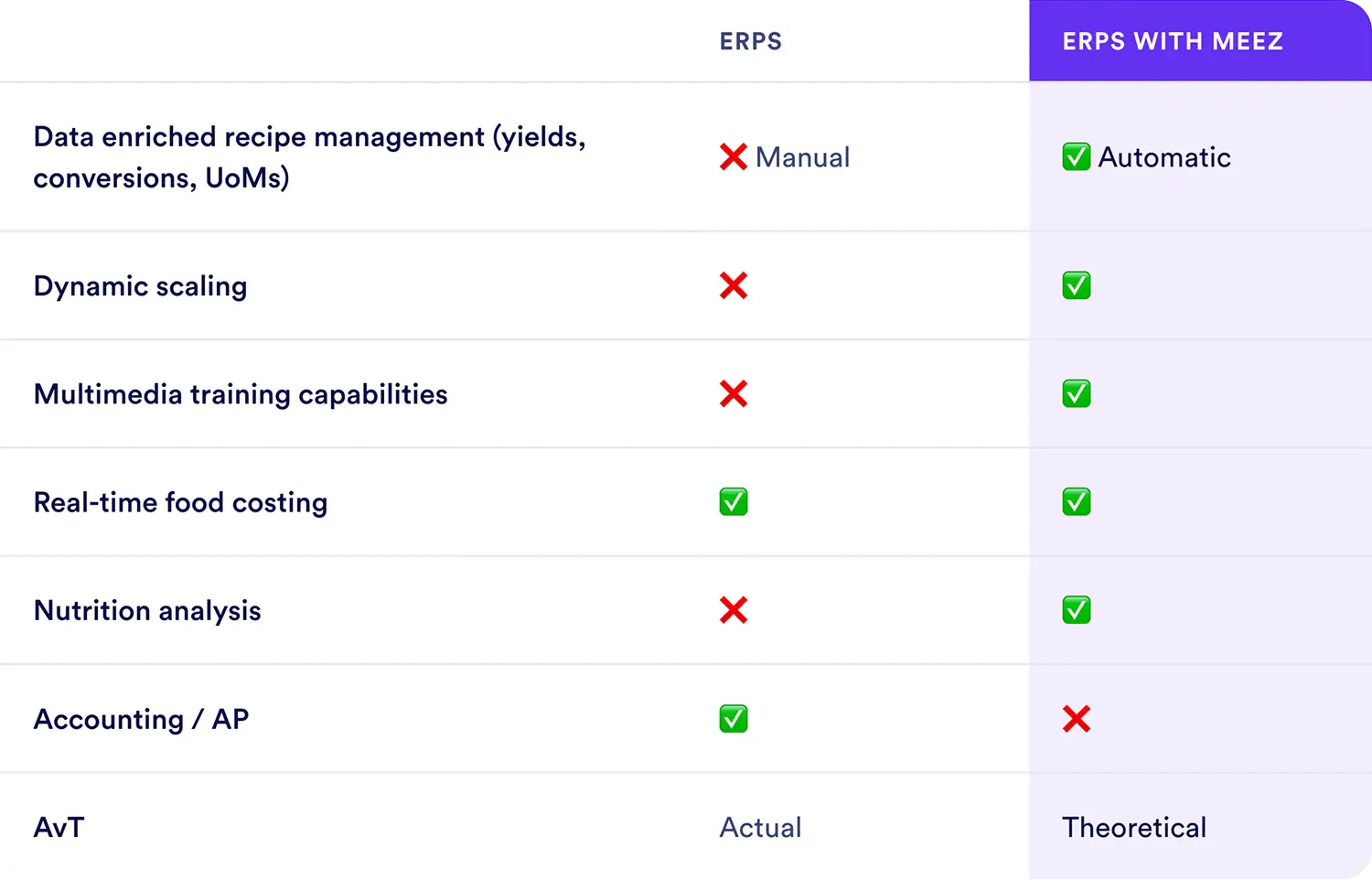
Connect Inventory and Purchasing Feeds




Stop finding out about cost problems in last month's P&L.
Recipe costs are only accurate if they reflect what you're actually paying for ingredients today. meez connects live purchasing data to every recipe automatically, so when a supplier raises prices, your cost data updates without anyone touching a spreadsheet.
- Live purchasing integration keeps every recipe's cost current — no manual updates, no stale spreadsheets
- Actual vs. theoretical food cost variance visible by location, category, and time period in one view
- Recipe-level drill-down shows exactly which dish and which ingredient is driving a variance
- Automated alerts when ingredient price changes push a recipe's food cost % above your target threshold
.webp)
.webp)
Your ERP is only as accurate as the recipe data feeding it.
meez is the culinary data layer that makes your back-office systems more valuable — not another silo to manage. Structured recipe costs flow from meez into your ERP, so your reporting reflects what the kitchen is actually producing.
- Native connection with Restaurant365 — recipe costs sync directly, no manual export or import required
- Step-by-step photos and videos built into every recipe so new cooks train to your standard
- Automatic scaling and batch calculations eliminate human error on the line
- One source of truth that both your culinary and finance teams are working from simultaneously
Price your menu on data, not instinct.
Most restaurants reprice menus on gut feel and competitor benchmarking. meez gives your finance team recipe-level contribution margins on every item, so pricing decisions are grounded in what dishes actually cost.
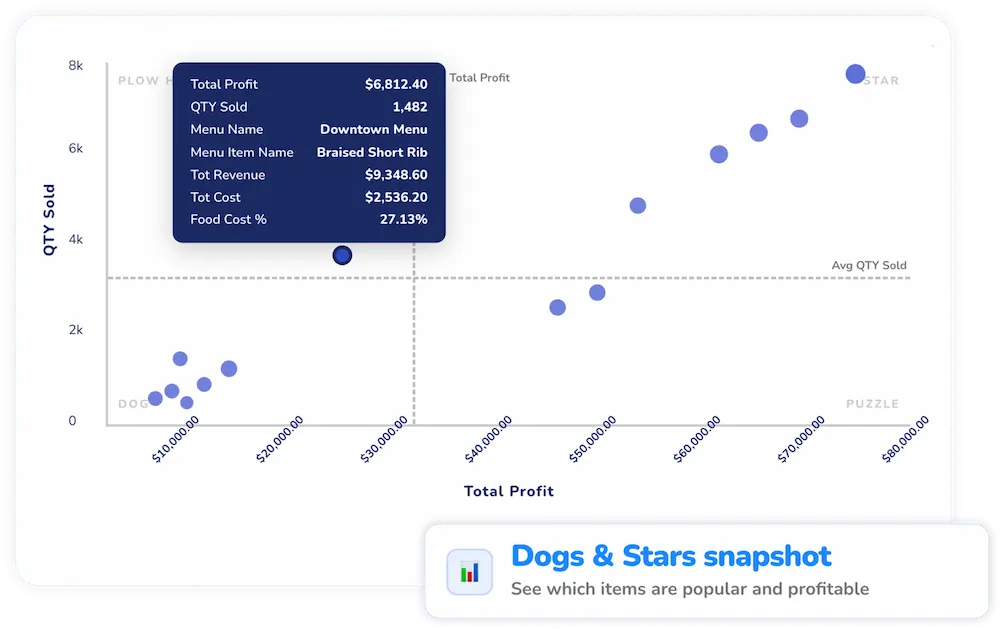
- Menu engineering view shows cost, revenue, and contribution margin for every item in one place
- Model ingredient swaps, portion changes, and price adjustments to see exact margin impact instantly
- Identify margin stars and hidden loss leaders before they show up in the P&L — not after
- Seasonal repricing is fast when all cost data is live and tied to actual current purchasing prices
The kitchen and finance finally speaking the same language.
Every handoff between culinary and finance is a place where data gets lost, delayed, or wrong. meez closes that gap — structured recipe data that chefs actually maintain, flowing automatically into the finance systems you depend on.
- Recipe changes made by culinary flow into finance reporting automatically — no more surprise variances at month-end
- AI-powered importer gets your recipe library costed and structured in days, not months
- Reduce manual costing from ~30 minutes per dish to minutes — freeing your team for actual analysis
- Financial-grade data structure from day one makes audits, due diligence, and investor reporting cleaner
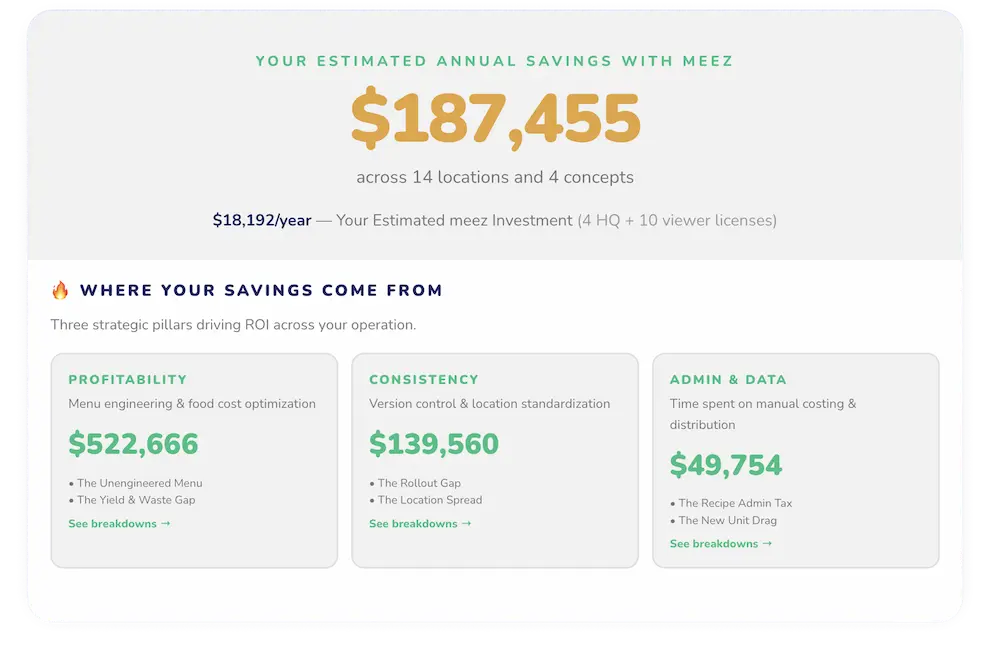
Real financial impact. Measurable from day one.
Free ROI calculator
What is inconsistent kitchen training costing your group?
See what onboarding inefficiency, turnover, and trainer-dependent training cost your group annually. Your number, based on your operation. Takes 60 seconds.
Calculate my costs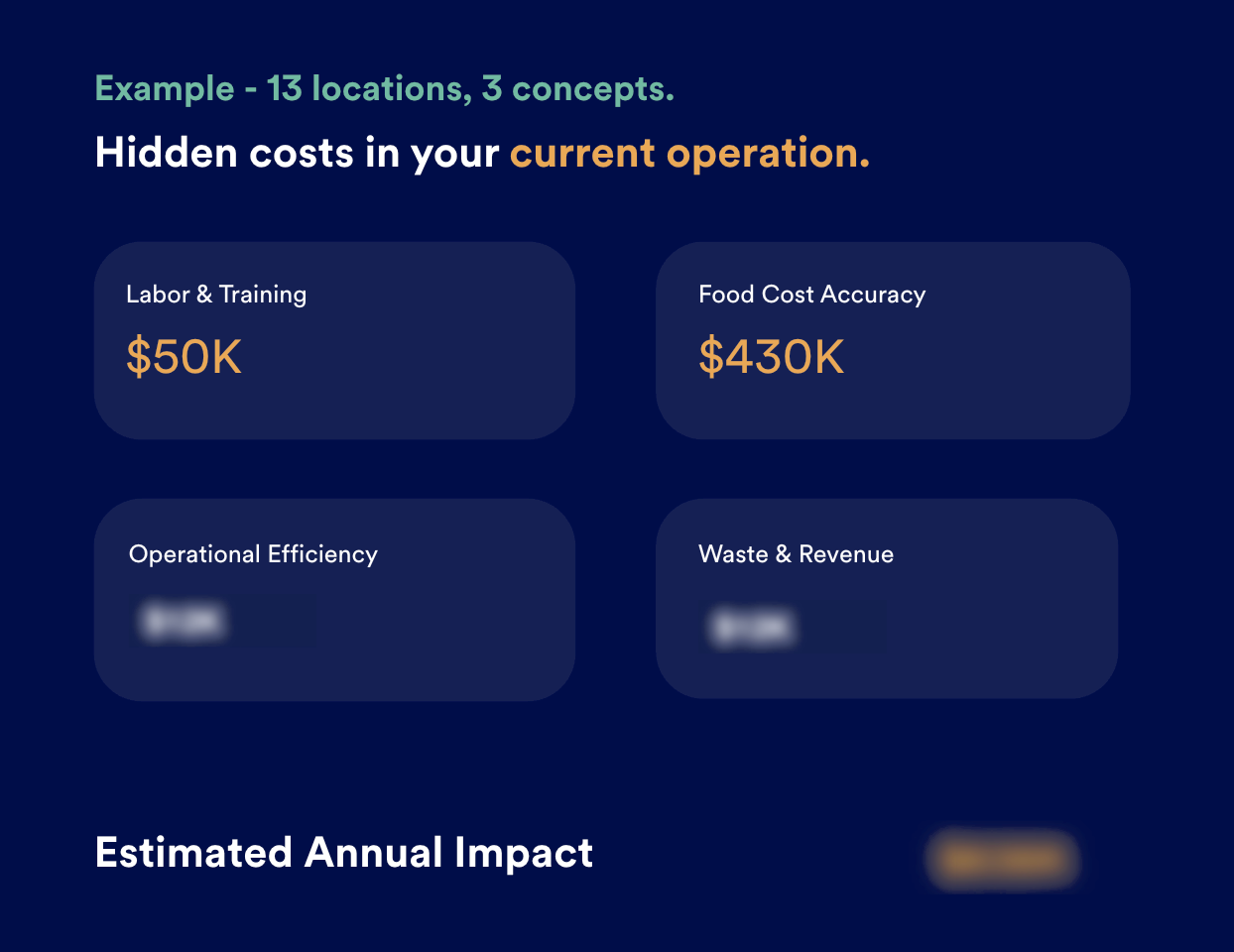
ROI in days, not months.
Most finance leaders see measurable food cost improvement within the first billing cycle. No 6-month project. No IT team required.
AI importer gets your full library in fast. Every recipe costed against live ingredient data from day one — no manual entry.
Link your invoices and suppliers. Ingredient prices update automatically so your cost data never goes stale between closes.
Recipe cost data flows directly into your finance systems. Reconciliation faster. Reporting reflects what the kitchen actually produces.
Use menu engineering to find margin opportunities. Build confidence in the numbers before the board meeting — not while you're in it.
FAQ
R365 is excellent for back-office accounting. But it doesn't solve the recipe data problem at its source, which is the kitchen. meez is the culinary layer that feeds accurate, chef-maintained recipe data into R365. Without it, R365 works from stale or incomplete inputs and your reports reflect that gap.
We'll build the model with your actual numbers in the demo. Then run a pilot and compare actual vs. theoretical variance before and after. At $10M revenue, a 2-point improvement is $200K annually. The ROI is verifiable, not theoretical — and measurable within the first billing cycle.
This is the right question. meez is built for chefs first — the UX is clean enough that kitchen teams adopt it without mandates. Because they actually use it, the data stays current. Kitchen adoption is the product, not an afterthought. That's what makes your R365 accurate downstream.
Most groups are live in 3 days. The AI importer handles recipe migration. No IT project, no months-long onboarding. Start with a one-location pilot to verify integration and confirm ROI — then roll out group-wide when you're ready.
Results that speak
for themselves.

“meez has saved our chefs hundreds of hours they used to spend trying to food cost manually, freeing them up to focus on running their kitchens. By centralizing the food costing process, we’ve made everything much more efficient and have seen a 4-5% reduction in menu costs across each venue.”

“meez is very to the point. I put my recipes in, it automatically calculates everything. I drop in invoice costs, it estimates my COGS, and it runs nutrition. Those are the three things I need, scalable recipes, nutrition, and cost, and meez does it all for me. After years of building massive spreadsheets from scratch, it was a breath of fresh air.”

With inflation and rising costs, keeping profits steady across most of our concepts is a big win. And in one concept, we’ve actually lowered menu costs by 2% year-over-year."meez finally got culinary and finance speaking the same language. Now, yield percentages make sense, targets are clear, and the team can execute the vision to hit menu costs.

"Now, we are able to see theoreticals in a more accurate way, specifically with their menu building feature. Our teams are all working off the same document with accurate costs, and are able to make strategic decisions on how to approach menu problems.”

“The ultimate goal is to make something delicious that we can handle to make as a team that’s not too expensive for our guests so that we can continue serving our guests rather than going belly up. meez makes our costing process very precise.”
Your food cost variance has an answer. Let's find it.
Build the ROI model with your actual numbers — not hypotheticals.


meez is the recipe software that helps chefs create, organize, and execute profitable recipes with precision.


