2026 RESTAURANT AI SURVIVAL GUIDE

Why Recipe Data Matters Before You Buy Another AI Tool

Most restaurant groups are evaluating AI tools while their recipe data lives in a Google Doc from 2022. Forecasting, purchasing, cost control — all of it depends on accurate, structured recipe data. If you haven’t fixed that first, you’re paying for intelligence that makes bad decisions faster.
35%
Food costs above
pre-pandemic levels

NRA State of Industry 2026

82%
of operators reported higher food costs in 2025

NRA State of Industry 2026

26%
of operators now
using AI tools

NRA State of Industry 2026

TL;DR

AI won't fix bad restaurant data. It will amplify it. Before investing in AI for forecasting, purchasing, pricing, or operations, restaurant groups need accurate, structured recipe data.

The operators getting real value from AI have already built a single source of truth for recipes, costing, training, and compliance. Recipe data isn't just documentation. It's the foundation of every operational decision your business makes.

The Landscape

AI Is Reshaping Restaurant Operations. But Almost Nobody Is Set Up to Benefit.

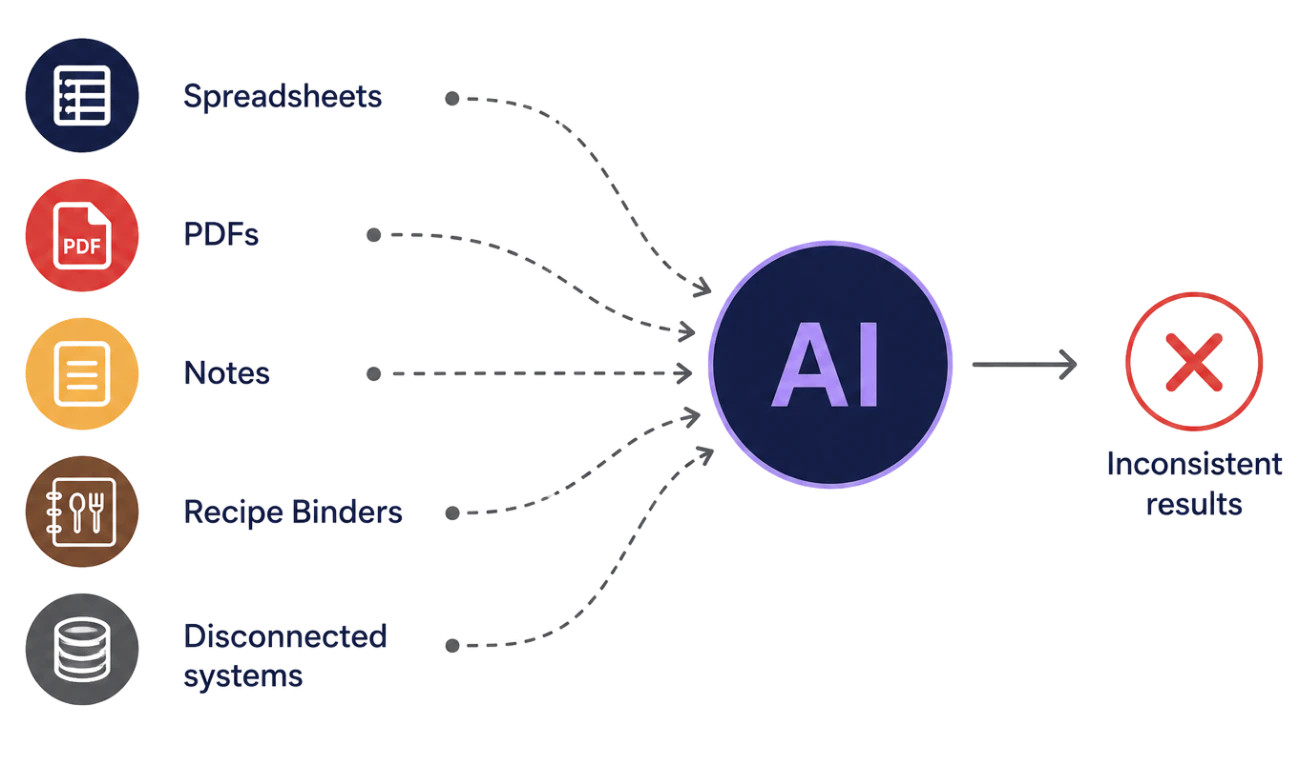
AI doesn’t conjure accuracy from thin air. It amplifies whatever data you feed it. In most restaurant operations, that data is broken at the source. That source is your recipes.

You can’t demand-forecast your way out of inaccurate yield data. You can’t optimize purchasing on recipes that aren’t costed. And when a procurement system pulls from recipe data that hasn’t been updated since your last menu change, it’s generating purchase orders built on fiction.

“AI doesn’t fix bad data. It scales it. A wrong yield figure that was an annoyance in a spreadsheet becomes a systematic error across 30 locations when it’s baked into an AI-driven system.” 
THE DATA

The Operators Winning With AI Already Sorted Their Data

At the 2026 NRA Show, restaurant technology executives issued a pointed warning against AI overdependence, cautioning that the value of any AI tool is constrained by the reliability of data feeding it.

The gap between operators benefiting from AI and those who aren’t is a data gap, not a technology gap according to the 2026 Restaurant Technology Outlook from Informa Foodservice. 

“86% of operators who identified as “data enthusiast” use AI for menu strategy and pricing compared to just 46% of operators. But 25% mention data silos as their biggest tech stack challenge

As Chowly CEO Sterling Douglass noted on The meez Podcast, the shift from systems of record to systems of action only works when the underlying data is structured, live, and connected. AI is only as reliable as the data it’s acting on. Clean recipe data turns automation into an advantage. Without it, AI amplifies mistakes.
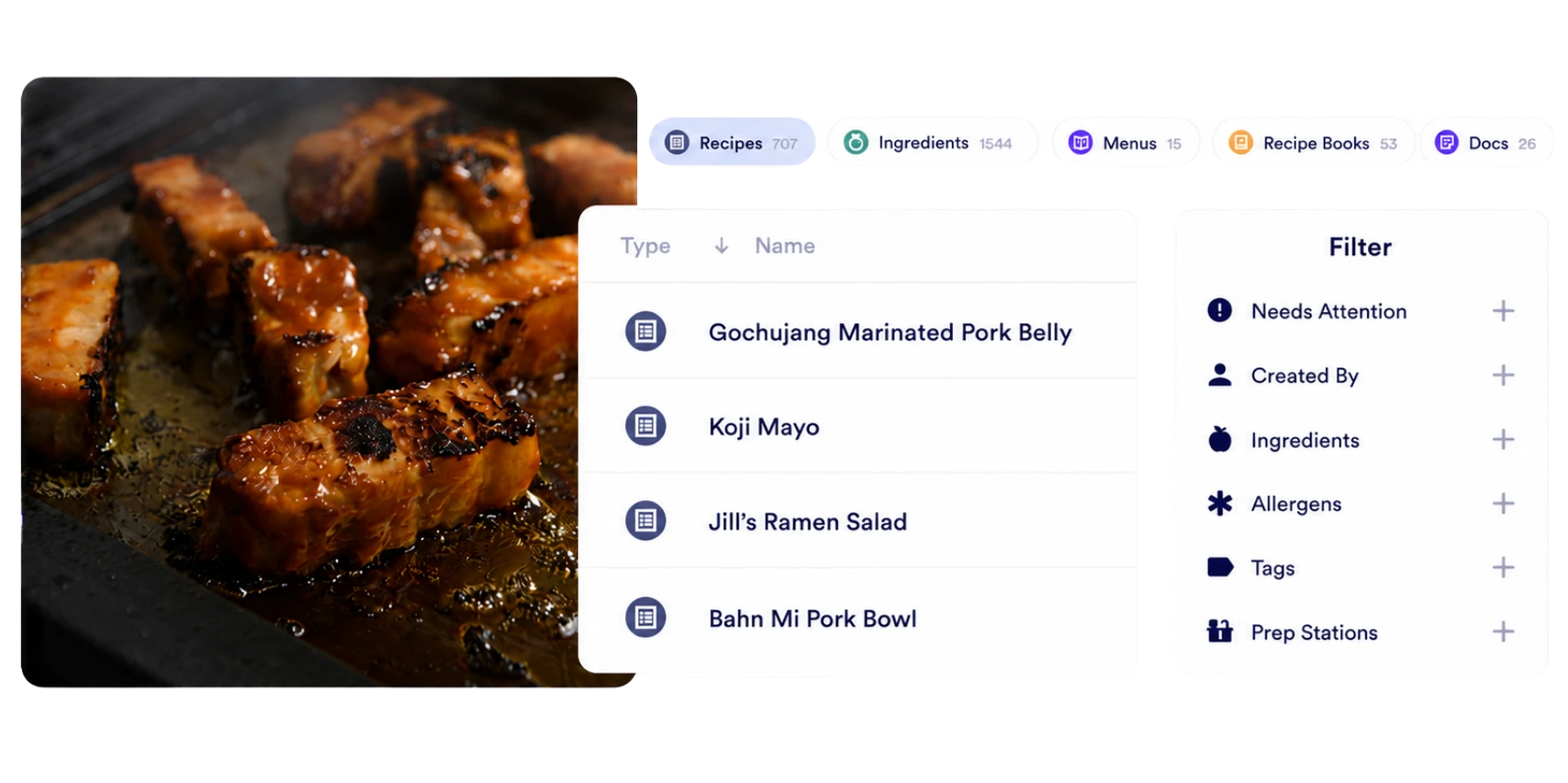
🧱  Recipe Management
The origin point of every downstream number — cost, yield, training, compliance.
📊  Food Costing & Engineering
Live-costed recipes connected to purchasing data mean theoretical food cost matches reality.
🚀  Training & Scaling
Recipe infrastructure cuts time-to-competency and eliminates tribal knowledge bottlenecks.
⚠️  Allergen Compliance
Broken at the ingredient level means broken everywhere — SB-68 enforcement begins July 1.
Deep Dive - part 1 of 4

Recipe Management: The Operating System Hiding in Your Kitchen

“A recipe that exists in 14 slightly different forms across 14 locations isn’t a recipe. It’s a risk and every AI tool you layer on top of it will make that risk harder to see.”

Your recipes are not only cooking instructions. They are the origin point of every operational and financial number that matters: food cost percentage, prep yield, portion size, invoice reconciliation, menu pricing, training standards, and allergen disclosures.

When those recipes live in Google Docs, spiral binders, a chef’s memory, or a spreadsheet last updated in 2022, none of the downstream numbers can be trusted no matter how sophisticated the AI layer you put on top.

What “AI-ready recipe data” actually means

  • Stored in a consistent, structured format with defined units of measure
  • Prep yields baked in. Not estimated, not ignored
  • Scaling logic that works at any batch size
  • Version-controlled. Every location on the same version, updated in real time
  • Costed and connected to live ingredient pricing
  • Integrated with ERP, inventory, and purchasing tools

3000+
Built-in yields & conversions in meez
1 source
of truth, version-controlled across all locations
Instant
Recipe edits deployed to all locations
IF YOU'RE CULINARY DIRECTOR / CORPORATE CHEF
The question isn’t whether your team “has recipes.” It’s whether those recipes can be actioned by your ERP, training program, purchasing system, and compliance disclosures — simultaneously, accurately, in real time.
Deep Dive - part 2 of 4
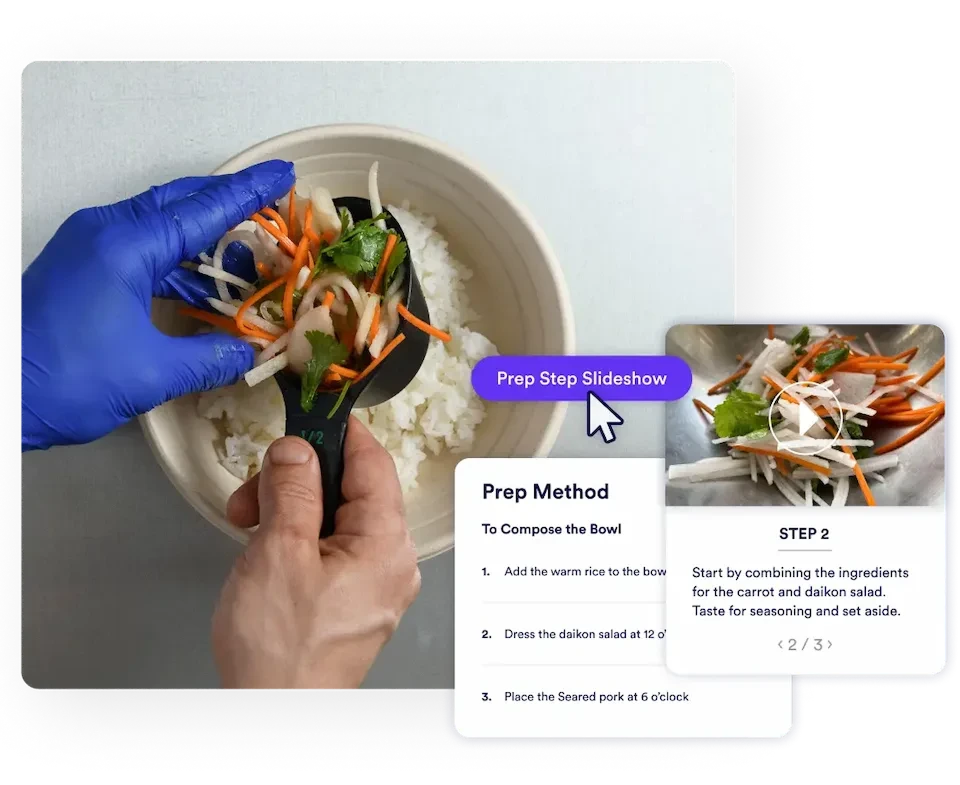
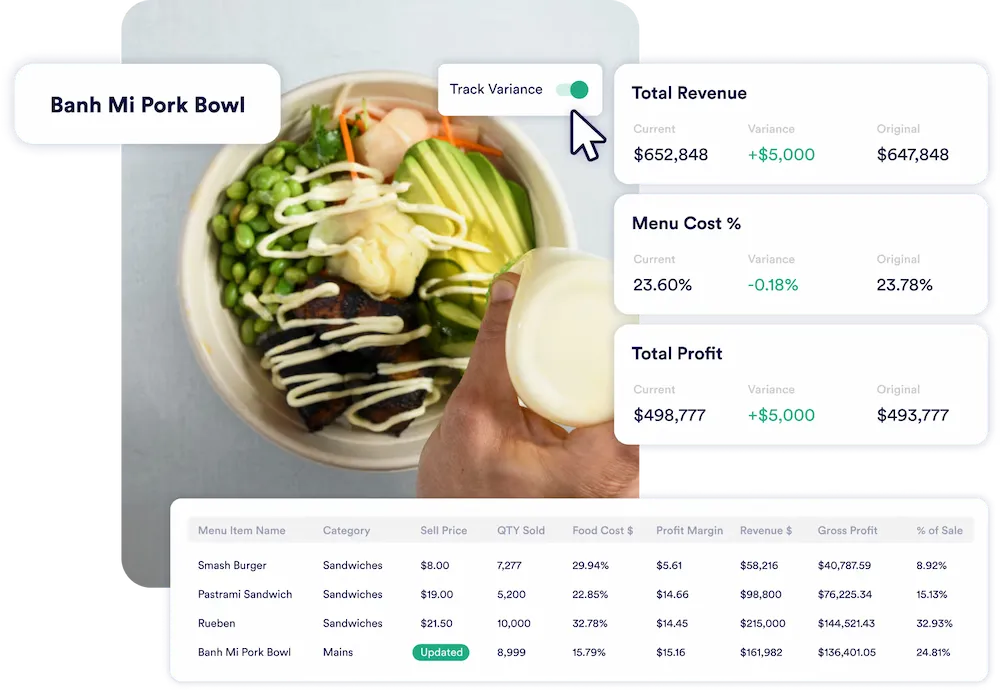
Banh Mi Pork Bowl with sauce being poured, revenue and profit data, and a menu sales table.

Food Costing & Menu Engineering: The Quiet Math That’s Eating Your Margin

“Little flexibility remains after several years of elevated pricing. The only lever left is operational precision.”

Food costs are 35% above pre-pandemic levels. And with consumer price sensitivity at a peak, most groups have exhausted the menu-price lever. Little flexibility remains. The only lever left is operational precision, and that starts with knowing your real food cost before service begins.

Food cost creep is dangerous, and a silent killer. For a restaurant doing $24 million in annual revenue, a 2-point creep from 30% to 32% is $480,000 in lost margin per year. Vanished. Silently. Oftentimes, simply because nobody updated the recipe costs while the ingredient costs changed MoM.

What accurate food cost data actually requires

  • Every recipe costed at the ingredient level. Not estimated, not averaged.
  • Fully costed sub-recipes that roll up into parent recipes automatically
  • Prep yields built in: butchery loss, trim waste, cooking shrink accounted for
  • Ingredient prices update automatically when your actual costs change
  • Consistent units of measure across every recipe and every location
  • Menu changes that trigger a cost model update, not just a recipe update

4%
Reduction in annual COGS
75%
Less time spent costing ingredients
IF YOU'RE CFO / VP FINANCE / CONTROLLER
Your theoretical food cost is only as accurate as the recipe data feeding it. meez gives tools like R365 accurate yields, conversions, prep loss, and scaling logic, so AvT analysis, purchasing, and P&L review are built on a real foundation.
Deep Dive - part 3 of 4

Training & Scaling: Why Your Best Recipes Never Make It to Location 12

“City Barbeque was able to open two restaurants on the same day for the first time. This was possible by having all recipes readily accessible and standardized for new team onboarding in meez.

The most underrated growth bottleneck in multi-unit restaurant operations isn’t real estate, hiring, or supply chain. It’s knowledge transfer. Can you get new teams trained fast enough? Can you guarantee the food is identical on day one at every new location?

Most restaurant training is a fire hose. Day one, eight hours of content. Neuroscience research shows people retain roughly three pieces of information per 90 minutes. Teams revert to old workflows within 60 days when the vendor moves on. 

The operators who’ve solved this treat recipe standardization as infrastructure, not documentation.

What recipe-as-infrastructure looks like in practice

  • Version-controlled recipe hub. One source of truth
  • Recipe media (photos, video) accessible at every station
  • Instant deployment of menu changes across all locations
  • Multilingual access for bilingual kitchen teams
  • BOH/FOH role-specific recipe access controls

70%
Reduction in
training time
30%
Less waste with
proper prep & training
Same day
Multi-location
opens now possible
IF YOU'RE DIRECTOR OF OPS / COO
You can’t be in every kitchen. Your systems have to be. Recipe knowledge available at the exact moment and place it’s needed is what makes AI-assisted training tools actually deliver.
Deep Dive - part 4 of 4

Nutrition & Allergen Compliance: The Data Chain That Breaks Without Warning

COMPLIANCE CLOCK
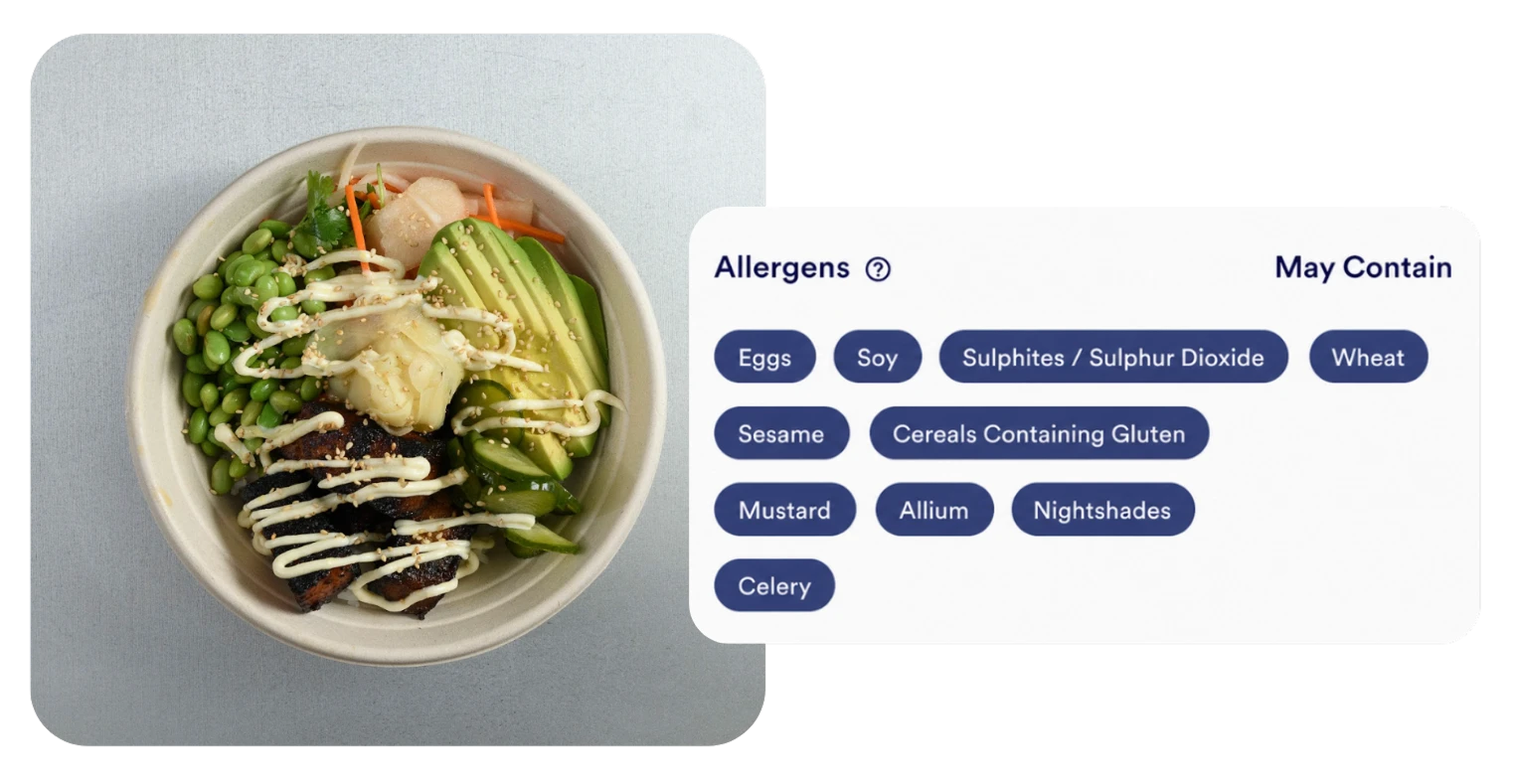
SB-68 enforcement begins July 1, 2026. California’s ADDE Act requires chains with 20+ locations to disclose the Top 9 allergens on every menu item. If you haven’t closed the data loop between ingredient records and guest-facing menus, you are exposed.

Your supplier reformulated the salad dressing used on several menu items. The product name, packaging, price, and ordering code all stayed the same. What changed? The new recipe now contains egg.

By Tuesday morning, guests are asking whether a salad is egg-free. Your menu, website, ordering app, and third-party delivery listings still show the old allergen information.

Allergen compliance is a data chain, not a menu problem. It starts with your ingredients, flows through your recipes, and reaches the guest as a disclosure. Every link has to stay current.

THE SCALE PROBLEM
15 locations × 3 ordering channels = 45 menu surfaces. One unnoticed ingredient swap = 45 incorrect allergen disclosures simultaneously.

What a real allergen compliance system needs

  • Allergen data at the ingredient level, not the dish level
  • Auto-propagation: when an ingredient changes, every recipe updates
  • Recipe-to-menu traceability with disclosures derived from the recipe
  • Full allergen audit trail: what changed, when, and why
  • Supplier change integration with ingredient swaps trigger recipe review
10%
of Americans have
a food allergy
~25%
Less waste with proper
prep & training
July 1
SB-68 enforcement
begins
IF YOU'RE OWNER / CEO / FOUNDER
SB-68 compliance is the floor; winning allergen guests’ loyalty is the ceiling. Both require the same thing: ingredient-level recipe data that stays current automatically.
THE MEEZ LAYER

Recipe Data That Flows Into Every System You Rely On

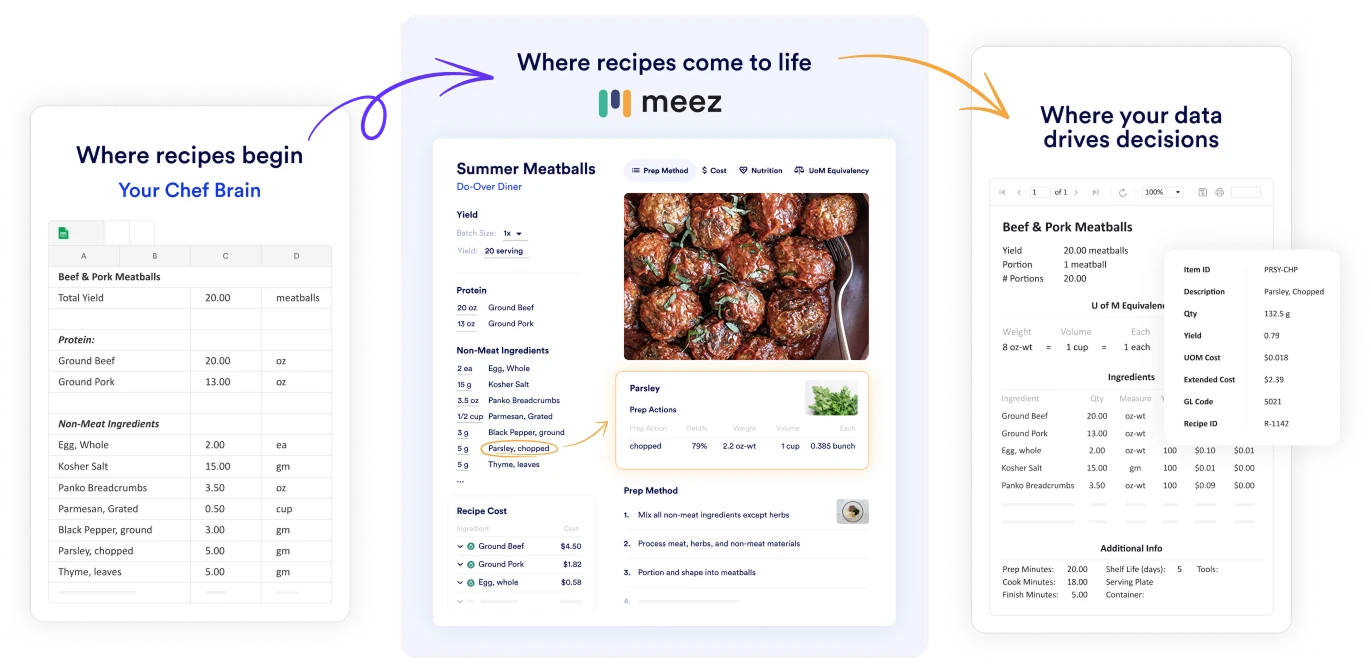
meez is the culinary operating system for multi-unit restaurant groups. It’s a single source of truth for every recipe, costed, version-controlled, and connected to the systems that run your business.

Chefs get a tool built for the way they actually work. Bulk AI import, auto-calculated yields, mobile access at every station.

Finance and ops get data they can trust. Prep yields, unit conversions, and scaling logic flow automatically into tools like R365 and downstream systems.

Most customers are live with costed recipes in weeks — not a 4–6 month implementation.

40–60 hrs
Accounting labor
avoided implementation
2–3 wks
Average go-live timeline
(vs. 4–6 months standard)

Your recipes are your data. Get this right and your margins will follow.

meez is the recipe operating system built for multi-unit restaurant groups. See how it works in 30 minutes.
Book a demo