Every chef has a version of this story. A notebook filled with recipes, techniques, and hard-won knowledge collected over years of early mornings, late nights, and hours spent honing a craft.
For Josh Sharkey, the founder of meez, that notebook was more than a collection of ideas. It was his culinary identity.
While working at Tabla in NYC, Josh spent his mornings making charcuterie under Chef Marco Canora—soaking up technique, building knowledge, filling pages. He kept everything in a little black book: pâtés, terrines, detailed prep notes, and ideas he never wanted to forget.
Then, one day while staging at Veritas on his day off, he lost it.
At the time, more than 20 years ago, there was no Evernote, no Google Sheets, no recipe app to fall back on. That loss stung. But it also planted a seed. What if there was a better way to capture, organize, and protect the work that chefs pour themselves into?
That question never left him. And over the years, as Josh worked in, managed, and eventually owned restaurants, the question got bigger. Chefs didn't just need a place to store recipes. They needed a system—one built for how kitchens actually function.
Why recipe deserve better
For years, most recipe tools treated recipes as a means to an end—a way to calculate food costs and populate inventory systems. But any chef knows a recipe is far more than a line item.
- Recipes are intellectual property—they represent a chef's creativity, experience, and craft.
- They are the operational foundation of a kitchen, not just a financial input.
- Costing is one important output of a recipe. But it's not what a recipe is for.
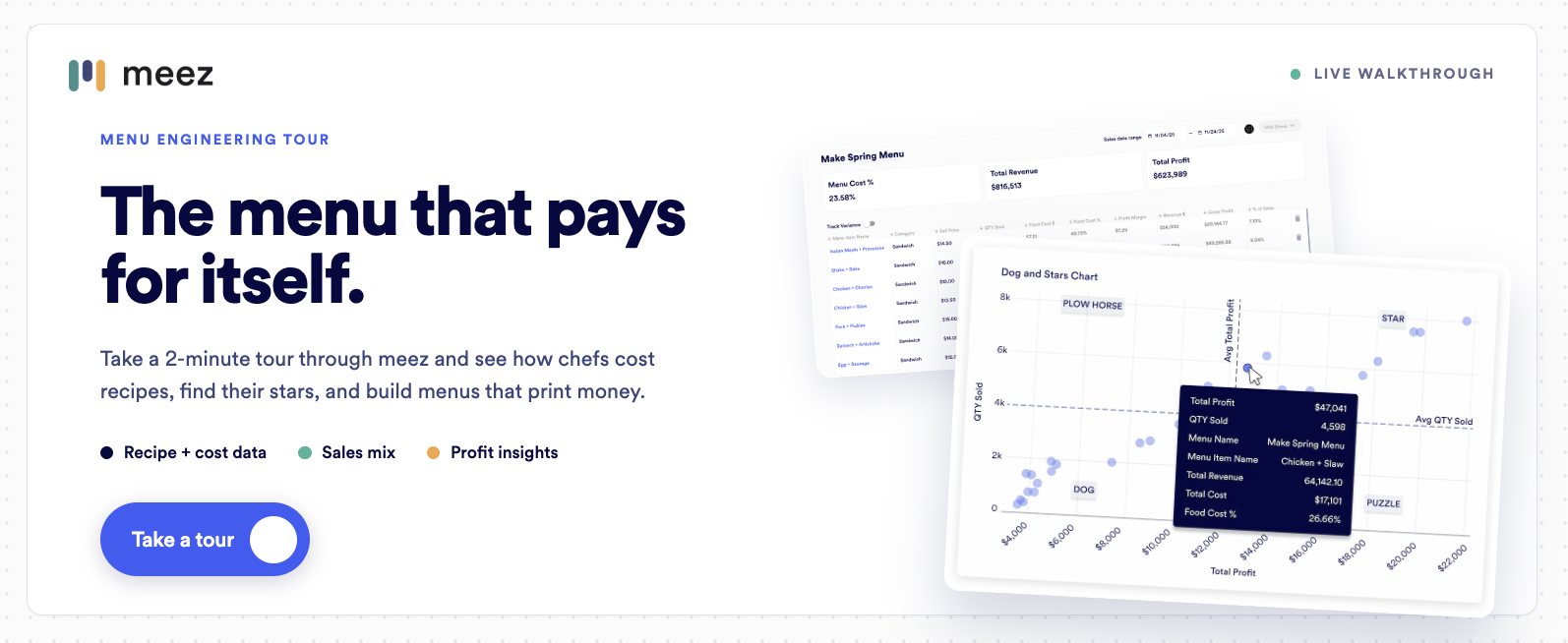
meez flips this outdated approach on its head. Instead of forcing chefs to work within the constraints of inventory platforms, meez was designed for how kitchens actually function. It prioritizes recipe accuracy, collaboration, and adaptability while seamlessly integrating costing, scaling, and unit conversions.
“The problem is that we’ve been looking at recipe tools the wrong way. Instead of starting with finance and adding recipes as an afterthought, we need to start with recipes and build everything else around them. That’s what meez is all about.”
Just like designers have Figma and architects have AutoCAD, chefs now have a purpose-built tool for their craft—not just for the finance team.
Building something that didn't exist yet
Turning a culinary career into a software company is not a straight line. For Josh, building meez was a process of iteration, learning, and finding the right people.
The first version was a solo effort. Josh and one engineer, outlining a vision for recipe management. It was slow, and the result didn't quite land. The second attempt brought in a full software team, but the platform still wasn't solving the right problems for kitchens.
The turning point came when Josh brought on MaryLee Rosenwald as CTO. She scrapped everything and rebuilt the system from the ground up, creating the foundation meez stands on today.
With each version, the team got closer to understanding what kitchens actually need. One of the biggest insights: chefs shouldn't have to manually input basic ingredient data—yields, conversions, prep losses—when every kitchen in the world was already figuring out the same things on their own.
“At the time, every single kitchen was doing that themselves. Everyone was reinventing the wheel in their spreadsheets.”
Data Driven Precision
Rather than relying on outdated reference books or scattered online sources, the meez team built something different: a database grounded in real-world kitchen data.
By testing ingredients across hundreds of kitchens, measuring everything from garlic yield loss after peeling to weight changes when mincing, meez built a robust, accurate foundation that chefs can actually trust.
The result:
- Consistent ingredient data across all recipes and platforms
- Accurate yield and conversion information, so chefs don't have to do the math themselves
- A smarter system that gets more reliable over time, built from real kitchen experience
Cracking the Code on Recipe Formatting
One of the hardest problems meez set out to solve: getting recipes into the platform quickly, accurately, and without making chefs reformat everything.
“When you write a recipe, it’s kind of the Wild West. There’s no standard format. Sometimes the quantity comes first, sometimes the unit, sometimes the ingredient. Sometimes it’s all over the place, and your instructions might be mixed in.”
To solve this, meez built a language model capable of parsing recipes in any format. The system had to recognize ingredients, units, quantities, and actions—no matter how they were written. Thousands of different recipe formats were fed into the system to train it, ensuring it could handle real-world variations.
The Complexities of Culinary Math
But text formatting wasn’t the only challenge. There were also inconsistent spellings and unit conversions to account for. Take "gram," for example—it could be written as "grm," "gram," "gm," or even "grrm" if misspelled. meez continuously updates its database so the system learns from every new entry.
Beyond text recognition, the platform had to make sense of culinary calculations.
- Baker’s percentages – Ingredients like flour and water in bread recipes are based on percentages, requiring meez to handle multiple variations of hydration ratios.
- Unit conversions – From ounces to grams to tablespoons, the system had to account for the different ways chefs measure ingredients.
Flexible measurements – When does "one to two tablespoons" become too vague? How should "a pinch" be interpreted? meez built logic to manage these nuances. - Scaling recipes – Originally, the system would automatically scale units up—for example, cups turning into quarts, then gallons. But chefs pushed back, preferring measurements to stay in familiar increments based on kitchen tools like Cambros.
“In the beginning, there were a lot of angry chefs, which I completely understand, because we just sort of picked ways to display things. Because you have to. That’s one of the things with code—you have to tell the computer what you want it to do, and that requires making a decision.”
By refining the system based on real-world feedback, meez turned recipe input and standardization into an intuitive, chef-friendly process—eliminating manual work and making kitchen operations smoother.

Boosts Back-of-House Retention and Staff Engagement
By solving issues like accurate scaling, unit of measurement conversions, and recipe format standardization, staff training becomes seamless with meez. Your team no longer has to decipher vague instructions or struggle with inconsistent measurements.
Instead, they get clear, actionable guidance exactly when they need it.
“One measure of success should be whether the team feels more empowered and set up for success. If you give them goals or tasks but not the right tools or resources, they won’t succeed, and that’s the fastest way to create unhappy team members.”
How meez Supports Kitchen Teams:
- Empower Staff for Success: meez ensures that kitchen teams have the right tools and resources to execute their tasks effectively. When employees feel supported, they are more engaged and satisfied in their roles.
- Designed for Daily Use: Teams that use meez rely on it every day. A tool that becomes an essential part of the workflow helps create consistency, reduces frustration, and improves overall efficiency.
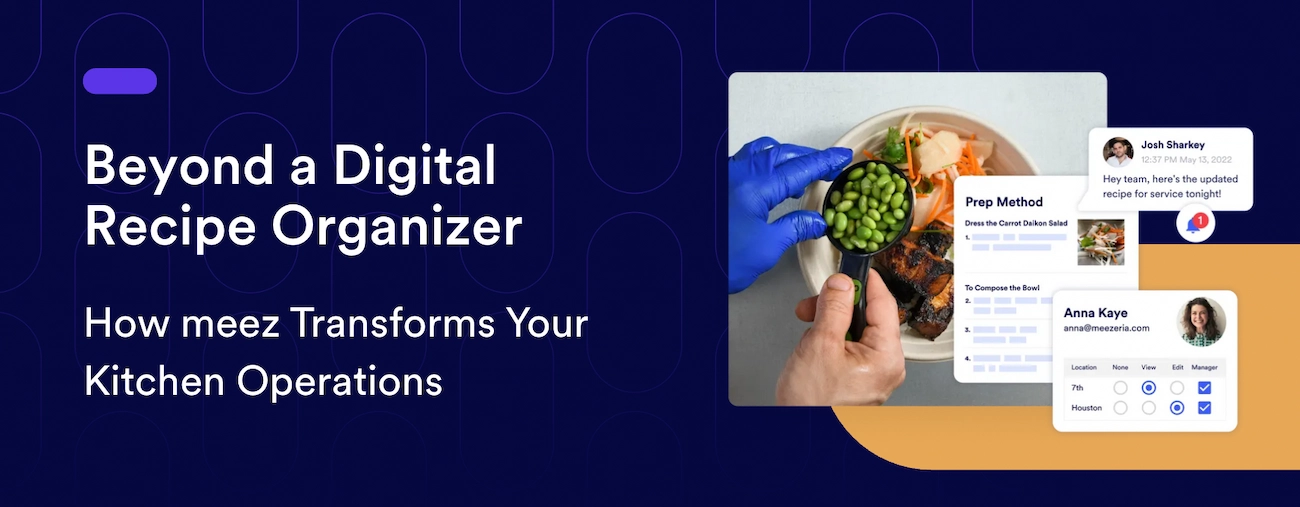
- Eliminates Miscommunication: With real-time updates, built-in instructional videos, and clear recipe documentation, meez keeps everyone on the same page, reducing errors and streamlining kitchen operations.
- Provides Just-in-Time Training: Instead of lengthy training sessions, meez allows chefs to share quick, focused videos and images that demonstrate specific techniques or
Instead of making staff sit through a 30-minute training video, meez allows chefs to share a quick clip on how to slice a shallot or what a sauce should look like when properly reduced. This ensures consistency and efficiency while respecting the fast-paced nature of restaurant work.
By making daily tasks easier, meez helps restaurant teams feel more confident, engaged, and set up for success—leading to stronger retention and more positive kitchen culture.
A Tool Designed for You, by Chefs Like You
meez exists because the recipe management kitchens needed simply didn't exist. It was built by someone who spent most of his life cooking—and who understood, deeply, what was missing.
Today, it's more than a recipe storage app. It's a recipe operating system that helps chefs organize, scale, cost, train, and collaborate—all from one place, without the mess of scattered spreadsheets or binders full of outdated printouts.
“As someone who has spent most of my life as a chef, there's nothing more rewarding than seeing chefs react to the product with excitement, saying things like, ‘Man, I wish I had this 20 years ago,’ or ‘We can tell this was built by other chefs.’ It's moments like these that reinforce the true value of what we're building.”
meez is for every person in the kitchen who has ever wished the tools they had were actually built for them. That time is now.