Costing Recipes and Dish Costing: The Complete Food Costing and Pricing Guide for Restaurants
Mastering food costing is essential for long-term success in any restaurant. Accurately costing your dishes can make the difference between a kitchen that runs profitably and one that bleeds money while serving full tables. And yet dish costing is something most restaurants do inconsistently, manually, or not at all — which is exactly why so many profitable-looking menus quietly underperform.
This guide covers everything you need to know about costing recipes: the challenges that make it difficult, the step-by-step dish costing process, how food costing and pricing connect, and the strategies and tools that keep costs accurate as ingredient prices change.
What Is Recipe Costing and Why Does It Matter?
Recipe costing — also called dish costing — is the process of calculating the total ingredient cost required to produce one serving of a menu item. It's the foundation of all food costing and pricing decisions: before you can set a menu price that generates profit, you need to know what the dish actually costs to make.
Most restaurants spend approximately 28–35% of gross revenue on food. That's a wide range, and where your operation sits within it depends almost entirely on how well you cost your recipes, how regularly you update those costs, and how consistently your kitchen executes to the standardized portions those costs assume.
When food costs are accurately calculated and monitored, they become a powerful decision-making tool. The cost data tells you which dishes are carrying the menu financially and which are dragging it down — information that no amount of intuition can substitute for.
The Challenges of Food Costing in Practice
Before walking through how to cost recipes correctly, it's worth understanding why so many restaurants struggle to do it accurately. The challenges are real, structural, and compounding.
Market volatility. Ingredient prices shift constantly — driven by seasonality, supply chain disruptions, weather, and demand fluctuations. A dish that's profitable in February may be underwater in September if a key protein or produce item spikes without a corresponding price adjustment.
Vendor variability. Prices differ significantly between suppliers, and the same supplier's pricing changes over time. Staying on top of this requires consistent invoice monitoring and regular supplier comparison — work that most restaurants don't have dedicated time for.
Recipe complexity. Many dishes involve numerous ingredients, sub-recipes, and preparation steps, each with its own cost, yield loss, and unit of measurement. Calculating an accurate plate cost from scratch — especially with prep loss factored in — requires precision that manual methods rarely achieve consistently.
Outdated cost data. Without real-time updates, cost calculations are based on what you paid for an ingredient weeks or months ago. Decisions made on stale data produce inaccurate pricing and eroding margins that are hard to diagnose until a monthly COGS review reveals the damage.
Step-by-Step: How to Cost a Recipe (Dish Costing)
Here is the practical process for costing recipes from raw ingredients to a priced menu item.
Step 1: List Every Ingredient and Exact Quantity Used
Start with a complete, standardized recipe that specifies every ingredient — including small-dollar items like oil, salt, garnishes, and sauces — in precise quantities using weight or volume measurements. Volume or weight is critical; vague quantities like "a handful" or "to taste" can't be costed.
The quantity used should be the quantity in the finished dish, not the quantity purchased. You buy a whole chicken; a dish uses 6 oz of boneless breast. These are different numbers.
Step 2: Establish the As-Purchased (AP) Cost Per Unit for Each Ingredient
For each ingredient, determine the current cost per unit from your supplier invoices. Cost per unit means the price per gram, ounce, pound, liter, or each — whatever unit you use in your recipes.
Calculation example:If you bought 10 lbs of chicken breast for $45.00, the AP cost per pound is $4.50. Per ounce: $4.50 ÷ 16 = $0.28/oz.
Step 3: Apply Yield Percentages to Each Ingredient
This is where most manual recipe costing falls short — and where the greatest inaccuracies live. Most ingredients lose weight during prep: trimming, peeling, butchering, cooking shrinkage. The quantity you purchase is almost never what goes into the dish.
Yield % = (Usable Weight ÷ As-Purchased Weight) × 100
Edible Portion (EP) Cost = AP Cost ÷ Yield %
If chicken breast costs $4.50/lb and yields 85% after trimming:EP Cost = $4.50 ÷ 0.85 = $5.29/lb
That $5.29 — not $4.50 — is the true per-pound cost that belongs in your dish costing calculation.
Produce, proteins, and herbs all have meaningful yield losses. A bunch of fresh mint priced at $10/lb might yield only 55% usable leaves after stems are removed — making the true cost $18.18/lb. Ignoring yield makes every affected ingredient look cheaper than it actually is, and dish costs look lower than they are.
For a complete guide to yield calculations with worked examples, see Yield in a Recipe: What It Means and Why It Changes Your Food Costs and Why Chefs Should Never Assume 100% Ingredient Yield.
Step 4: Calculate the Cost of Each Ingredient in the Recipe
Multiply the quantity used by the EP cost per unit for each ingredient, then sum all ingredient costs for the dish.
Example — Roasted Chicken Plate:
IngredientQty UsedEP Cost/UnitLine CostChicken breast (trimmed)6 oz$0.33/oz$1.98Roasted vegetables4 oz$0.18/oz$0.72Pan sauce (sub-recipe)2 oz$0.22/oz$0.44Herbs and oilestimate—$0.15Total dish cost$3.29
Step 5: Account for Sub-Recipes
Most professional kitchen recipes aren't single-layer builds — they reference sauces, stocks, doughs, and other batch-prepared components. Each of these is a sub-recipe with its own cost that needs to be calculated and expressed as a per-unit cost before it flows into the composed dish.
Example: If your pan sauce costs $22.50 to produce a batch of 3 quarts (96 oz), the cost per ounce is $22.50 ÷ 96 = $0.23/oz. That $0.23/oz is what belongs in your dish costing, not a guess or an approximation.
Sub-recipe architecture makes costing scalable: when a component's ingredient costs change, the sub-recipe updates, and every dish that uses it updates automatically.
Step 6: Add the Q Factor
A category of costs that rarely appears in recipe ingredient lists but always shows up in actual food spending: the Q Factor. This accounts for the small extras that accompany every dish — salt, pepper, oil used in cooking, garnishes, bread and butter for the table, condiments, and waste from overproduction or mis-fires.
In a sit-down restaurant, the Q Factor typically runs 5–10% of the raw plate cost. On a $3.29 plate cost, a 7% Q Factor adds $0.23 — bringing the true dish cost to $3.52. Building this in prevents systematic underestimation across the entire menu.
Step 7: Calculate the Total Dish Cost
Sum all ingredient line costs plus the Q Factor allocation. This is your dish cost — the foundation for all pricing decisions.
Food Costing and Pricing: How to Set Menu Prices from Dish Costs
Once you know what a dish costs, food costing and pricing connects that cost to a selling price that achieves your financial targets.
The Food Cost Percentage Formula
Food Cost % = (Dish Cost ÷ Menu Price) × 100
Working backward from your target food cost percentage:
Menu Price = Dish Cost ÷ Target Food Cost %
If your dish costs $3.52 and you're targeting 30% food cost:$3.52 ÷ 0.30 = $11.73 minimum menu price
Most full-service restaurants target 28–35% food cost. If your target is 28%:$3.52 ÷ 0.28 = $12.57
This gives you an anchor price derived from actual economics. From there, competitive positioning, market rates, and guest price sensitivity shape the final number — but you're deciding with real data rather than guesswork.
Balancing Your Menu Mix
Not every dish needs to hit the same food cost target. Balancing your menu means mixing high-cost items with low-cost items so the overall portfolio achieves your target margin — even if individual dishes vary.
A prime protein like filet mignon may have a 40%+ food cost but generates a high contribution margin in raw dollars. A pasta dish may run 20% food cost and also generates strong margin. Together, they contribute to a menu mix that averages to your target.
Choosing ingredients with stable pricing alongside more volatile items also provides protection against temporary price spikes in any single category. The menu as a whole should be designed to tolerate market fluctuation in its most exposed ingredients.
Portion Control Is Where Pricing Meets Execution
Accurate dish costing assumes standardized portions. If a recipe calls for 6 oz of protein and a cook plates 8 oz, the dish cost increases by 33% — and food cost percentage blows past target without anyone realizing it.
Portion control practices that protect your pricing:
- Train kitchen staff to measure or weigh expensive ingredients during prep
- Pre-portion proteins and high-cost components before service
- Post portion specs at stations where deviations are most likely
- Periodically test dishes that come from the kitchen to verify portion accuracy
Costing recipes correctly while allowing portions to drift is one of the most common ways restaurants end up with accurate recipe cards and inaccurate actual food costs.
Food Costing and Pricing for Catering and Special Events
Dish costing for catering and special events requires additional consideration beyond standard menu pricing. The same food cost formulas apply, but several additional expense categories need to be incorporated:
- Labor outside normal hours: Prep, transport, service, and breakdown
- Delivery and logistics: Distance, fuel, vehicle costs
- Disposables and supplies: Serving equipment, chafing dishes, linens
- Off-site refrigeration or holding: Equipment rental or van cooling costs
- Service staff: If servers accompany the catering order
For catering, the pricing model is also different. Common structures include:
Fixed pricing — set prices per item or platter, regardless of guest count
Tiered pricing — per-person cost that decreases as guest count increases, reflecting fixed cost distribution across more people
Custom pricing — built from scratch for complex events where conditions, menus, and services vary significantly
A general rule: mark up every expense rather than simply passing along costs. Something always goes wrong, quantities always shift, and the complexity of off-site service consistently introduces costs that weren't anticipated. Each event should generate a clear margin after all costs — time, labor, food, and logistics — are accounted for.
The Key to Accurate Costing: Standardized, Recipe-Linked Data
To overcome the challenges of market volatility, vendor variability, and recipe complexity, integrating recipe management directly into your food costing process is essential.
Recipes contain detailed information about each dish's ingredients, quantities, preparation steps, and cooking times. When this data is accurate, standardized, and connected to live ingredient pricing, food costing becomes a dynamic system rather than a periodic manual exercise.
Recipe data allows you to track how changes in ingredient costs impact your overall food cost percentage in real time — so a price spike in a key protein surfaces immediately as a cost alert on every dish that uses it, not as a surprise at month-end. It also enables scaling: if a recipe uses 6 oz of chicken and you need to scale to 24 portions, every ingredient scales proportionally without manual recalculation.
By centralizing all recipe and menu information in a single accessible source, both back-of-house and back-office staff can share accurate data, unlocking COGS savings and margin improvements that are hard to achieve when costing lives in disconnected spreadsheets.
Restaurants that successfully implement recipe-linked food costing consistently see:
- A 3–5% reduction in food costs
- $40,000+ average reduction in annual COGS
- $10,000+ average increase in menu item revenue
Theoretical vs. Actual Food Cost: The Gap That Reveals Kitchen Performance
Your theoretical food cost is what dish costing says you should spend — calculated from standardized recipes and current ingredient prices. Your actual food cost is what COGS says you actually spent.
The gap between the two is one of the most diagnostic numbers in restaurant operations. When actual consistently exceeds theoretical, it signals problems:
- Over-portioning: Cooks serving more than the standardized portion
- Waste and spoilage: Inventory expiring before use
- Theft: Shrinkage from staff or guests
- Recipe inconsistency: Dishes prepared differently than written
- Yield assumptions: Recipes costed at theoretical yield but actual prep loss is higher
Tracking this gap monthly — and investigating when it exceeds 1–2 percentage points — is one of the highest-value habits an operator can build. For more on the most common reasons actual food cost runs above theoretical, see Why Your Food Costs May Not Be Accurate.
Strategies for Maintaining Accurate Recipe Costs Over Time
Standardize and Digitize Recipe Costing
Standardized recipes with exact quantities, defined units, and documented procedures are the prerequisite for any costing system. Without them, dish costs are recalculated differently by different people and drift over time. Digital systems enforce standardization and calculate automatically — eliminating the rounding errors and omissions that accumulate in manual processes.
When a recipe is standardized and digitized, costing is instantaneous. Change an ingredient quantity or portion size and the cost recalculates in real time. Change a supplier price and every dish that uses that ingredient updates automatically.
Implement Dynamic Costing Models
Static costing models assume fixed prices and produce accurate costs only at the moment the calculation was run. Dynamic costing models update in real time as supplier prices change — meaning your dish costs reflect today's ingredient prices, not last month's.
This is especially important for volatile categories: fresh seafood, seasonal produce, and proteins that respond quickly to market conditions. A dynamic system flags when a dish is trending toward unprofitability so you can adjust portion size, substitute an ingredient, or update the menu price before the margin damage compounds.
Integrate Invoice Processing
Automating invoice processing eliminates the primary source of pricing lag in most restaurant costing systems. When supplier invoices are scanned and line items are matched to ingredients automatically, cost data updates in real time — without anyone manually entering a price or remembering to update a spreadsheet.
Automated invoice processing also captures pricing discrepancies between what was ordered and what was invoiced, supplier price changes, and patterns in spending that inform smarter purchasing decisions.
For more on how to approach recipe costing from first principles, see Recipe Costing Best Practices and A Chef's Guide to Accurate Recipe Costing.
How meez Simplifies Costing Recipes and Dish Costing
meez is designed to simplify and enhance food costing for restaurants, connecting recipe management directly to cost data so dish costs stay accurate as ingredient prices change.
Comprehensive Ingredient Database: meez's 2,500+ system ingredients come with yield, prep loss, and unit-of-measure equivalencies built in — so dish costing automatically accounts for the prep loss factors that most manual calculations miss. You don't need to know that fresh mint yields 55% after picking; meez already does.
Dynamic Market Price Tracking: Connect invoices to ingredient records in meez and costs update in real time. Every dish that uses an affected ingredient reflects the new price automatically — giving you an accurate theoretical food cost at any given moment, not just when someone remembers to update the spreadsheet.
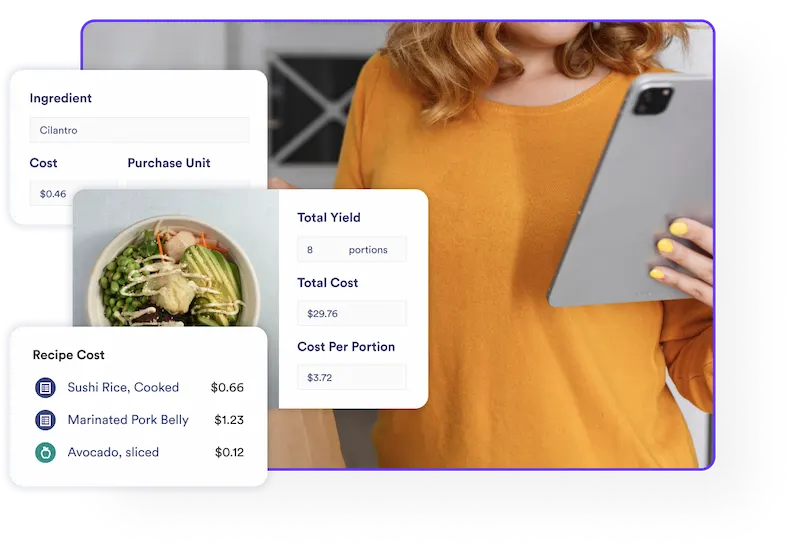
Food Cost Calculator: Automatically generate portion cost, food cost percentage, and profit per recipe. Input your target food cost percentage, desired sell price, or target margin and meez calculates the rest — including how changes in portion size or ingredient substitutions affect profitability before they go live.
Sub-Recipe Architecture: Build batch components as their own recipes in meez, cost them to a per-unit cost, and reference them in composed dishes. When a sub-recipe's ingredient prices change, every dish built on it updates automatically.
For more on meez's menu engineering tools and how dish costing connects to menu performance, see Menu Engineering: The Complete Guide to a More Profitable Restaurant Menu.
Frequently Asked Questions About Costing Recipes and Dish Costing
What is dish costing in a restaurant?
Dish costing (also called recipe costing) is the process of calculating the total ingredient cost required to produce one serving of a menu item. It accounts for every ingredient in the exact quantity used, adjusted for yield loss, plus sub-recipes and small-cost extras (the Q Factor). The resulting dish cost is the foundation for all food costing and pricing decisions.
How do you calculate the cost of a recipe?
List every ingredient with its exact quantity as used in the recipe. Apply the yield percentage to each ingredient to get the edible portion (EP) cost per unit. Multiply quantity used by EP cost per unit for each ingredient. Sum all ingredient costs and add an allowance for the Q Factor (5–10% of raw plate cost). The total is your dish cost per serving.
What is a good food cost percentage for a restaurant?
Most full-service restaurants target 28–35% food cost. Fine dining may run 25–32%, fast-casual 28–32%, and catering operations 25–30%. The right target depends on your concept, overhead structure, and menu mix. More important than hitting a specific percentage is tracking your actual food cost consistently against your theoretical cost and investigating when the gap widens.
How does yield affect recipe costing?
Yield percentage is the proportion of an ingredient that's usable after prep — peeling, trimming, butchering, or cooking. If you cost a recipe using the as-purchased (AP) price without adjusting for yield, every affected ingredient appears less expensive than it actually is. Accurate dish costing uses the edible portion (EP) cost: EP Cost = AP Cost ÷ Yield %. The difference can be significant — a protein with 70% yield at $10/lb has a true EP cost of $14.29/lb.
How often should recipe costs be updated?
At minimum, whenever a significant ingredient price changes. In practice, this means monitoring invoices actively — especially for high-cost, volatile ingredients like proteins, seafood, and fresh produce. Dynamic costing systems like meez update dish costs automatically when invoice prices change, eliminating the latency that makes manual systems unreliable.
How is dish costing different for catering vs. regular menu items?
The ingredient costing formula is the same, but catering pricing needs to account for additional expense categories that don't apply to in-restaurant service: labor outside normal hours, delivery and logistics, disposables, off-site equipment, and service staff. Catering prices should be built from a true all-in cost and marked up to generate a clear margin — not priced as a simple food cost percentage the way regular menu items are.
What is the Q Factor in food costing?
The Q Factor accounts for the small-cost extras that accompany a dish but don't appear in the standardized recipe: cooking oil, salt and pepper, garnishes, condiments, bread and butter for the table, and overproduction waste. In sit-down restaurants, the Q Factor typically runs 5–10% of the raw plate cost. Including it prevents systematic underestimation of true dish cost — which is one of the most common reasons menu prices don't generate the margins they should.
Ready to cost every recipe in your kitchen accurately, with costs that update automatically as ingredient prices change? Get a demo of meez or take an interactive tour to see dish costing in action. Full product tour here.