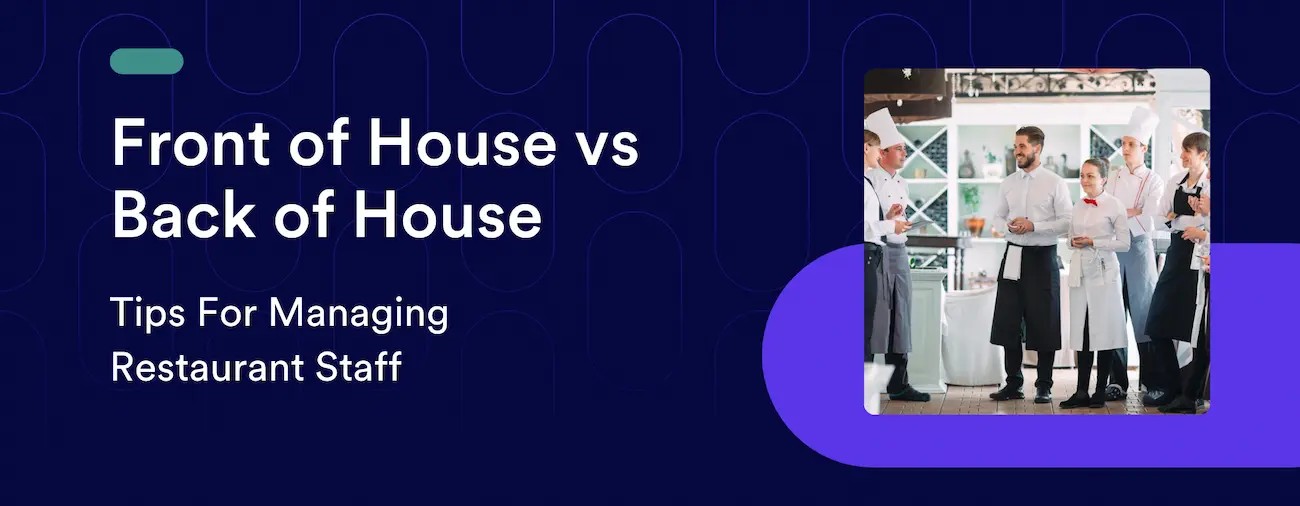
For any restaurant, the dynamic between Front of House (FOH) and Back of House (BOH) teams is what determines whether the guest experience holds together or falls apart. Each team has a distinct set of roles and a fundamentally different working environment — yet their ability to work in sync is what elevates an ordinary meal into something worth returning for.
This guide covers everything operators need to know: what FOH staff are and what they do, how the restaurant back of house runs, how team communications in restaurants can be dramatically improved, and the strategies that turn two parallel teams into one cohesive operation.
What is FOH? What does FOH stand for?
FOH stands for Front of House — the customer-facing side of a restaurant operation, including the dining room, the bar, the host stand, and every staff member who interacts with guests.
BOH stands for Back of House — the kitchen and all food preparation, cooking, and operational areas guests never see.
Together, FOH and BOH are the two halves of every restaurant. FOH delivers the guest experience; BOH produces the food. The two teams are equally essential and completely interdependent — but they require different management approaches, different communication styles, and different tools to run well.
What is FOH in a restaurant?
FOH stands for Front of House — the customer-facing side of a restaurant operation. It encompasses every space, every interaction, and every staff member that a guest encounters from the moment they walk in to the moment they leave. The dining room, the bar, the host stand, the waiting area — this is FOH territory.
The core objective of FOH operations is to deliver a guest experience that earns repeat visits, positive reviews, and genuine word-of-mouth. When FOH staff are well-trained, well-coordinated, and genuinely engaged, the result is a dining room that feels effortless from the guest's perspective — even when service is moving at full speed behind the scenes.
FOH is distinct from the restaurant back of house (BOH), which covers food preparation, cooking, and all the kitchen operations that guests never directly see. The two sides of a restaurant are equally essential and completely interdependent — but they require different management approaches, different communication styles, and different tools to run well.
FOH vs BOH at a glance
Here is how the two sides of a restaurant compare side by side:
FOH Staff Roles and Responsibilities
Understanding each role in the front of house is foundational to managing it effectively. Here's a breakdown of the key FOH positions and their direct impact on the guest experience.
Here are the core FOH roles in a typical restaurant operation:
Host/Hostess
The host or hostess is often the first and last person a guest interacts with. They manage the waitlist, coordinate reservations, greet arriving guests, and handle seating. A strong host keeps the dining room flowing efficiently — reducing perceived wait times, managing table turns, and setting the tone before a single word is spoken about food.
Servers
Servers are the primary liaison between guests and the kitchen. They take orders, communicate special requests, pace service, handle complaints at the table level, and are the most direct driver of average check through upselling. Their product knowledge, attentiveness, and ability to read a table all translate directly into revenue and guest satisfaction.
Bartenders
Bartenders serve drinks, manage the bar as its own service station, and often handle some of the most sustained guest interaction in the building. A skilled bartender builds guest loyalty, sells high-margin beverages, and creates an energy in the bar area that guests feel from the dining room.
Food Runners
Food runners carry finished dishes from the kitchen pass to the table, ensuring food arrives hot, plated correctly, and to the right guest. They're a critical connector between BOH and FOH — any breakdown in this handoff is immediately visible to guests.
Bussers
Bussers clear and reset tables, maintain dining room cleanliness, and support servers during service. Their efficiency directly affects table turn rate. In high-volume restaurants, a strong bussing operation is often what separates acceptable service from excellent service.
FOH Manager
The FOH manager oversees all front-of-house operations — scheduling, staff performance, complaint resolution, and day-to-day service flow. Unlike servers or hosts who manage individual interactions, the FOH manager manages the entire room simultaneously, making real-time adjustments to keep service running smoothly. This role is a key multiplier: a strong FOH manager can elevate every person on the floor through clear communication, visible leadership, and tactical decision-making during service.
The FOH guest journey: what great service actually looks like
Understanding how a guest moves through a service — and where the moments of impact are — helps managers train FOH staff with purpose rather than just process.
Entry and greeting. First impressions are set in the first 30 seconds. Hosts should acknowledge arriving guests immediately, even when they're occupied. A warm, personalized greeting and efficient seating or waitlist management establish the emotional tone for the entire meal.
Order and drink service. Servers need to be confident, knowledgeable, and efficient — and in that order. Menu knowledge enables genuine recommendations rather than scripted suggestions. Prompt drink and water service signals attentiveness. This is also when skillful upselling happens naturally: not as a sales tactic, but as a server helping a guest find something they'll enjoy.
Food delivery. Runners need to confirm they're serving the right dishes to the right guests. Bussers need to clear at the right moment — not too early, not late enough to clutter the table. The transition from order to food arrival is where most dining room friction occurs, and FOH staff who handle this window smoothly make the whole experience feel cohesive.
Handling complaints. Complaints handled well can create stronger loyalty than a flawless experience. FOH staff should be trained to acknowledge the issue quickly, apologize genuinely, and offer a concrete solution — not deflect or over-explain. The fastest path to resolution is usually the best one.
Payment and farewell. A slow checkout after a good meal erodes the ending. Payments should be processed promptly, and departing guests should receive a genuine thank-you and an invitation to return. The last impression is what people carry out the door.
What motivates FOH staff (beyond pay)
With ongoing labor shortages and high restaurant turnover rates, retaining quality FOH staff requires understanding what actually keeps them engaged — and it's not just compensation.
Flexibility. Scheduling flexibility is consistently cited as one of the top factors in hospitality job satisfaction. FOH staff who can influence their schedule — getting shifts that work with their lives rather than against them — are more likely to stay.
Feeling seen and valued. FOH work is high-visibility but often low-acknowledgment. Managers who recognize excellent service in the moment — publicly, specifically — build the kind of loyalty that money alone doesn't buy. As Chef Marc Forgione puts it:
"I try to continuously show everybody that works not just in the kitchen, but in the front of the house, how much I actually care. After like a couple weeks or a month, one by one, people will just come up to me and say, 'A lot of people say it, but they don't really do it. This is great. I've never worked anywhere where people actually have each other's back instead of sabotaging.'"
Growth and skill development. FOH staff who can see a path forward — from server to trainer, from bartender to bar manager — are more engaged and more committed. Formal development programs, cross-training, and genuine career conversations signal that the restaurant sees its people as more than hourly labor.
Culture and belonging. A restaurant where people genuinely look out for each other is one where staff stay. Chef Franklin Becker's observation holds:
"Everybody has something to contribute and you just have to find it, and once you do, these people will be loyal to you. They will follow you. They will become your future generals, your future commanders in chief. But you've gotta give them what they're looking for. You've gotta give them inspiration, you gotta make them feel good, and you gotta allow them to speak."
Best practices for managing FOH staff
Create a Welcoming Atmosphere from the First Moment
Prompt, warm guest acknowledgment sets a standard for the entire team. Train FOH staff that a greeting happens even when a host is occupied with another guest — eye contact and a nod communicate acknowledgment before words do.
Train for Efficiency and Consistency
FOH training should cover the menu in depth, service etiquette, upselling language, and how to handle common guest problems. This training shouldn't end after the first week. Ongoing coaching — before shifts, after difficult services, and as the menu evolves — keeps standards from drifting.
Optimize Seating and Table Turns
Seating management is one of the highest-leverage operational choices FOH managers make. Balance server cover counts in real time rather than loading one section and leaving another slow. Use tight reservation windows to stagger arrivals rather than creating waves. Track hourly seat utilization to identify slow corners that can be pulled into earlier reservations.
Upsell With Intention
Train servers to upsell through conversation, not script. "Would you like to explore one of our seasonal cocktails?" opens a dialogue. "Can I interest you in a dessert?" is an afterthought. Track upsell performance by server and by item to identify where coaching is needed and which suggestions actually move.
Dominate Rush Hours
Peak periods are where FOH management earns its value. Consider a floating host who shifts to food running during the busiest 90-120 minutes of service. Stage glassware and pre-batch high-volume cocktails during prep. Add bussers only for the peak window rather than carrying the labor cost across the full shift.
Implement Streamlined Complaint Resolution
Give servers a small discretionary comp allowance — $5–10 — that can be applied immediately without manager sign-off. Small gestures prevent most complaints from escalating to situations that require management intervention. Track complaint types in the POS with simple codes so patterns surface in weekly reviews.
Restaurant back of house: roles and best practices
The restaurant back of house is responsible for everything guests taste but never see: food preparation, cooking, plating, kitchen operations, sanitation, and the orchestration that gets a dish from raw ingredients to a finished plate in minutes.
Back of house operations: what's included
Back of house operations cover everything that happens in the kitchen and supporting areas, including:
- Food preparation — prep, butchery, mise en place, and recipe execution by line cooks and prep cooks
- Cooking and plating — firing, cooking to spec, and plating to standard on the line
- Expediting — managing the pass, calling tickets, and coordinating the handoff to FOH
- Inventory management — ordering, receiving, storage, and stock rotation
- Sanitation and food safety — dishwashing, cleaning, temperature control, and HACCP compliance
- Kitchen scheduling — staffing the line based on covers, prep load, and station coverage
- Recipe and menu execution — maintaining quality and consistency across every plate, every shift
Key BOH Roles
Chefs and Line Cooks prepare, cook, and plate food with precision and speed. In most restaurants, the line cook team is the engine of the back of house — their skill, their stamina, and their ability to work in sync directly determines the quality and consistency of every dish that leaves the kitchen.
Sous Chefs support the executive or head chef in managing the kitchen, maintaining quality standards, and ensuring the team operates efficiently during service.
Expeditors coordinate the flow of food from the kitchen to the FOH. The expo is the bridge between BOH and FOH — managing ticket timing, calling orders, and ensuring plates reach the pass correctly and on time.
Dishwashers keep the kitchen operational by maintaining a continuous supply of clean equipment. This role is the operational bedrock of the back of house — when dishwashing breaks down, the entire kitchen slows.
As Chef Markus Glocker observes, the back of house and front of house are more interdependent than many kitchens acknowledge:
"Service is key in having a positive dining experience. Chefs don't wanna really hear that. Food is just such a vital part. It has to be good. But at the end of the day, I do think having a positive guest experience is 40% the food and the rest is service."
BOH Management Best Practices
Optimize the kitchen layout. A well-organized kitchen minimizes unnecessary movement and keeps the workflow logical — prep flows to cooking, cooking flows to plating, plating flows to expo. Stations grouped by task reduce the friction that slows service during peak hours.
Invest in ongoing training. Kitchen staff need consistent training on technique, safety protocols, and inventory management practices. Quality and efficiency are byproducts of training, not just talent.
Cross-train for resilience. When BOH staff can cover multiple stations, a single call-out doesn't destabilize service. Cross-training also reduces burnout by giving line cooks variety and the sense that their skills are growing.
Standardize inventory management. Use technology to monitor ingredient levels, predict stock needs, and reduce food waste. The gap between what a restaurant thinks it has and what it actually has is one of the most common sources of unexpected food cost variance.
Cultivate a culture of mutual respect. A BOH that functions as a team produces better food more consistently than one where individual ego dominates. Chef Marc Forgione's approach applies directly here: lead with respect, make it clear you actually mean it, and build an environment where people have each other's backs.
Team communications in restaurants: how to bridge FOH and BOH
Team communications in restaurants are structurally difficult by design. FOH and BOH operate at different paces, with different pressures, different vocabularies, and often without any formal time to align. The result, when communication breaks down, is visible to every guest: food that arrives late, orders that are wrong, servers who don't know what the kitchen has 86'd, kitchen staff who don't know a guest has a severe allergy.
Closing this communication gap is one of the highest-value operational investments a restaurant can make.
Pre-Shift Briefings
A consistent pre-shift meeting — even five minutes — is among the most cost-effective communication tools available. The chef announces 86'd items, lengthy prep times, and any new dishes. The FOH manager covers VIP reservations, allergy flags, large party alerts, and service priorities. The whole team starts the shift with the same information.
Centralized Information and Technology
Kitchen Display Systems (KDS) connect FOH and BOH in real time, replacing paper tickets with digital displays that show order timing, modifications, and alerts. When a plate hits the pass, servers can be notified immediately. This eliminates the communication gap that causes food to sit on the pass while servers are occupied and guests wait.
meez supports this connection by providing FOH staff with instant access to centralized recipe information — ingredients, preparation methods, photos, and allergen flags — so servers can answer guest questions accurately without interrupting the kitchen. When a recipe changes, both teams are updated simultaneously. See how meez's allergen identification tools and centralized recipe updates support FOH-BOH alignment.
Adapt Communication Styles
A "one-size-fits-all" approach to leadership doesn't work in a team that includes quieter prep cooks, high-energy servers, experienced line cooks, and brand-new hosts all in the same building. Understanding how individuals prefer to receive information and feedback — and adapting accordingly — is what Chef Franklin Becker means by meeting people where they're at:
"Everybody communicates differently and you just have to meet people where they're at. In the late nineties, early two thousands of kitchens, you just got screamed at right. And not a great way to learn or teach or to inspire."
Lead With Inspiration, Not Fear
The traditional kitchen culture of high-pressure, fear-based management produces compliance, not commitment — and often produces high turnover alongside it. The restaurants that build genuine FOH-BOH cohesion are led by people who understand that accountability and respect aren't mutually exclusive.
Create Platforms for Everyone to Contribute
Both FOH and BOH staff have operational insight that management often doesn't. A server who notices that a particular dish always comes back with complaints knows something worth hearing. A line cook who spots a prep inefficiency has a suggestion worth implementing. Creating the conditions where people feel safe offering that input — and where it's genuinely acted on — produces a better operation.
5 ways to prevent FOH and BOH conflicts
Conflict in restaurant environments is inevitable. High-pressure shifts, time pressure, and competing priorities create friction — but that friction can be managed, reduced, and occasionally prevented entirely.
1. Job-Swapping and Cross-Department Shadowing
Having FOH staff spend time in the kitchen — and BOH staff on the floor — builds genuine empathy for each other's working conditions. A server who's spent a shift behind the line understands why ticket modifications cause problems. A line cook who's worked the floor understands why a table of twelve with one server creates chaos. Incorporating job-shadowing into onboarding sets this tone from day one.
2. Cross-Department Training on Communication and Conflict Resolution
Train both teams on how to address friction constructively before it escalates. Emphasize how each team contributes to the restaurant's success and what it looks like when that contribution is undermined. When people understand the whole system rather than just their piece of it, they're more likely to solve problems collaboratively.
3. Foster a Culture of Mutual Respect
Respect between FOH and BOH doesn't develop on its own — it requires explicit cultivation. Managers who model it, insist on it during high-stress periods, and address its absence quickly create an environment where collaboration is the default. Chef Marc Forgione's simple standard applies:
"The first thing I say when opening a restaurant is 'I'm going to respect you guys, and you guys are going to respect us, and we're going to care about each other, and it's a family.'"
4. Organize Team-Building Activities
Post-shift outings, team meals, and offsite events break down the social barriers that feed professional friction. When people know each other as people rather than just as roles, they extend more patience during difficult service moments and collaborate more readily when things go sideways.
5. Structure Tip-Sharing Programs
A well-designed tip-sharing program aligns FOH and BOH financial interests with the same goal: delivering an exceptional guest experience. When both teams share in the financial outcome of service, the incentive to undermine each other disappears and the incentive to support each other grows.
Effective FOH staff training and development
Training is the most scalable investment a restaurant can make in its FOH team. The difference between a team that delivers consistently excellent service and one that delivers inconsistent service is almost always training quality — not staff quality.
Onboarding. Introduce new FOH staff to the restaurant's culture, values, and operational expectations alongside the practical mechanics of their role. Making clear from the beginning how FOH and BOH work together sets the foundation for collaborative behavior before any conflict has a chance to develop.
Ongoing product knowledge. Menu knowledge training shouldn't stop after week one. When new items launch, run pre-service tastings. Update servers on ingredient changes. The FOH team's ability to answer guest questions confidently and make genuine recommendations depends on actually knowing the food.
Role-playing and scenario training. Preparing staff for difficult situations through realistic practice is more effective than briefing them theoretically. Handling a guest complaint, managing a large impatient party, navigating an allergy flag mid-service — these are learnable skills that scenario training builds.
Skill-building beyond the floor. Chef Dan Simons makes this point directly:
"Our industry believes that it's all about on the job training. But there's so much to learn to step off of that stage. I teach classes to all of our team on building powerful and effective relationships. Management 101, personal productivity, time management. I don't think people really need to be lectured to. They need to spend a couple hours in a classroom and actually walk out a bit differently. With a new tool, with a wider lens on something that they're gonna take back into the restaurant and do differently."
Incentives for performance. Recognizing and rewarding top performers — through bonuses, public acknowledgment, growth opportunities, or additional responsibility — creates the conditions where FOH staff are motivated to improve, not just to show up.
Measuring FOH and BOH success
Tracking performance metrics lets managers assess what's working, identify what needs attention, and make adjustments before small problems become systemic ones.
Table turnover rate — how efficiently the dining room converts covers, especially during peak periods
Customer wait times — from arrival to seating, from order to food delivery; leading indicators of service quality
Average check size — a proxy for upsell effectiveness, menu mix, and pricing strategy performance
Guest satisfaction scores — Google, Yelp, and post-visit survey data; a leading indicator of repeat visit rates
Staff retention rates — high turnover signals dissatisfaction, burnout, or cultural issues that management training and investment can often address
Customer feedback — collected via surveys, comment cards, review platforms, and server conversations; what guests say directly tells you what metrics miss
How meez enhances FOH and BOH operations
meez is an essential tool for improving both FOH and BOH operations by centralizing recipe management, streamlining communication, and providing real-time operational data.
Allergen and intolerance identification: FOH staff can quickly identify allergens or food intolerances in recipes, answering guest questions accurately without interrupting the kitchen. Recipes can be filtered by dietary restriction, enabling confident recommendations for guests with specific needs.
Centralized recipe updates: When a new menu item launches or an existing recipe changes, meez notifies both FOH and BOH simultaneously. Detailed menu item descriptions, ingredients, preparation methods, and photos give FOH staff the knowledge they need to explain dishes to guests — and ensure BOH is executing to the same standard.
Efficient inventory management: meez helps teams track the ingredients that make up the majority of food costs, enabling more accurate inventory counts, reducing waste, and ensuring the kitchen has what it needs for smooth service. For more on inventory management challenges in restaurant operations, see 4 Common Challenges in Restaurant Inventory Management.
Accurate scaling for catering: For large events and catering orders, meez makes recipe scaling precise — aligning FOH and BOH on quantities and ingredient amounts to reduce errors and ensure consistency at scale.
Menu performance analysis: meez provides menu item performance data that helps both FOH and BOH teams understand which dishes are driving revenue, which need adjustment, and where the kitchen and dining room are aligned or misaligned on guest experience.
Frequently Asked Questions About FOH Staff and Restaurant Back of House
What does FOH staff mean in a restaurant?
FOH stands for Front of House. FOH staff are all restaurant employees who interact directly with guests in customer-facing areas — including servers, hosts/hostesses, bartenders, food runners, bussers, and the FOH manager. Their shared responsibility is delivering the guest experience from arrival to departure.
What is the difference between FOH and BOH in a restaurant?
FOH (Front of House) encompasses the dining room, bar, and all guest-facing staff and spaces. BOH (Back of House) is the kitchen and all food preparation, cooking, and kitchen operations. FOH staff interact with guests; BOH staff produce the food guests receive. Both sides are equally essential — the dining experience only works when they operate in sync.
What are the main FOH staff positions?
Core FOH roles include host/hostess (greeting, seating, waitlist management), servers (order taking, service, upselling), bartenders (beverage service, bar management), food runners (food delivery from kitchen to table), bussers (table maintenance and turnover), and FOH manager (overall service floor oversight and staff management).
Why is team communication between FOH and BOH so important?
Communication breakdowns between FOH and BOH cause order errors, delayed service, missed allergy flags, and guest-facing problems that damage reputation and repeat visits. Effective team communications in restaurants — through pre-shift briefings, KDS technology, and shared recipe information — prevent these failures and create the coordination that makes consistently excellent service possible.
How do you improve team communications in a restaurant?
The most effective tactics are: consistent pre-shift briefings where chefs and FOH managers share operational information with both teams; Kitchen Display Systems that connect order flow between FOH and BOH in real time; centralized recipe management tools (like meez) that give FOH staff accurate menu and allergen information; cross-department shadowing that builds empathy between teams; and a leadership culture that rewards open communication rather than punishing it.
What motivates FOH staff to stay in their jobs?
While competitive wages matter, research consistently shows that FOH retention depends significantly on flexibility in scheduling, genuine recognition of performance, a sense of belonging and being valued, opportunities for skill development and career growth, and working in an environment where respect is the norm rather than the exception.
Ready to give your FOH and BOH teams the tools to operate in sync? Get a demo of meez or take a 2-minute interactive tour to see how meez supports both sides of your restaurant.
Related resources
- Executive chef: job description, duties, skills & salary
- 9 qualities of a great culinary director
- 4 common challenges in restaurant inventory management
- meez kitchen training and team management
Frequently asked questions about FOH and BOH
What is FOH in a restaurant?
FOH stands for Front of House — the customer-facing side of a restaurant, including the dining room, the bar, the host stand, and all the staff who interact with guests. FOH employees include hosts, servers, bartenders, food runners, bussers, and the FOH manager. Their shared job is delivering the guest experience from arrival to departure.
What does FOH stand for?
FOH stands for Front of House. The term is used in restaurants and hospitality to describe the customer-facing side of the operation — the dining room, bar, and any space or staff role that interacts with guests. Its counterpart is BOH (Back of House), which refers to the kitchen and food preparation.
What does FOH staff mean in a restaurant?
FOH stands for Front of House. FOH staff are all restaurant employees who interact directly with guests in customer-facing areas — including servers, hosts/hostesses, bartenders, food runners, bussers, and the FOH manager. Their shared responsibility is delivering the guest experience from arrival to departure.
What is the difference between FOH and BOH in a restaurant?
FOH (Front of House) is the customer-facing side of a restaurant — the dining room, bar, and all guest-facing staff and spaces. BOH (Back of House) is the kitchen and all food preparation, cooking, and kitchen operations. FOH staff interact with guests; BOH staff produce the food guests receive. Both sides are equally essential — the dining experience only works when they operate in sync.
What are the main FOH staff positions?
Core FOH roles include host/hostess (greeting, seating, waitlist management), servers (order taking, service, upselling), bartenders (beverage service, bar management), food runners (food delivery from kitchen to table), bussers (table maintenance and turnover), and FOH manager (overall service floor oversight and staff management).
What is an FOH manager?
An FOH manager oversees all front-of-house operations — scheduling, staff performance, complaint resolution, and real-time service flow during peak periods. Unlike servers or hosts who manage individual interactions, the FOH manager runs the whole dining room simultaneously, making tactical adjustments to keep service moving and guests happy.
Why is team communication between FOH and BOH so important?
Communication breakdowns between FOH and BOH cause order errors, delayed service, missed allergy flags, and guest-facing problems that damage reputation and repeat visits. Effective team communications in restaurants — through pre-shift briefings, KDS technology, and shared recipe information — prevent these failures and create the coordination that makes consistently excellent service possible.
How do you improve team communications in a restaurant?
The most effective tactics are: consistent pre-shift briefings where chefs and FOH managers share operational information with both teams; Kitchen Display Systems that connect order flow between FOH and BOH in real time; centralized recipe management tools (like meez) that give FOH staff accurate menu and allergen information; cross-department shadowing that builds empathy between teams; and a leadership culture that rewards open communication rather than punishing it.
What motivates FOH staff to stay in their jobs?
While competitive wages matter, research consistently shows that FOH retention depends significantly on flexibility in scheduling, genuine recognition of performance, a sense of belonging and being valued, opportunities for skill development and career growth, and working in an environment where respect is the norm rather than the exception.