Why Most Restaurants Struggle With Menu Profitability
Most restaurant operators already have the numbers they need to improve profitability. What they usually don’t have is a framework for turning those numbers into decisions.
Most restaurant systems operate in silos:
What none of them show clearly is:
- which menu items are truly driving profit
- which dishes are quietly eroding margin
- which items deserve promotion
- which items need operational changes
- which dishes should probably leave the menu entirely
That’s the problem the menu engineering matrix solves.
Precision is everything — recipes, prep, execution, costing. Menu engineering is really just applying that same discipline to profitability.
The matrix combines contribution margin and sales volume into a single visual framework that classifies every menu item into one of four categories: Stars, Plowhorses, Puzzles, and Dogs.
Once items are classified, operators can make targeted decisions about:
- Pricing
- Portions
- Menu placement
- Promotion
- Recipe adjustments
- Ingredient sourcing
—all with the goal of building a more profitable restaurant menu.
Menu engineering itself isn’t new.
But most restaurants still run menu analysis manually, inconsistently, or based on incomplete cost data. And that’s where things get dangerous.
I’ll never forget the first time I realized how misleading food cost percentages can be.
For example, say you are making your own sauerkraut — 400 pounds of cabbage, sliced and spiced by hand, packed into barrels. A full day of prep. On paper, cabbage looked like a twenty-cent-per-pound ingredient. In reality, once you accounted for yield loss, prep labor, and usable output, it was closer to two dollars per pound.
That gap between purchase price and true production cost was hiding everywhere in the kitchen.
Most operators are making pricing and menu decisions based on what they paid for an ingredient — not what it actually cost to turn it into a dish.
The entire point of menu engineering is making those hidden costs visible before they erode margin.
Before you start: This page is lika a menu engineering worksheet you can work through with your own numbers. You'll need two inputs to get value from it: (1) recipe costs for every item on your menu, and (2) 30–90 days of POS sales data showing units sold per item.
What Is the Menu Engineering Matrix?
The Core Framework Behind Menu Engineering
The menu engineering matrix is a two-axis framework that classifies every item on a restaurant menu by its contribution margin (profitability) and its sales volume (popularity). Items ranking above the menu's average on both axes are Stars; below on both are Dogs. Basic menu analysis determines which dishes drive profit, which drain it, and what to do about each one.
Where the Matrix Came From
The framework was originally developed by Michael Kasavana and Donald Smith at Michigan State University in 1982. More than forty years later, it’s still one of the most practical systems restaurant operators have for understanding menu performance.
What the Matrix Replaces
What makes the matrix valuable is that it replaces instinct-driven menu decisions with a repeatable operational process. Instead of relying on gut feel, anecdotal guest feedback, or food cost percentage alone, operators can categorize menu items based on measurable profitability and measurable demand.
Successful kitchens are obsessive about systems and consistency. The restaurants that operate best financially usually think the exact same way.
The Four Categories at a Glance
Every menu item falls into one of these four categories.
The classification itself is only the beginning. The real value comes from understanding what each category means operationally — and what actions operators should take next.
Contribution Margin vs. Food Cost Percentage — Which Metric Runs the Matrix?
Why Operators Often Confuse These Metrics
Food cost percentage is the metric most restaurant operators grew up with.
Every kitchen speaks the language of “our food cost is 28%” or “that dish runs too high.” It’s familiar, useful, and still important. But food cost percentage alone doesn’t tell you which menu items actually generate meaningful profit.
That’s where contribution margin comes in.
Food Cost Percentage Formula
Food cost percentage is calculated as:
(portion cost ÷ selling price) × 100
For most full-service concepts, a reasonable food cost percentage falls somewhere between 28–35%. A low food cost dish can look attractive through this lens alone — but low food cost doesn’t automatically mean high profitability.
Contribution Margin Measures Actual Profit Dollars
Contribution margin tells a different story.
Contribution margin — sometimes called gross profit margin at the item level — is calculated as:
selling price − portion cost
Instead of showing a ratio, contribution margin shows the actual dollar amount each sale contributes toward labor, fixed costs, and profit.
Example: Same Food Cost %, Different Profitability
Two dishes can share the exact same food cost percentage and generate completely different contribution margins.
A six-dollar appetizer running at 30% food cost contributes $4.20 per plate.
A twenty-eight-dollar entrée running at 30% food cost contributes $19.60 per plate.
Same percentage. Completely different profit impact.
That distinction matters because menu engineering is ultimately about maximizing total profitability, not optimizing for the prettiest ratio.
Why Contribution Margin Matters More Than Percentages
A dish can look great on food cost percentage and still quietly hurt profitability if the contribution dollars aren’t there.
The matrix uses contribution margin because classification needs to reflect which menu items actually generate meaningful dollars.
A high-CM item with higher food costs can still be enormously valuable. Meanwhile, a low-priced dish with a low food cost percentage can quietly underperform because the contribution margin simply isn’t large enough.
The Simplest Way To Think About These Metrics
The best way to think about the relationship is this:
- Use contribution margin to classify menu items
- Use food cost percentage to identify recipes that may be operationally out of line
They’re complementary metrics — not competing ones.
For a deeper breakdown of the relationship between the two, read our guide to contribution margin vs. food cost percentage.
How to Calculate the Matrix Thresholds
The Two Numbers That Define Your Matrix
Before you can classify a single item, you need two numbers for your entire menu: your average contribution margin and your average popularity percentage. These become the dividing lines between “high” and “low” on each axis — and they’re the two numbers most POS systems don’t automatically calculate for you.
Step 1 — Calculate Your Average Contribution Margin
Contribution Margin Formula
Contribution margin is calculated using a simple formula:
Contribution Margin = Selling Price − Portion Cost
Once you’ve calculated the contribution margin for every menu item, add them together and divide by the total number of menu items.
That gives you your average contribution margin.
Example: 10-Item Menu Calculation
Any item above that number qualifies as “high profitability.” Anything below it becomes “low profitability.”
Here’s a simple example using a 10-item menu:
- Item 1 CM = $6
- Item 2 CM = $7
- Item 3 CM = $8
- Item 4 CM = $9
- Item 5 CM = $10
- Item 6 CM = $11
- Item 7 CM = $12
- Item 8 CM = $13
- Item 9 CM = $14
- Item 10 CM = $15
Total contribution margin = $105
$105 ÷ 10 items = $10.50 average contribution margin
That means:
- Any item above $10.50 = high profitability
- Any item below $10.50 = low profitability
What This Number Actually Tells You
This number becomes the profitability dividing line for the entire matrix.
What’s useful about this calculation is that it also gives operators a quick read on the menu’s overall profitability structure.
If only two or three menu items clear the average, your restaurant may be overdependent on a very small number of dishes to drive profitability. That’s usually a sign the menu needs rebalancing.
For more on calculating contribution margin accurately, especially with prep yield and sub-recipes, see our guide to contribution margin.
Step 2 — Calculate Your Average Popularity Percentage
Sales Mix Formula
The second axis in the matrix measures popularity.
This number comes directly from your POS sales data.
The formula looks like this:
(units sold of item ÷ total units sold across all items) × 100
That gives you the item’s sales mix percentage.
To determine the popularity threshold for your menu, use this formula:
(1 ÷ number of menu items) × 0.70
Example: Popularity Threshold Calculation
For a 10-item menu:
(1 ÷ 10) × 0.70 = 7%
That means:
- Any item ordered more than 7% of the time = high popularity
- Any item below 7% = low popularity
Why the 0.70 Adjustment Exists
The 0.70 adjustment matters.
If you used a pure average, every item on a 10-item menu would need to sell at least 10% of the time to qualify as “popular.” In practice, ordering behavior is never distributed evenly. Some dishes naturally outperform others.
The 0.70 factor accounts for that variation and prevents the popularity threshold from becoming unrealistically strict.
Most POS systems can export the sales mix data required for this calculation. What they usually can’t do is automatically calculate contribution margins against live recipe costs.
Most systems tell operators what happened after service. Very few help them understand what should have happened operationally.
That’s where most manual menu engineering workflows break down.
Operators end up exporting spreadsheets, reconciling recipe costs separately, and trying to combine the data manually.
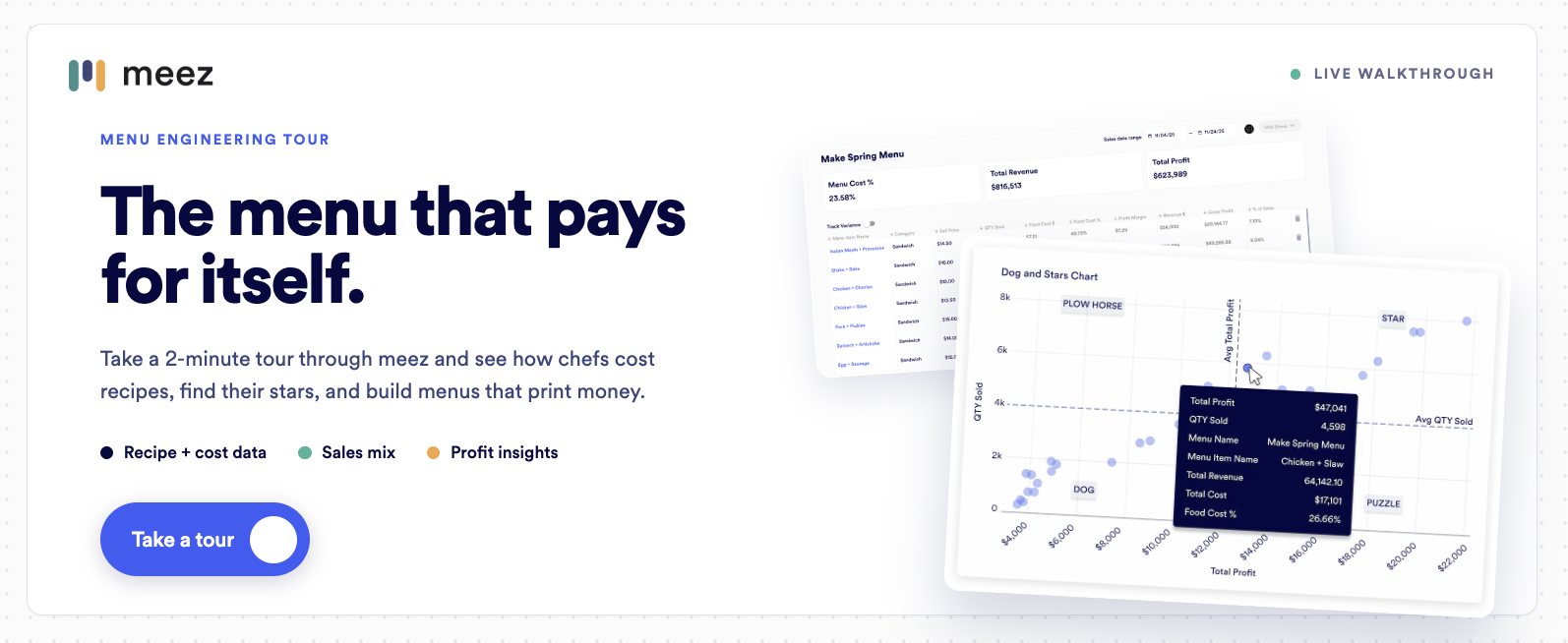
In meez, recipe costs and sales data sync automatically into the same view, making the menu engineering process continuous instead of quarterly.
If you’re building the matrix manually in a menu engineering worksheet, these two threshold calculations are the only menu-wide calculations you need.
Everything after that happens at the item level.
The Four Categories — What Each Means and What to Do
How To Use The Matrix Operationally
Once you’ve plotted every item on the matrix, each one falls into one of four categories. The category determines what you do next — and the order in which you act on them matters.
Stars sit in the high profitability, high popularity quadrant. Plowhorses, Puzzles, and Dogs each require a completely different operational playbook.
⭐ Stars — High Profitability, High Popularity
Definition
Above average on both axes. Stars are your highest-margin, highest-volume menu items. These are the dishes that anchor profitability, drive repeat visits, and often become signature items guests associate with your restaurant.
What Defines a Star?
Stars are menu items that perform above average on both axes. They generate strong contribution margins and they sell in high volume. These are your highest-value menu items — the dishes that anchor profitability while also driving repeat visits and guest loyalty.
In many restaurants, Stars are also signature dishes. They’re the items guests come back for specifically.
That means the operator’s job with Stars isn’t to improve them. It’s to protect them.
Guests build loyalty around consistency long before they build loyalty around price.
How Stars Usually Start Losing Margin
Stars tend to erode slowly over time through operational drift:
- Portions gradually increase
- Substitutions happen without recosting
- Prep consistency slips
- Managers discount them to drive traffic
- Pricing changes happen too aggressively
All of those decisions weaken the most valuable items on the menu.
Why Stars Matter
Stars do more than generate contribution margin.
They often create:
- Guest loyalty
- Repeat visits
- Word-of-mouth marketing
- Predictable sales patterns
- Stronger average check performance
Protecting Stars is usually more valuable than aggressively optimizing them.
Best Practices for Protecting Stars
The best strategies for Stars are operationally conservative:
The “golden triangle” of menu design — center, top right, and top left placement — is still some of the most valuable real estate on a physical menu.
On digital menus and online ordering platforms, first-screen visibility matters even more.
A simple price adjustment can also have an outsized effect.
If a loyal Star can absorb a one-dollar increase without reducing demand, that increase compounds quickly across volume.
For example:
- Pasta selling price = $16
- Portion cost = $4
- Contribution margin = $12
- Monthly volume = 300 orders
That dish generates $3,600 in monthly contribution.
Protecting that consistency matters.
If a Star is also a signature dish, consistency matters more than optimization. Operators get into trouble when they slowly change portions, ingredients, or execution trying to squeeze another point of margin out of a dish guests already love. The fastest way to lose trust is changing something regulars notice before you realize they notice it.
🐎 Plowhorses — Low Profitability, High Popularity
Definition
Above average popularity, below average contribution margin. Guests order Plowhorses constantly — but the economics behind them are weaker than operators usually realize.
Why Plowhorses Matter More Than Operators Think
Plowhorses are menu items with high popularity but below-average contribution margins.
Guests love them. They sell constantly. But they don’t generate enough profit per plate.
These are often high food cost items relative to their selling price.
And despite their lower margins, Plowhorses are frequently among the most important financial drivers on the menu.
The Counterintuitive Truth About Plowhorses
That’s the part operators often miss. A Plowhorse can generate more total monthly profit than a Star simply because of sales volume.
For example, despite generating $7.75 less contribution margin per plate, the Plowhorse can generate 72% more total monthly profit because of volume.
That’s why Plowhorses deserve careful operational attention.
The biggest menu engineering wins usually come from operational adjustments guests never notice.
The Most Common Plowhorse Mistake
Why Operators Mishandle Plowhorses
The biggest mistake operators make with Plowhorses is jumping immediately to a large price increase. Guests remember prices on high-volume items.
A burger going from twelve dollars to fourteen dollars overnight gets noticed.
Usually the smarter strategy is operational.
The Practical Rule
Volume changes everything.
A lower-margin dish selling 300 times per week can matter far more financially than a premium entrée selling 40 times.
That’s why improving Plowhorses usually creates the fastest operational margin gains.
Best Strategies for Improving Plowhorses
Best Plowhorse Strategies
The best Plowhorse strategies move from lowest guest disruption to highest:
- Improve ingredient sourcing or yield
- Tighten portion control
- Reduce invisible over-portioning
- Bundle with a high-margin side
- Use modest price increases only after operational improvements
Small operational changes compound dramatically on high-volume items. ven slight yield improvements across hundreds of covers per week can materially improve profitability without changing guest perception.
This is where operators often discover the difference between purchase price and actual production cost.
Theoretical food cost matters enormously here. An ingredient that appears inexpensive on paper can become operationally expensive once prep loss, trim, labor, and yield are properly accounted for.
That’s why accurate recipe costing matters so much in menu engineering.
Most operators go straight to raising price because it feels like the fastest fix. But usually the smarter move is operational: tightening portion control, improving yield, swapping one ingredient, or adjusting a prep process guests will never notice. Small changes across a high-volume item compound faster than people realize.
⬛ Puzzles — High Profitability, Low Popularity
Definition
Above average contribution margin, below average sales volume. Puzzles are profitable dishes guests simply aren't ordering enough.
Why Puzzles Are Often The Biggest Opportunity
Puzzles are menu items with strong contribution margins but weak sales volume. Financially, these are often the most exciting items in the matrix.
The economics already work. The problem is visibility. Guests simply aren’t ordering the item often enough.
That makes Puzzles different from every other category. You don’t need to fix profitability. You need to improve demand.
Best Strategies for Increasing Puzzle Sales
This is where menu psychology, menu design, and descriptive language become operational tools.
The Most Important Insight About Puzzles
The economics already work. You usually don't need to fix the dish. You need to improve visibility, communication, or perceived value.
Best Puzzle Strategies
The best Puzzle strategies focus on improving visibility before changing the recipe itself.
- Rewrite the menu description
- Improve menu placement
- Train servers to recommend the item
- Use price anchoring strategically
- Test seasonal positioning if necessary
Descriptive language changes.
This can dramatically improve performance.
“Wood-fired flatbread with whipped ricotta and charred lemon” communicates far more value than simply “flatbread.”
The dish hasn’t changed. The guest’s perceived value has. That’s menu psychology in practice.
Placement matters too.
On a printed menu, operators should prioritize golden-triangle positioning. On digital menus and online ordering platforms, category ordering and first-screen visibility matter more. Digital menu behavior is fundamentally different from physical menu behavior, especially on mobile.
Server recommendation scripts
This can be even more influential than menu design. A simple “Chef’s favorite tonight” from FOH often outperforms expensive design changes.
Price anchoring
This can also reshape customer perception. Positioning a moderately priced Puzzle beside a significantly more expensive item can make the Puzzle feel like strong value without changing anything operationally.
The key with Puzzles is patience.
If visibility tactics fail over multiple analysis cycles, the item may have a genuine demand problem.
At that point, operators should consider repositioning it seasonally or removing it entirely.
For more on descriptive language and menu psychology, see our guide to menu engineering.
A lot of Puzzles aren’t actually product problems — they’re communication problems. I’ve seen dishes become top sellers with nothing more than a better description or a different placement on the menu. Before you change the recipe or lower the price, make sure guests actually understand why the dish is worth ordering.
🐕 Dogs — Low Profitability, Low Popularity
Definition
Below average on both axes. Dogs generate weak contribution margin and low demand while still consuming operational resources.
When a Menu Item Stops Earning Its Place
Dogs are menu items that perform below average on both axes. They generate weak contribution margins and they rarely sell.
Operationally, Dogs create one of the biggest hidden drains in restaurants because they consume prep time, inventory space, purchasing complexity, and menu real estate without generating meaningful return.
Important: Not Every Dog Should Be Removed
Dogs aren’t automatically bad. Some menu items provide value the matrix itself can’t measure.
Kids’ menu items, legacy dishes, dietary accommodations, and brand-signaling dishes may still deserve a place on the menu even if they underperform financially.
That’s why operators should evaluate Dogs carefully before removing them.
Some dishes stay on menus because they matter to the identity of the restaurant — even if the matrix alone wouldn’t justify them.
Questions To Ask Before Removing a Dog
- Does this item provide strategic brand value?
- Is the low popularity caused by weak visibility rather than weak demand?
- Would a better description, placement, or seasonal positioning improve performance?
If the answer is no, it’s usually time to cut the item.
Many low-performing menu items survive purely because of inertia.
Nobody removes them because nobody notices them. But every menu item increases operational complexity.
Every additional menu item creates:
- More prep
- More purchasing complexity
- More inventory
- More training
- More waste potential
- More operational variability
Complexity becomes expensive quickly.
What Not To Do With Dogs
What operators should not do with Dogs:
- Don’t discount them
- Don’t feature them as specials
- Don’t train FOH to recommend them
- Don’t increase volume on your weakest-margin item
In many restaurants, the first menu engineering analysis is eye-opening precisely because it exposes how many low-performing items have quietly accumulated over time.
The hardest part about Dogs is emotional attachment. Kitchens keep dishes because they used to sell, because one regular orders them, or because nobody wants to admit they’re not working anymore. But every item on the menu creates operational complexity, and complexity gets expensive fast if the item isn’t earning its place.
How Software Automates the Matrix
Why Manual Menu Engineering Breaks Down
Most restaurants still run menu engineering manually.
And that’s the reason most restaurants don’t run it often enough.
Why Manual Menu Engineering Is So Inconsistent
A full menu engineering analysis can easily take six to eight hours:
- Exporting POS reports
- Reconciling recipe spreadsheets
- Updating ingredient costs
- Calculating contribution margins
- Building threshold calculations
- Classifying items manually
As a result, many operators only revisit menu engineering once or twice a year. By then, ingredient prices, purchasing behavior, and menu performance have already changed.
Most POS systems only show what happened after service. They can show sales volume, revenue, and historical purchasing.
What they usually can’t show is what should have happened operationally.
That’s the difference between actual food cost and theoretical food cost. Theoretical food cost reflects what the menu should cost if recipes, portions, yield, prep, and production all perform according to spec.
That’s where operators gain the most control over profitability.
Theoretical food cost is where operators actually gain control over profitability — because that’s where production discipline lives.
How meez Automates Menu Engineering
In meez, menu engineering becomes a continuous operational process instead of a quarterly spreadsheet project.
What meez Automates
Recipe costs update dynamically as invoice prices change. POS integrations pull sales data automatically. Contribution margins, popularity thresholds, and category classifications update in real time.
What Operators Can See Inside meez
The platform continuously connects all of this into one single view:
- Theoretical food cost
- Recipe logic
- Ingredient volatility
- Sales mix percentage
- Contribution margin
- Menu performance
- Variance tracking
Instead of manually reconciling spreadsheets, operators can immediately see:
- Which items drive revenue
- Which dishes drive contribution margin
- Which ingredients create the most volatility
- Where theoretical food cost is drifting
- Which menu items have reclassified
That matters because menu performance changes constantly. A protein price spike can turn a Star into a Plowhorse almost overnight.
Without continuous costing visibility, operators usually don’t notice until margins have already deteriorated.
meez also tracks ingredient-level impact across the menu.
Operators can see which ingredients disproportionately affect revenue, margin, and volatility across every dish and every location. That creates a much more sophisticated version of menu engineering than simple sales reporting.
For example, adjusting a single ingredient inside a recipe automatically updates every connected sub-recipe, menu item, and theoretical food cost calculation.
The same adjustment inside a spreadsheet workflow can take hours and introduce significant error. This is especially important for multi-unit operators.
Theoretical food cost discipline becomes exponentially harder as concepts scale. With meez, operators can filter menu performance by location, concept, or property while maintaining standardized recipe logic and centralized costing visibility.
The Operational Outcome
The result is a more profitable menu driven by current operational data instead of stale spreadsheets.
When Plowhorses improve through yield adjustments, when Dogs are removed before they create unnecessary complexity, and when Puzzles become Stars through better positioning, profitability compounds.
These aren’t menu engineering tricks.
They’re the operational mechanics of running a modern restaurant business with accurate data.
For a deeper look at the platform, explore meez menu engineering software.
Conclusion — Start With the Matrix
The Matrix Is Only Valuable If You Revisit It
The menu engineering matrix gives restaurant operators a repeatable framework for understanding profitability at the item level.
The threshold calculations create the structure. The four categories create the strategy. And continuous analysis turns menu engineering from a one-time project into an operational discipline.
Most restaurants already have the raw data they need.
The challenge is connecting recipe costs, theoretical food cost, sales mix percentage, and contribution margin into a system operators can actually act on.
That’s why the matrix matters.
Whether you’re running a single restaurant or managing multiple concepts across a portfolio, the framework stays the same:
Protect Stars. Improve Plowhorses. Promote Puzzles. Remove Dogs.
And rerun the analysis often.
The operators who treat menu engineering as a continuous process — not an occasional spreadsheet exercise — are the ones who capture the biggest margin gains over time. If you want to see your own menu classified in the matrix using live recipe and sales data, explore meez menu engineering.
FAQs
What are the four categories of the menu engineering matrix?
The four categories are Stars, Plowhorses, Puzzles, and Dogs. Stars are high profitability and high popularity items that should be protected and promoted. Plowhorses are high popularity but low profitability items that usually require operational improvements or modest pricing adjustments. Puzzles are high-profit items with weak demand that need better visibility or positioning. Dogs are low profitability and low popularity items that often should be removed unless they serve an important strategic purpose.
How do you calculate the thresholds for the menu engineering matrix?
The profitability threshold is calculated using the average contribution margin across all menu items. Add every item’s contribution margin together and divide by the number of menu items. The popularity threshold is calculated using the formula (1 ÷ number of menu items) × 0.70. For a 10-item menu, the popularity threshold would be 7%.
What is the difference between contribution margin and food cost percentage?
Contribution margin measures the dollar profit generated per sale and is calculated as selling price minus portion cost. Food cost percentage measures the ratio between portion cost and selling price. Two dishes can share the same food cost percentage while generating very different contribution margins. The menu engineering matrix uses contribution margin because it reflects actual profit dollars rather than percentage ratios.
How do you classify a menu item as a Star or Plowhorse?
First calculate the item’s contribution margin and sales mix percentage. Then compare both numbers against your menu averages. A Star performs above average on both profitability and popularity. A Plowhorse performs above average on popularity but below average on profitability.
What is the difference between a Puzzle and a Star?
Both Puzzles and Stars generate above-average contribution margins. The difference is demand. Stars sell in high volume while Puzzles are underordered relative to the rest of the menu. The goal with Puzzles is to improve visibility, menu placement, descriptions, and server recommendations rather than changing the economics of the dish.
What should you do with Plowhorse menu items?
Start with operational improvements before raising prices. Tighten portion control, improve yield, evaluate ingredient sourcing, and consider bundling with high-margin sides. Small operational adjustments often improve profitability without changing guest perception. Large price increases on high-volume items should generally be a last resort.