For decades, success in the restaurant industry has followed a familiar script. Work your way through the best kitchens. Learn from the best chefs. Open your own restaurant. Earn critical acclaim. Build a loyal following. Win awards. Expand.
For many chefs, that's the dream. But what happens when you achieve it?
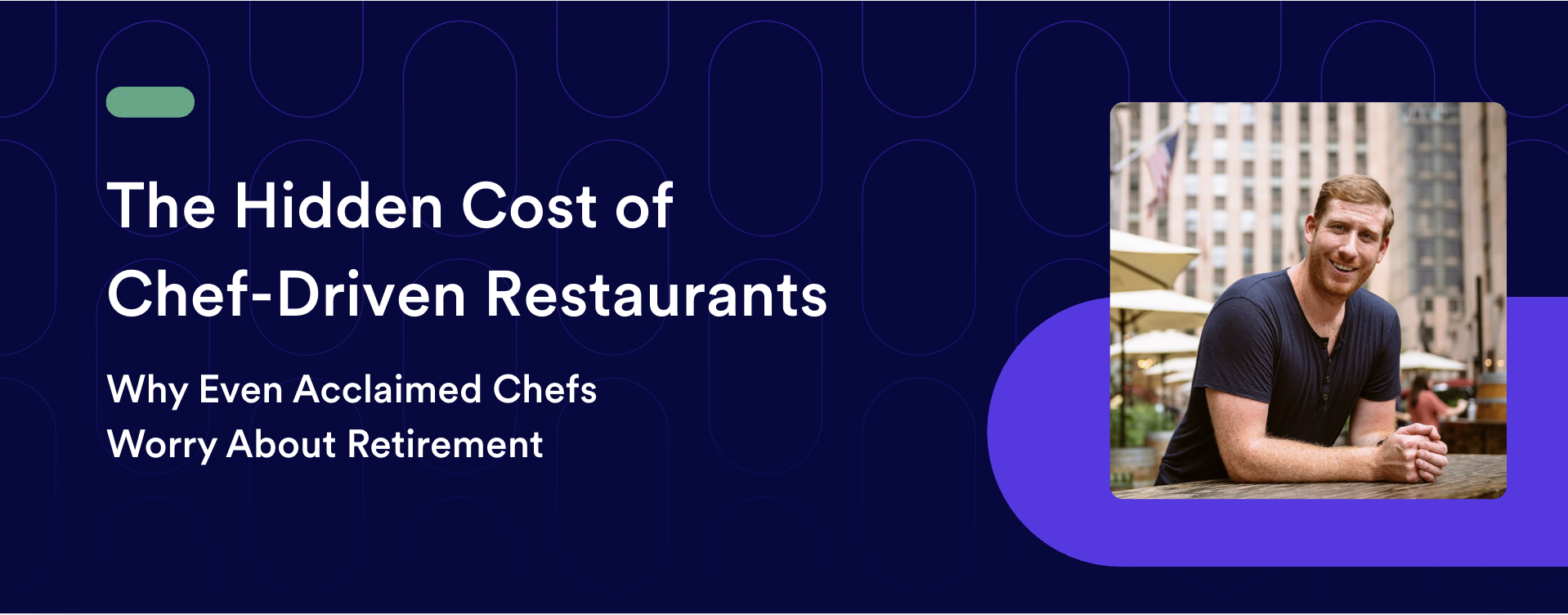
On a recent episode of the meez Podcast, chef Greg Baxtrom posed a question that's becoming increasingly common among restaurant operators.

"What I talk to all my chef friends, it's about how the heck do we retire in this industry? Not that we actually want to retire, but when we're in our seventies and our bodies start failing, how will we afford that?"
It's a surprisingly vulnerable question coming from someone whose career would be considered a success by almost any standard. Baxtrom trained at Alinea, Per Se, and Blue Hill at Stone Barns. He opened Olmsted in Brooklyn to widespread acclaim, earned recognition from Bon Appétit, Esquire, GQ, and Food & Wine, and became one of the most respected chef-owners of his generation.
He checked nearly every box the industry tells chefs to chase.
And yet the conversation he keeps having with peers isn't about the next award. It's whether hospitality can actually provide long-term security. Whether a career built on sacrifice, creativity, and relentless execution can eventually support a normal life — a family, some savings, and a body that doesn't give out before the money does.
That question sits at the intersection of two things the industry rarely discusses together: the emotional weight of building something celebrated, and the financial reality of what it actually costs to run it.
The Success Paradox
One of the most striking moments in the conversation is when Baxtrom compares chefs to Olympic athletes.
He references the documentary The Weight of Gold, which follows elite athletes after they achieve the goal they've spent their entire lives pursuing. For years, they trained with singular focus, sacrificed relationships and stability, and then — they got there. And life didn't fall into place.
Baxtrom saw the same pattern in his own career. After years in elite kitchens, he opened Olmsted and watched it become one of the most celebrated restaurants in New York. The accolades arrived quickly. The dining room was full. The industry took notice.
And then:
"I remember being drunk in the middle of the street on Vanderbilt Avenue. Behind me was Olmsted in its prime and across the street was Maison Yaki. And I didn't want to be at either one of them."
Both restaurants were thriving. Both were receiving recognition. The dream had technically arrived.
Achievement and fulfillment are not the same thing. The restaurant industry celebrates visible success — awards, reviews, new openings, press. But those things don't necessarily answer deeper questions about purpose, identity, financial stability, or what life looks like in thirty years. In many cases, they simply create new pressures: higher expectations, more staff depending on you, more noise to cut through, and a growing gap between what the business looks like from the outside and what it actually costs to run.
That gap is where most of the real damage happens.
The Economics Nobody Sees
The public tends to assume that successful restaurants are profitable businesses. Packed dining rooms suggest strong economics. Awards imply stability. A reservation waitlist feels like proof of a healthy business.
The reality is often far more complicated.
Baxtrom was direct about the gap between what his Brooklyn restaurants looked like from the outside and what was actually happening inside.
"Basically everything I made from my restaurant in Rockefeller Center, I would just pump into my restaurants in Brooklyn to keep them alive as long as I could. I wasn't collecting a penny from any restaurant in Brooklyn for years and years."
He was moving money between businesses simply to make payroll. A nationally acclaimed chef, running restaurants that appeared by every external measure to be thriving, quietly subsidizing them out of pocket. For years.
For operators, this story is far from unique. A restaurant can be full every night and still struggle. A chef can become nationally recognized and still be one bad quarter away from a cash crisis. The disconnect between perception and reality is one of hospitality's most persistent — and most dangerous — challenges, because it makes the problem harder to talk about and harder to solve.
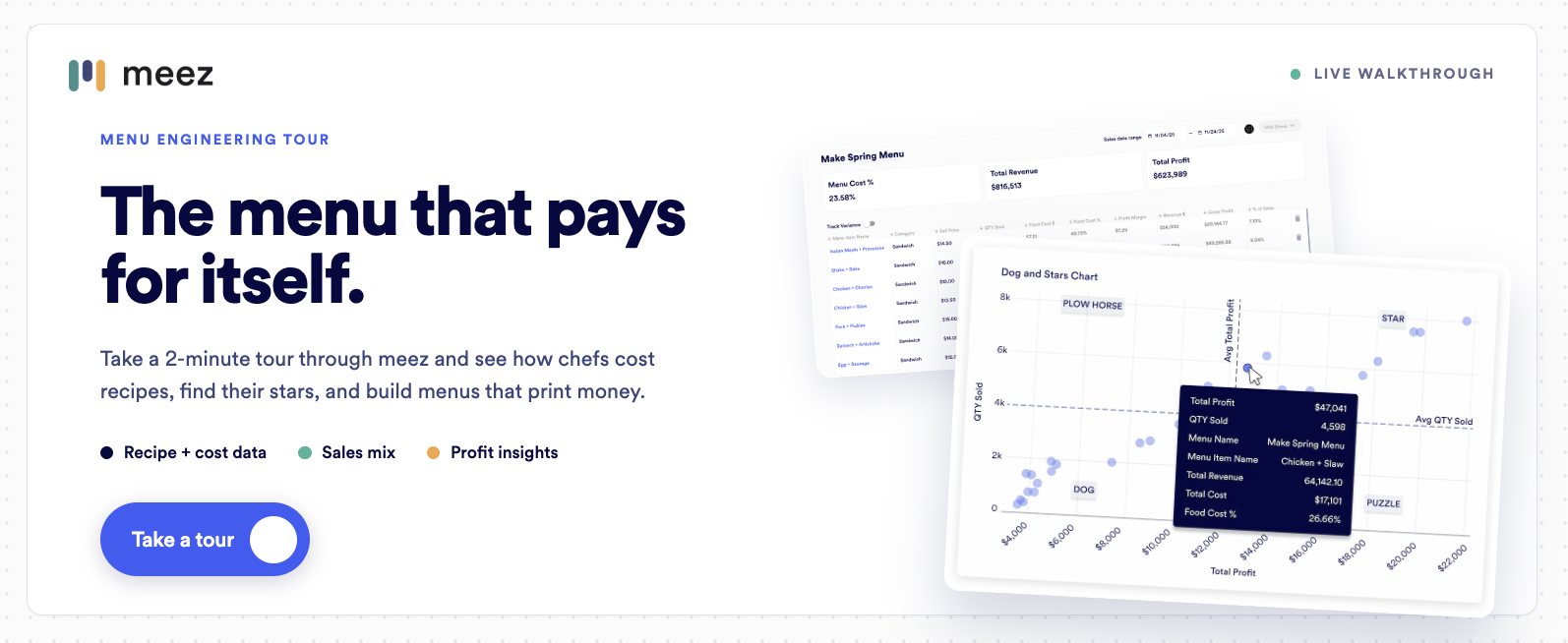
Part of what makes this so difficult is that most food businesses don't have true visibility into where their money is going. Food cost percentage is often tracked at a high level, but the numbers behind it — theoretical food cost versus actual, item-level profitability, contribution margin by dish, food waste costs accumulating across prep and service — are frequently managed through instinct and experience rather than real data. When food cost control is happening in a chef's head rather than a system, cost variance analysis is nearly impossible. And when you can't see the leaks clearly, you can't stop them.
The Hidden Cost of Creativity
Part of the challenge lies in the nature of chef-driven restaurants themselves.
Restaurants like Olmsted are built around constant creative output. Guests expect innovation. Menus evolve every season. Every visit is supposed to feel different. That level of creativity is exciting. It's also one of the most expensive operating models in hospitality.
Every new dish requires development time, sourcing, testing, and training. Seasonal menu changes mean recipes need to be retested, yields recalculated, and costs re-evaluated from scratch. Without a rigorous approach to recipe costing and menu profitability, it's easy for a restaurant to innovate its way into margin compression — adding labor and ingredient costs without a clear picture of what each new dish is actually contributing to the bottom line.
Baxtrom described the relentless pressure of constantly surprising guests at Olmsted. One example: the team created what they called "restaurant inception," where ordering a single menu item triggered a completely separate embedded menu — its own food and beverages, its own server, its own experience layered inside the main dining room. Creative, memorable, and exhausting to execute.
The systems required to sustain that kind of creativity are significant. Every new concept requires new recipes, new training, new prep flows, and new costs to track. Without proper menu costing keeping pace with the innovation, menu margin analysis becomes a lagging indicator at best — and a guessing game at worst.
At some point, operators begin asking a different question. Not "Can we do this?" but "Can we keep doing this for twenty years?"
The Founder Dependency Problem
When Josh Sharkey pushed on why Olmsted struggled financially despite strong demand, Baxtrom's answer was direct.
"Being chef-driven. Requiring a high salary person to maintain that quality is not wise."
This gets to one of the most structurally underappreciated problems in hospitality. A chef-driven restaurant is, by definition, built around a person. The food is the founder's vision. The quality is tied to their standards. The training is informal because the chef is the system. Guests return because of something ineffable that lives in the food — and that something is deeply, sometimes irreparably, tied to the person who makes it.
When that person needs to step back, scale, or take a night off, the only solution is to replace their judgment with someone equally skilled. That talent commands a high salary. And for a restaurant already running on thin margins, the labor math changes completely.
What makes this problem worse is that it's usually invisible until it's a crisis. If recipes live in a chef's head rather than a documented system, if prep standards are passed down through watching and doing rather than written guides, if there's no costing system capturing what each dish actually costs to produce — then the restaurant's entire operation is dependent on one person showing up every day. That's not a business. It's a performance.
Baxtrom acknowledged this himself. He noted that the restaurants he actually admires going out to eat at — places like Rucola in Brooklyn — stubbornly don't change their menus. The same pasta. The same dishes. A small team executing consistently week after week. The economics work because the food is codified, the system is repeatable, and the restaurant isn't constantly spending resources on reinvention.
That kind of stability isn't less creative. It's a different choice — one that often produces better economics and, over time, a more sustainable career.
What the Numbers Actually Need to Tell You
Restaurateurs who eventually figure out how to build sustainable businesses tend to share one thing: they develop real visibility into their numbers before a crisis forces them to.
That means knowing your food cost percentage by dish, not just for the kitchen as a whole. It means running menu mix analysis to understand which items are actually driving profit versus which are popular but margin-negative. It means tracking food waste costs systematically, because inventory variance — the gap between what you theoretically should have used and what you actually used — is often where profitability quietly disappears. It means understanding contribution margin at the item level, so when you engineer a new seasonal menu, you're making decisions with data rather than instinct alone.
Dish costing and plate costing aren't glamorous. They don't get covered in food press. But they're the difference between a restaurant that produces a beautiful dining experience and a business that can sustain the people who built it.
Most chef-driven restaurants don't start with these systems. They start with a vision, a lease, and a talented team — and build the financial infrastructure later, often after a painful reckoning. The operators who avoid Baxtrom's experience are usually the ones who treated recipe costing and menu profitability as foundational rather than administrative.
What Profitability Really Means
In hospitality, profitability is usually discussed through operational metrics — food cost, labor, prime cost, margins. All of those matter. But Baxtrom's story points to a broader definition.
Real profitability isn't just whether a restaurant survives this month. It's whether the business creates a sustainable life for the people running it. Can owners pay themselves appropriately? Can they take time off without everything falling apart? Can they support families, afford healthcare, and eventually stop working before their body forces them to?
Operators who have clear visibility into where their money is going — and where it's quietly leaking — are the ones who can actually answer those questions. That's the gap meez was built to close: giving culinary teams the same financial clarity that finance teams expect, rooted in accurate recipe data and real-time food cost management that keeps pace with how kitchens actually operate.
None of this is incompatible with being a great chef or building a creative restaurant. The chefs who figure out how to do both — creative and financially viable — are the ones still cooking on their own terms twenty years later.
The Question Every Operator Should Be Asking
Toward the end of the conversation, Baxtrom reflects on how much his priorities have shifted in the last six years. Six years sober. Six years in therapy. A lot of evolution in how he thinks about what he's building and why.
The questions occupying him now aren't about awards or recognition. They're the same ones he hears from chef friends around the world.
"I want to provide for my inevitable wife and kids. I want them to have whatever life they want. And it definitely was ego driven before. Now... now when I talk to all my chef friends, it's about how the heck do we retire in this industry."
It's a question that the industry's most celebrated figures are asking quietly, behind closed doors, at late-night industry dinners. Not how to earn another award — but whether the careers they've devoted their lives to can eventually provide a stable foundation for the rest of their lives.
Restaurants that depend entirely on heroic effort are fragile by design. Restaurants that build repeatable systems, documented recipes, visible food cost control, and financial infrastructure that doesn't live only in a chef's head create options. They create the ability to step back. To scale. To hire well. To eventually retire.
The hard truth Baxtrom's story surfaces is that acclaim and profitability are not the same thing, and the industry has spent decades celebrating one while neglecting the other. But the conversation is changing. Slowly, and often quietly, more operators are asking what it actually takes to build something that lasts — not just a restaurant that earns recognition, but a business that can support a life.
That answer may be the most important thing hospitality figures out in the years ahead.
Want to see how meez helps operators build the financial visibility their restaurants need? Take a tour of recipe costing →
Heading 1
Heading 2
Heading 3
Heading 4
Heading 5
Heading 6
Lorem ipsum dolor sit amet, consectetur adipiscing elit, sed do eiusmod tempor incididunt ut labore et dolore magna aliqua. Ut enim ad minim veniam, quis nostrud exercitation ullamco laboris nisi ut aliquip ex ea commodo consequat. Duis aute irure dolor in reprehenderit in voluptate velit esse cillum dolore eu fugiat nulla pariatur.
Block quote
Ordered list
- Item 1
- Item 2
- Item 3
Unordered list
- Item A
- Item B
- Item C
Bold text
Emphasis
Superscript
Subscript
Frequently Asked Questions
Why do successful chefs still worry about retirement?
Many chefs achieve critical acclaim and operate popular restaurants, yet still struggle to build long-term financial security. Thin profit margins, high labor costs, founder dependency, and inconsistent cash flow can make it difficult to save for retirement, even when a restaurant appears successful from the outside.
Are award-winning restaurants always profitable?
No. Awards, positive reviews, and full dining rooms do not necessarily translate into strong profitability. Many acclaimed restaurants operate on slim margins and may require owners to reinvest earnings back into the business to cover rising food, labor, and operating costs.
What is a chef-driven restaurant?
A chef-driven restaurant is a business where the menu, quality standards, and guest experience are closely tied to the vision and involvement of a specific chef. While this model can create unique dining experiences, it can also make scaling and long-term sustainability more difficult if too much knowledge and decision-making remain with one person.
Why is founder dependency a challenge in restaurants?
When recipes, training processes, and operational knowledge live primarily in the owner's head, the business becomes dependent on that individual. This can increase labor costs, limit growth opportunities, and create operational risks if the founder needs to step away from day-to-day operations.
How does recipe costing improve restaurant profitability?
Recipe costing helps operators understand the true cost of every menu item by tracking ingredient costs, yields, and portions. Accurate recipe costing allows restaurants to price dishes effectively, protect margins, and make more informed menu decisions.