
Brian Smith had thought a lot about heavy cream.
When he and his wife Jackie Cuscuna were building Ample Hills Creamery into one of Brooklyn's most beloved ice cream shops, Brian made a deliberate choice to buy the expensive stuff: $120 per five-gallon bag instead of $80. On paper, that decision hurt. Food cost at Ample Hills regularly ran 30–35%, above the standard industry target.
But Brian wasn't apologetic about it. On the meez Podcast, he explained the logic plainly:

"You can make ice cream with this heavy cream, which costs $80 for a five-gallon bag, or you can pay $120 for a five-gallon bag. Maybe 75% of your audience isn't gonna tell the difference. But the 25% that can are gonna be the ones that are the brand ambassadors."
That's not a food cost problem. That's a strategic decision, made with eyes open. Brian knew exactly what his ingredients cost, exactly what it was doing to his margins, and exactly why it was worth it.
Here's the real question for most restaurant operators: do you know what your ingredients cost right now — not six months ago when you last updated your recipe cards, but today, after your dairy supplier raised prices, your produce costs shifted with the season, and your protein vendor sent a new invoice with a line item that's quietly 12% higher than last quarter?
If the answer is anything less than a confident yes, you're not managing food cost. You're discovering it after the fact on your P&L.
The Difference Between a Spike and a Creep
Food cost spikes are easy to spot. A supplier goes out of stock, you emergency-source at a premium, actuals jump four points in a week — someone notices. That's a crisis, and crises get attention.
Food cost creep is different. It's quiet. It's cumulative. And by the time it shows up clearly on the books, it's already been eroding your margins for months.
It works like this: ingredient prices move constantly. Your produce costs fluctuate weekly. Dairy, protein, and dry goods shift with supply chains, seasons, and market conditions. But your recipe costing system — whether that's a spreadsheet, a binder, or a module in your accounting software that nobody updates — reflects what things cost the last time someone sat down and manually entered prices.
Which means your theoretical food cost is wrong. Not by a lot, necessarily. Maybe 1.5 points. Maybe 2. But on a restaurant doing $2 million in annual food revenue, a 2-point creep from 30% to 32% is $40,000 in lost margin per year. Vanished. Silently.
Most operators don't catch it until the monthly or quarterly P&L — and by then, the question is why actuals are running above theoretical, which kicks off an investigation that usually ends in inconclusive finger-pointing at waste and over-portioning.
The real culprit, most of the time, is simpler: your theoretical food cost was already wrong before service started.

Four Reasons Food Cost Creeps
1. Ingredient prices move, and nobody updates the recipes
This is the most common cause, and the most quietly devastating. When you're running a busy kitchen, re-costing every recipe every time a supplier price changes isn't a realistic workflow. So prices get updated quarterly — or when someone remembers — or when a new culinary director inherits a costing sheet that's 18 months stale.
Every recipe in your system is calculating cost based on old numbers, and every food cost percentage you're looking at is fiction.
One meez customer described the moment this came to a head during a period of significant market volatility:
"These past few years, we've had to re-engineer our menu because we saw a 30% increase in the cost of goods across the board. meez was invaluable when we did this because we could see what the cost would be after switching the ingredients and quantities. It helped us make our dishes more affordable."
Without live costing, you can't see that. You're pricing dishes based on what flour, eggs, and cream cost last year.
For a broader look at where margin quietly disappears, see 5 Hidden Costs Eating Into Restaurant Profits — and How to Fix Them.
2. Yields aren't accurate, so the baseline is wrong from the start
Recipe cost doesn't start with what you pay for an ingredient. It starts with what you actually get from it after trim, butchery, cooking loss, and prep waste. A chicken breast that costs $4.50/lb has a very different true cost depending on whether you're accounting for 20% butchery loss or ignoring it entirely.
Most operations are either guessing at yields, using whatever default their software populated years ago, or — most commonly — not accounting for them at all. The result: theoretical food cost is systematically underestimated, and the gap between theoretical and actual always seems mysterious.
Brian Smith ran into a version of this in the ice cream world. His product wasn't complicated by butchery loss, but he dealt with the same underlying principle: the precise composition of every component mattered for the final cost, not just the sticker price. He described the deliberate work of building his ice cream base with exactly the right solids content:
"The number one ingredient in whole milk is water... you need the properties of water that turn into ice, the freezing properties of it, to turn your ice cream from a liquid into a solid. But nobody wants icy ice cream."
Every ingredient serves a function, and every ounce matters. The operators who understand their yields at that level of granularity — not just the price on the invoice, but what they actually get to use — have a fundamentally more accurate picture of their true costs.
For a practical walkthrough of how to build this into your process, see A Chef's Guide to Accurate Recipe Costing.
3. Sub-recipes aren't costed, so parent recipes are incomplete
Your braised short rib entrée doesn't just cost short rib, aromatics, and wine. It costs the demi-glace you spent hours reducing, the gremolata that's a sub-recipe of three other components, and the polenta portioned from a larger batch with its own yield factors. If those sub-recipes aren't individually costed and rolling up into the parent recipe, you're not seeing the true cost of the dish — you're seeing a fragment of it.
This is especially common in full-service restaurants with complex preparations. The more components a dish has, the more likely it is that the stated recipe cost is an undercount. And the more undercounted your costs are, the more your food cost will creep the moment any one of those sub-components gets a price increase.
4. Menu updates happen but the cost model doesn't follow
You tweak a dish. Swap a protein, adjust a garnish, reduce a portion after guest feedback. The recipe gets updated — in a Google Doc, in a group chat, in a note on the prep station. But the costing model doesn't get updated. Now you have a recipe being executed one way and costed another, and that divergence compounds every day it goes uncorrected.
This is one of the most pervasive pain points for culinary directors: recipes don't stay in sync with their cost models. Menus that change often are almost always poorly costed, because it's nearly impossible to keep ingredient prices current across a constantly-evolving recipe library without a system built to do it automatically.
If you're managing a multi-unit culinary program, the 9 Qualities of a Great Culinary Director post covers why cost discipline is one of the most underrated skills in that role.
High Food Cost Isn't Always the Problem — Invisible Food Cost Is
Brian Smith's heavy cream decision is worth sitting with for a moment, because it illustrates something important: high food cost isn't inherently bad. Unmanaged food cost is.
When Ample Hills was running at 35%, Brian knew why. He'd made deliberate ingredient choices — premium cream, scratch-made mix-ins, fresh eggs — and he understood exactly what those decisions cost and what they bought in brand loyalty. He could speak to the tradeoff fluently because he was tracking it.
The dangerous food cost isn't the one that's high. It's the one you can't explain.
When your culinary director looks at the P&L and can't tell you whether 34% reflects a strategic ingredient investment or operational leakage — that's where margins disappear.
As Brian put it when reflecting on his food cost targets:
"It should be like, you know, 25–30%... oftentimes we were pushing 35% just because we were buying the best ingredients and the best cream and the best eggs."
That's the posture every operator should have: there's a target, there's awareness of where you actually land, and there's reasoning behind the variance. That's what good food cost management looks like — regardless of what the number is.
Why Spreadsheets Can't Solve This
The natural response to food cost creep is to update the spreadsheet. And that works — the first time. But spreadsheets have a structural problem: they only reflect reality when someone updates them, and in a busy operation, that someone rarely has time.
Consider what keeping a spreadsheet-based costing system current actually requires:
- Every time a supplier raises a price, someone manually finds every recipe that uses that ingredient and updates the cost
- Every time you change a portion size or swap a component, someone recalculates the recipe cost
- Every time you add a new sub-recipe, someone builds the cost model and links it to parent recipes
- Every time invoices come in, someone reconciles new prices against the existing costing model
In a small single-unit operation, this might be manageable. In a multi-unit group with hundreds of recipes, seasonal menu changes, and invoices from multiple distributors — it's not. The spreadsheet becomes a snapshot of costs at one point in time, slowly diverging from reality every week.
One meez customer described the before-and-after clearly:
"It's so quick to cost recipes. It takes 1/4 of the time to cost them and we have live purchasing data which is really, really helpful. The big thing is our chefs don't need to sit and update costs — it's all automated."
That last line is the whole thing. The system updates costs automatically when invoice prices change. Every recipe in the library reflects current ingredient costs without anyone having to manually re-enter data. That's the difference between a static snapshot and a live costing engine.
What Live Recipe Costing Actually Looks Like
Here's how food costing software like meez addresses each of the four problems above:
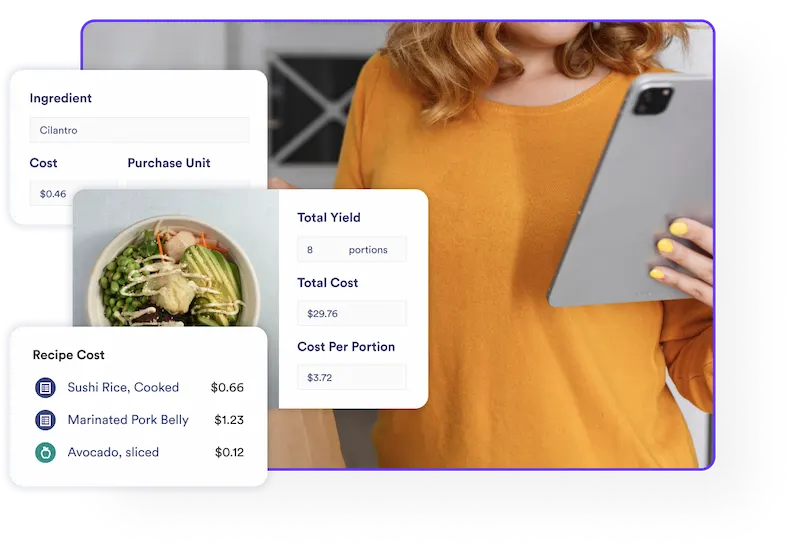
- Ingredient price changes propagate automatically. When you process an invoice — manually uploaded, synced from a purchasing system like Gordon Food Service, or pulled from an integration like Restaurant365 — meez updates every recipe that uses those ingredients. A dairy price increase doesn't require a re-costing session; it happens across your entire recipe library automatically.
- Yields are built into the costing model. meez has a built-in database of ingredient yields and prep conversions, so when you're costing a whole chicken, the system accounts for butchery loss rather than pricing it as if you're using 100% of the purchased weight. This closes one of the most common gaps between theoretical and actual food cost.
- Sub-recipes roll up into parent recipes automatically. When you nest a sub-recipe inside a parent — your house-made stock inside your braise, your prep sauce inside your pasta — the sub-recipe cost flows into the parent automatically. Change the cost of one ingredient in the stock, and every dish that uses that stock updates accordingly.
- Menu engineering becomes a real-time tool. With live recipe costs visible on every dish, you can model what-if scenarios before they hit your P&L: what happens to this dish's margin if you swap the protein, if produce costs keep climbing, if you adjust the portion size? The answer is immediate — not six weeks later when actuals come in.
The impact compounds at scale. Berg Hospitality Group, operating multiple concepts across Texas, saw a 21% overall reduction in food cost after implementing meez alongside their Restaurant365 integration — saving 20+ admin hours per month in the process.
See It for Yourself

Wondering what live recipe costing actually looks like in practice? Take a self-guided tour of meez and see how food cost, yields, sub-recipes, and invoice syncing all work together in one place. Take the meez product tour →
Already know you want to dig into the numbers? Run your operation through the meez ROI Calculator to estimate exactly how much margin you could recover.
The Simple Test: When Did You Last Update Your Recipe Costs?
Here's a practical way to gauge whether food cost creep is affecting your operation right now. Ask your culinary team one question: when did someone last update the ingredient prices in your recipe costing system?
- Within the last 30 days: You're likely in reasonable shape.
- A few months ago: You almost certainly have some drift between your theoretical and actual costs.
- Not sure, or whenever we had a supplier conversation: Your recipe costs are significantly wrong — and you're managing food cost without an accurate baseline.
The operators who catch food cost creep early share one thing in common: their recipe costs stay current without requiring a manual effort to maintain them. That's not a discipline problem. It's an infrastructure problem. And it's exactly the problem food costing software is designed to solve.
Start With an Accurate Theoretical
Brian Smith's point about brand ambassadors isn't just about ice cream. It's about the relationship between quality, cost, and transparency. The operators who spend more on ingredients and run higher food cost percentages aren't doing it wrong — they're doing it intentionally, with eyes open, because they can see exactly what they're spending and why.
The operators who are struggling aren't the ones spending too much. They're the ones who don't know their number — not because they don't care, but because they don't have a system that keeps their recipe costs current.
If your food cost has been creeping and you can't pinpoint exactly why, the first move isn't negotiating harder with suppliers or trimming portions. It's getting your theoretical food cost right. Once that number is accurate and live, you can have the conversation Brian was having at Ample Hills: this is what we spend, here's why, and here's whether it's worth it.
Ready to stop discovering food cost after the fact? Explore meez's recipe costing features →
Brian Smith and Jackie Cuscuna, co-founders of Ample Hills Creamery, were guests on Episode 92 of the meez Podcast. Listen to the full episode →
Frequently Asked Questions
1. Why does food cost keep going up even when I haven't changed my menu?
Food cost rises when ingredient prices increase but recipe costs aren't updated to reflect them. If your costing system relies on manually entered prices, any supplier price change — dairy, produce, protein — silently erodes your margins until someone updates the data. This is called food cost creep, and it's the most common cause of unexplained gaps between theoretical and actual food cost.
2. What is the difference between food cost creep and a food cost spike?
A food cost spike is a sudden, visible jump, usually caused by an emergency sourcing situation or a single large price increase. Food cost creep is gradual margin erosion caused by ingredient prices slowly rising while your recipe cost model stays static. Creep is harder to catch because no single event triggers an alarm, but over months it can cost tens of thousands of dollars in lost margin.
3. How much does a 2-point food cost increase affect restaurant profitability?
On a restaurant doing $2 million in annual food revenue, a 2-point food cost increase , say, from 30% to 32%, represents $40,000 in lost margin per year. Because restaurant net margins typically run 3–9%, that swing can represent a significant portion of annual profit, which is why catching food cost creep early matters so much.
4. Why are spreadsheets unreliable for tracking food cost?
Spreadsheets only reflect current ingredient prices when someone manually updates them, which in a busy operation rarely happens consistently. They also don't automatically account for yield loss, roll sub-recipe costs into parent recipes, or flag which dishes are affected when a supplier price changes. The result is a theoretical food cost that slowly diverges from reality with every passing week.
5. How do I know if food cost creep is affecting my operation right now?
Ask your culinary team when someone last updated the ingredient prices in your recipe costing system. If the answer is more than 30 days ago, or "not sure," your theoretical food cost is almost certainly wrong. The gap between that stale theoretical number and your actual spending is where food cost creep hides.