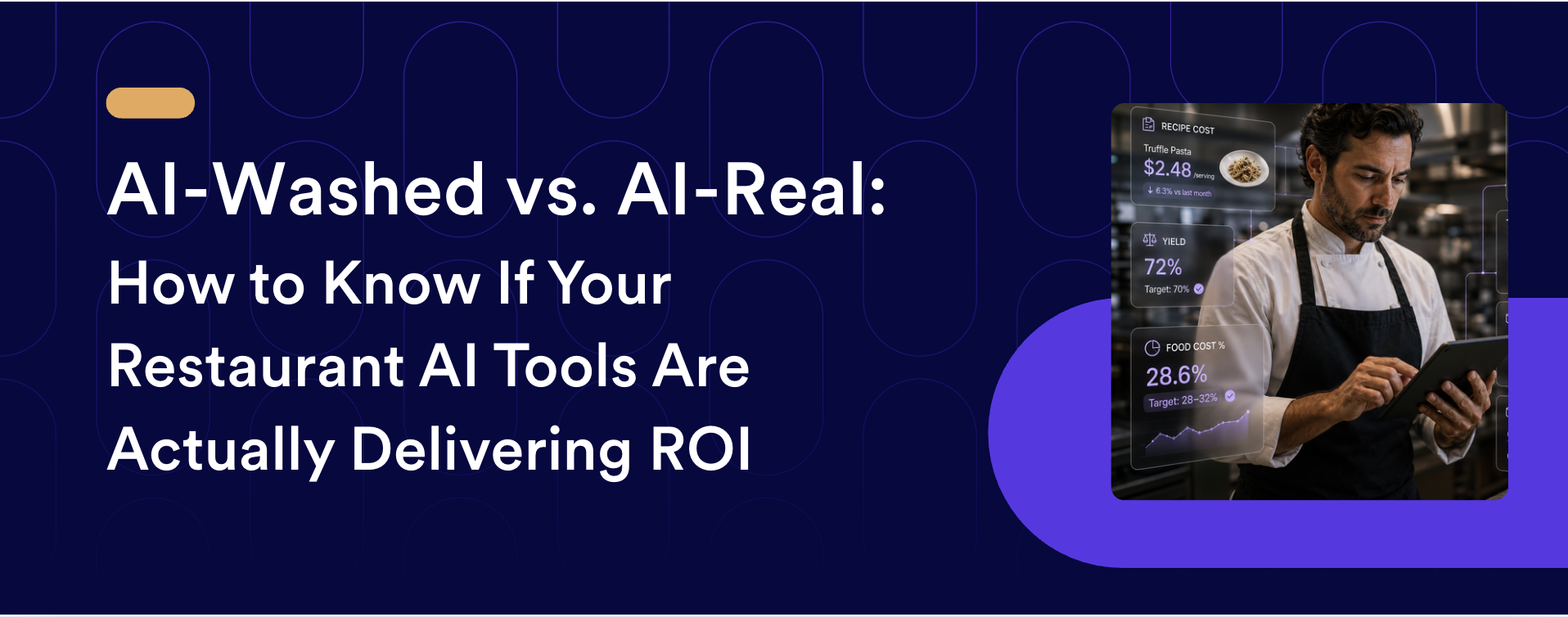
Two 15-location restaurant groups bought the same "AI-powered" forecasting tool last year.
One group cut waste by double digits within a quarter. The other group is still explaining to their board why the forecasts are consistently wrong, and why the tool nobody trusts is still on the P&L as a line item.
Same software. Same sales pitch. Same "AI-powered" badge on the homepage. Wildly different outcomes.
The difference wasn't the AI. It was everything underneath it.
That's the problem with restaurant AI tools right now. Every POS, every inventory tool, every scheduling app has bolted "AI" onto its feature list somewhere between the last funding round and this year's renewal cycle.
Some of that is real, operationally meaningful intelligence. A lot of it is a chatbot wrapper on the same static report you were already getting, relabeled to justify a price increase.
That gap has a name: AI-washing, when a restaurant tech vendor markets a feature as AI-powered without meaningfully changing the decision, workflow, or result underneath.
Operators evaluating restaurant AI platforms right now don't have an AI problem. They have a “how do I tell the difference” problem.
The data backs this up. A recent State of Digital report from restaurant tech supplier Qu found 51% of limited-service chains are currently investing in AI, but few have seen it meaningfully move the needle yet.
37% percent of operators surveyed pointed to fragmented systems and disconnected data as the thing actually standing between them and results.
The hype arrived on schedule. The ROI didn't, and the data gap is why.
What AI-Washing Actually Looks Like
AI-washing isn't always a lie. Most of the time it's a technically true claim doing a lot of work it can't back up. It shows up across every category of restaurant AI:
- AI food cost forecasting tools that are really just historical averages with a chat interface
- AI demand forecasting platforms guessing at unmapped sales data
- AI procurement tools generating purchase orders off stale specs
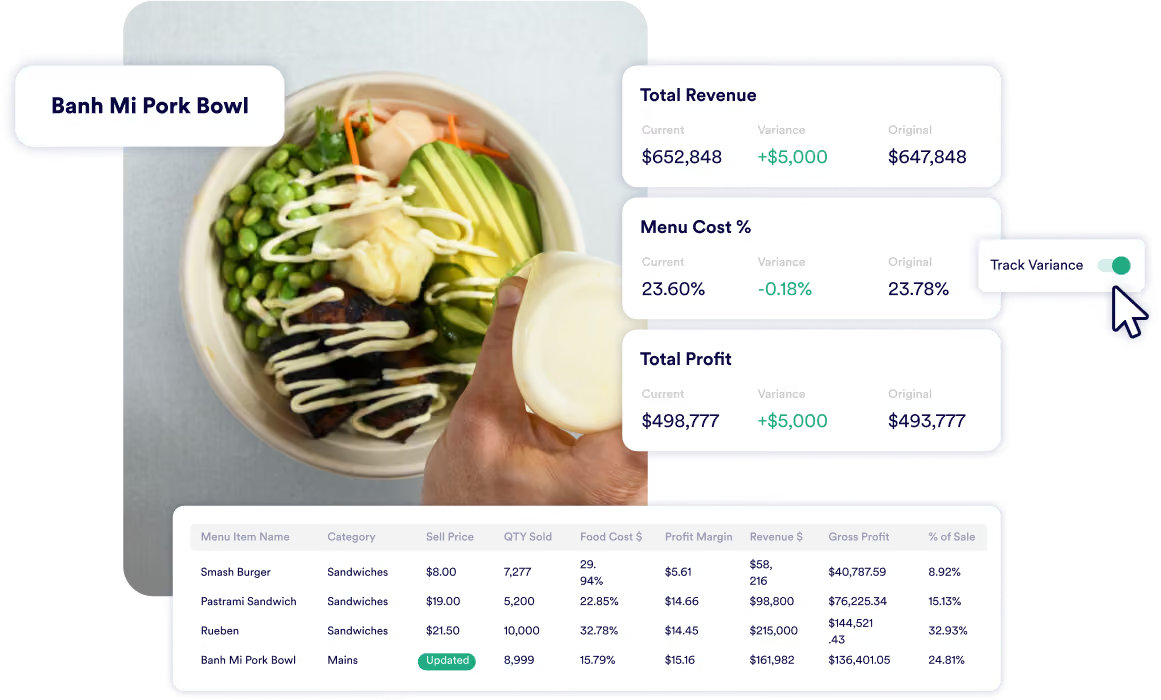
- AI menu pricing or ai menu engineering dashboards offering "smart menu decisions" that are just contribution-margin math anyone could run in a spreadsheet
The AI label rarely tells you which side of the AI-washed/AI-real line a specific tool falls on. But a few patterns show up constantly when you start pulling back the curtain on restaurant AI software:
The dashboard got smarter. The decision didn't.
A tool surfaces a trend you could have found in a spreadsheet pivot table, wraps it in a chat interface, and calls it restaurant AI insights. Nothing about the output changed. Only the packaging did.
The model is real. The inputs are garbage.
This is the most common and most dangerous version. The AI itself might be perfectly sophisticated. But it's running against recipe costs nobody's updated since a supplier price change eighteen months ago, or sales data that isn't mapped to actual menu items across locations. Sophisticated math on broken inputs still produces broken outputs. It just produces them faster and with more confidence.
It's automation, not intelligence.
A rules-based "if X then Y" workflow gets marketed as AI because it runs without a human clicking a button. That's automation, and automation has real value. But it's not the same claim as an AI system that learns, forecasts, or adapts, and operators paying an AI premium for a rules engine are overpaying for the wrong thing.
The demo is real. Your data isn't the demo's data.
Every vendor demo runs on a clean, curated dataset built to make the tool look brilliant. The real test is what happens when that same tool meets your actual recipe files: some in a shared drive, some in a chef's head, some in a spreadsheet that hasn't been touched since a menu update two years ago.
Five Questions That Separate AI-Real From AI-Washed
Before the next "AI-powered" pitch, ask the vendor these five questions. The answers tell you more than any feature list.
1. What data is this actually running on?
Not "what data could it use." What is it running on today, in your environment, with your current systems? If the answer is vague, that's the answer.
2. What happens when the input is wrong?
Every vendor has an answer for when the data is clean. Few have a good answer for what happens when a recipe yield is off, an ingredient swap wasn't logged, or a location's menu drifted from the standard. That failure mode tells you whether the tool was built for the real world or the demo.
3. Can you show me results on data that looks like mine, not a case study from a different vertical?
A forecasting tool built for a 100-unit fast casual chain with standardized recipes solves a different problem than one built for a 12-unit group with chef-driven menus. Ask for the specific proof point, not the aggregate marketing number.
4. Is this a system of record or a system of action?
This distinction, raised by Chowly CEO Sterling Douglass on a recent episode of The meez Podcast, is one of the clearest ways to separate real AI value from a dashboard with a new coat of paint.
Douglass put it plainly: at its core, most restaurant software, a POS included, is just a handful of databases wrapped in a UI.
A system of record stores that data. A system of action does something about it: adjusting a purchase order, flagging a margin erosion, 86'ing an item automatically when inventory runs out, triggering a prep alert before the problem shows up on next month's P&L.
Most "AI-powered" restaurant tools are still systems of record wearing an AI badge.
5. What's the data foundation this depends on. Who owns it?
If the honest answer is "your ERP" or "your POS," ask a harder follow-up: is the recipe, cost, and yield data feeding that ERP actually structured and current? Because that's usually where the chain breaks.
The Uncomfortable Truth: AI Doesn't Fix Bad Restaurant Data. It Scales It.
Here's the part most AI vendor pitches skip entirely: the sophistication of the model matters far less than the quality of what you feed it. This is a restaurant data infrastructure problem before it's ever an AI problem.
Bad Data Doesn't Stay Small. AI Scales It.
A wrong prep yield sitting in a spreadsheet is an annoyance.
The same wrong yield baked into an AI-driven forecasting or purchasing system becomes a systematic error running across every location that touches it, compounding with every forecast cycle instead of getting caught and corrected.
AI doesn't add judgment to bad data. It adds scale and confidence to it.
Restaurant Groups Seeing ROI Fixed the Foundation First
That's not an argument against AI. It's an argument about sequencing.
The restaurant groups getting real ROI from AI right now aren't the ones with the flashiest tools.
They're the ones who fixed the foundation first: structured, costed, version-controlled recipe data that every downstream system, forecasting, purchasing, labor, pricing, can actually trust.
What AI-Ready Restaurant Data Actually Looks Like
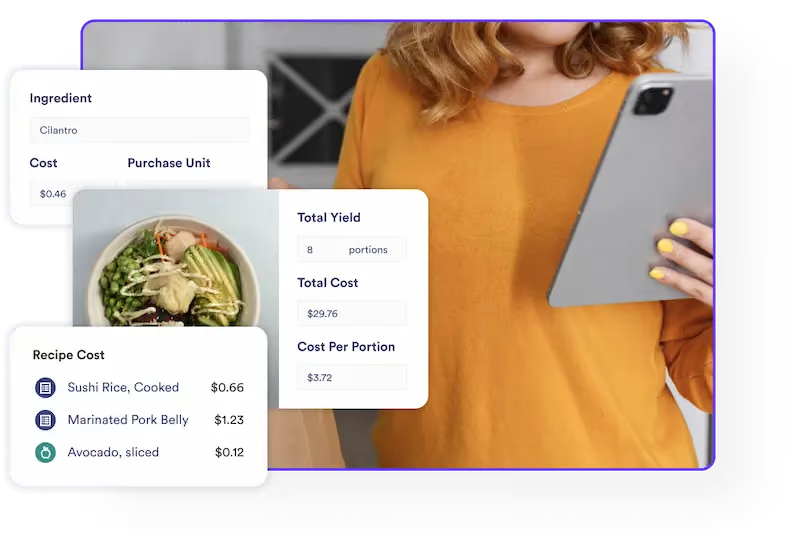
Recipe data isn't a side detail here. It's the origin point for nearly every number an AI tool touches: food cost, prep yield, portion size, menu pricing, invoice reconciliation, training standards.
When that data lives across Google Docs, a chef's memory, and a spreadsheet last updated before the last menu refresh, no AI layer on top of it is AI-real, no matter how good the model is.
That's restaurant data management failing at the source, and it's the most common form of restaurant data silos: recipe data that never connects to purchasing, POS, or ERP systems in the first place.
Proof That Clean Data Unlocks Better AI
There's a useful contrast here in what "AI-real" actually looks like when the foundation is right.
Deliverect, the digital ordering platform used by KFC, Burger King, and Taco Bell, recently ran an AI agent that autonomously designed, deployed, and optimized a marketing promotion for KFC Netherlands, producing a 118% single-day sales lift with no manual intervention.
That result wasn't magic. It was possible because the agent was acting on clean, real-time, connected order and menu data. Same principle, different data layer than recipes, same underlying truth: AI performs when the data underneath it is structured enough to act on.
The Industry Is Moving Toward Unified Data
There's a useful distillation of this from meez CEO Josh Sharkey himself, on the same episode with Sterling Douglass. Talking through how AI has made reporting and dashboards trivial to spin up, Sharkey's read was blunt: those problems don't need more technology to solve them.
They need a good data source that's actually structured well. Reports are cheap to generate now. What's still scarce is the clean, connected data underneath them, and no amount of AI sophistication substitutes for it.
This shift isn't theoretical — it's showing up in what the biggest back-office platforms are building right now. In May 2026, Restaurant365 launched R365 AI, an intelligence engine it's explicitly positioning around unified data, noting that most competing tools "rely on partial data — focusing on sales, labor, or inventory in isolation."
That's the AI-real argument playing out at the platform level: even a sophisticated intelligence engine is only as good as how connected the data feeding it is. Recipe and cost data is the piece of that puzzle R365 doesn't originate on its own, which is exactly why pairing R365's financial data with meez's costed, connected recipe layer closes the loop rather than adding another silo.
Why Multi-Unit Restaurant AI Carries More Risk Than Single-Location AI
A single-location operator with an AI-washed tool loses some time and maybe some trust in the software. A 20-location group with the same problem has a much bigger exposure, because multi-unit restaurant AI doesn't fail quietly. It fails at scale.
Recent industry data puts it plainly: operators who identify as "data enthusiasts" are far more likely to use AI successfully for menu strategy and pricing than the average operator, but roughly a quarter of operators still cite data silos as their single biggest tech stack challenge.
That gap between AI adoption and AI results is a data gap, not a technology gap.
At scale, a bad forecast doesn't cost you one bad prep list. It costs you a bad prep list at every location running that forecast, every day, until someone notices.
A recipe that exists in fourteen slightly different versions across fourteen locations isn't just an inconsistency problem anymore once you layer AI-driven purchasing or labor forecasting on top of it. It's a risk multiplier, and the automation makes that risk harder to catch, not easier.
Clean, connected restaurant operational data, the kind that stays identical across every location by design, is what keeps that risk from compounding in the first place.
Build vs. Buy Doesn't Solve This Either
AI has made it easier than ever for restaurant groups to build their own tools, not just buy them. That's a real and useful shift. But it doesn't change the core issue.
Whether you build a custom forecasting workflow in-house or buy an enterprise platform off the shelf, both approaches depend entirely on the same thing underneath: structured, accurate, connected data. A brilliantly engineered AI tool built on top of an ungoverned recipe and cost data layer will produce the same unreliable output as a mediocre one.
The intelligence isn't the bottleneck. The foundation is.
How to Know If Your Restaurant AI Platform Is Actually AI-Real
Run this quick gut check before your next renewal or new tool evaluation:
- Can the vendor show you a specific, verifiable result, not an aggregate industry stat?
- Does the tool degrade gracefully or fail silently when the input data is wrong?
- Is it acting on your data, or a curated version of data that looks nothing like your actual operation?
- Is it doing something (a system of action) or just reporting something (a system of record) with a chat interface bolted on?
- Have you fixed the recipe, cost, and yield data feeding it, or are you asking AI to compensate for a foundation you haven't built yet?
The restaurant groups getting genuine ROI from AI right now didn't wait for the perfect tool. They got their recipe data structured, costed, and connected first, then layered intelligence on top of a foundation that could actually support it. That's the difference between AI-washed and AI-real. It's not the model. It's what the model is standing on.
meez is the recipe operating system built for multi-unit restaurant groups and food service brands, giving culinary teams a single source of truth for every recipe, costed and connected to the systems that run your business. Most customers are live with costed recipes in 3 days or less, and R365 customers using meez see a 4% average reduction in food cost.
If you're evaluating restaurant AI tools, get the data foundation right first. See how meez gives your AI tools clean data to work with →
Frequently Asked Questions
What does "AI-washing" mean in the restaurant industry?
AI-washing refers to restaurant technology marketed as "AI-powered" when the underlying capability is closer to basic automation, a rules-based workflow, or an existing report wrapped in a new interface. The claim is often technically true but doesn't reflect a meaningful intelligence upgrade or ROI.
How can restaurant operators tell if an AI tool is actually delivering ROI?
Ask for specific, verifiable results rather than aggregate marketing statistics, confirm what data the tool runs on in practice (not in a demo), and check whether it acts on data automatically (a system of action) or just reports on it (a system of record). If a vendor can't clearly answer what happens when the input data is wrong, that's a signal.
Why does data quality matter more than the AI model itself?
AI amplifies whatever data feeds it. A sophisticated model running on outdated, inconsistent, or unstructured data, like recipe costs that haven't been updated in years, will produce forecasts and recommendations that compound inaccuracy rather than reduce it. Clean, structured data is the actual determinant of whether AI delivers value.
What is "AI-ready" recipe data?
AI-ready recipe data is structured and standardized with consistent units of measure, includes accurate prep yields, is version-controlled and centralized across every location, stays costed against live ingredient pricing, and integrates with ERP, purchasing, and inventory systems. Recipes stored in spreadsheets, PDFs, or a chef's memory don't meet that bar.
Does building custom AI tools solve the AI-washing problem?
Not on its own. AI has made it easier for restaurant groups to build their own automations, but whether a tool is built in-house or bought from a vendor, it depends on the same underlying data foundation. A well-built AI tool running on disconnected recipe and cost data will still produce unreliable results.
What should multi-unit restaurant groups prioritize before adopting more AI tools?
Establish a single source of truth for recipe, cost, and yield data across every location before layering on additional AI-powered forecasting, purchasing, or pricing tools. Getting that foundation right first is what separates operators who see real ROI from AI from those who are paying for intelligence acting on broken data.
What's the difference between a restaurant AI platform and an AI-enabled feature bolted onto existing software?
A restaurant AI platform is built around acting on live, connected operational data across the business, forecasting, purchasing, pricing, labor, as a core function. An AI-enabled feature is usually a single capability added to existing software, often running on the same siloed data the rest of the platform already has, which limits how much it can actually improve.