
There's no shortage of AI hype in the restaurant industry right now.
Demand forecasting. Dynamic pricing. Automated scheduling. Procurement optimization.
The promise is real: AI-powered tools can meaningfully reduce waste, cut labor costs, and sharpen the operational decisions that determine whether a restaurant group survives a margin squeeze or gets buried by one.
But here's what's getting lost in the conversation: AI doesn't conjure accuracy from thin air. It amplifies whatever data you feed it.
And in most restaurant operations, the data feeding these systems is broken at the source.
That source is your recipes.
The Foundation Nobody's Talking About
At the 2026 National Restaurant Association Show, restaurant technology executives issued a pointed warning against AI overdependence, cautioning that the value of any AI tool is constrained by the reliability of the underlying data and the processes feeding it.
It's a reasonable concern. And it points directly at a gap most operators haven't closed.
Your recipes aren't just cooking instructions. They are the origin point of nearly every operational and financial number that matters:
Food cost percentage
- Prep yield
- Portion size
- Invoice reconciliation
- Menu pricing
- Training standards
When recipes live in Google Docs, spiral binders, a chef's head, or a spreadsheet last touched in 2022, none of those downstream numbers can be trusted, no matter how sophisticated the AI layer on top.
You can't demand-forecast your way out of inaccurate yield data. You can't optimize purchasing on recipes that aren't costed. You can't build a training engine on instructions that vary by location.
Garbage in, garbage out. And in restaurants, the garbage almost always starts with the recipe.
AI Makes a Broken Foundation Worse Faster
This is the part that should concern multi-unit operators most.
"AI doesn't just reflect bad data. It scales it. A wrong yield figure that was an annoyance in a spreadsheet becomes a systematic error across 30 locations when it's baked into an AI-driven system."
Have an AI-driven procurement system that's pulling from recipe data that hasn't been updated since your last menu change? It's generating purchase orders built on fiction.
Use a forecasting tool models demand using historical sales tied to recipes that no longer reflect actual prep specs? The forecast compounds inaccuracy over time.
And when a labor optimization tool tries to schedule prep hours based on undefined yield assumptions, you get labor math that never quite works.
The more automated and interconnected your tech stack becomes, the more consequential the recipe data problem gets.
This isn't an argument against adopting AI. The operational efficiency gains are real, for operators who are set up to capture them. It's an argument for sequencing it correctly.
What "Good Recipe Data" Actually Means
Recipe data quality isn't about how beautifully written your recipes are. It means:
Structured and standardized
Recipes stored in a consistent format, with defined units of measure, prep yields baked in, and scaling logic that works whether you're cooking for 20 covers or 200, can actually be read and used by downstream systems.
Recipes in free-form text, PDFs, or mixed-format spreadsheets cannot.
Version-controlled and centralized
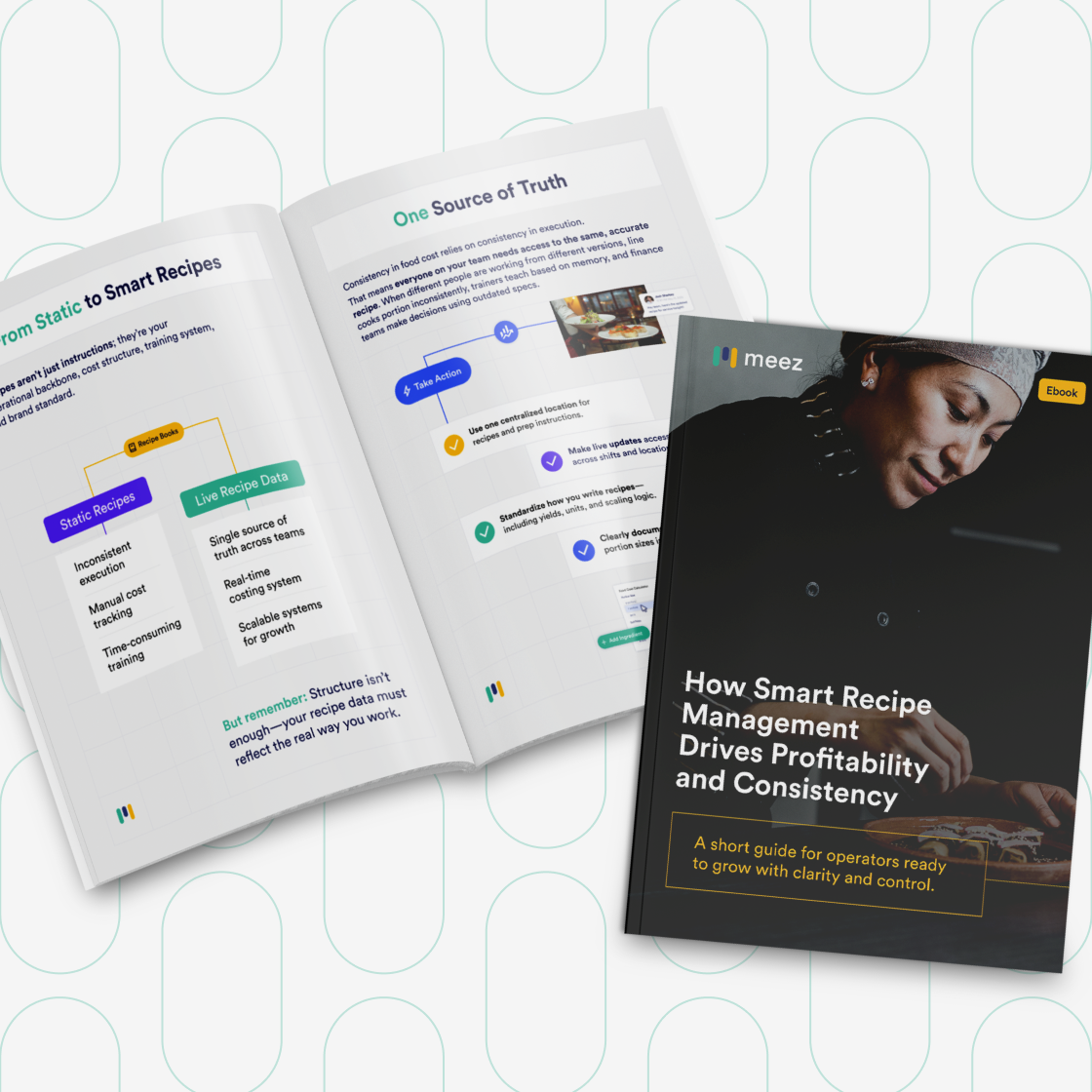
Every location needs to work from the same version of every recipe, updated in real time when something changes.
“A recipe that exists in 14 slightly different forms across 14 locations isn't a recipe. It's a risk, and every AI tool you layer on top of it will make that risk harder to see."
Costed and connected
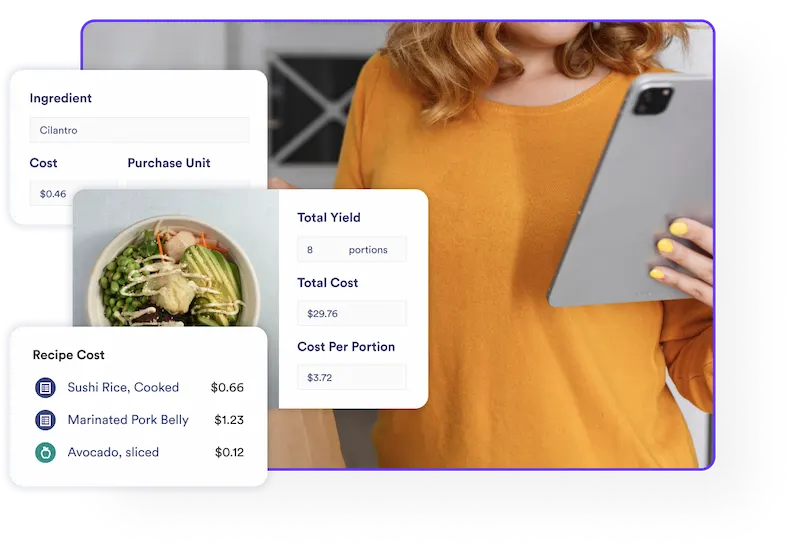
Recipes need to carry their cost data, including ingredients, quantities, and actual prep yields, and that cost data needs to update automatically when ingredient prices change.
Static cost cards go stale within weeks of creation. The key to unlocking accurate food costs lies in the intersection of purchase data, sales mix data, and recipe data, and recipe data is the one most operators are missing.
Integrated with the broader stack
Recipe data that lives in isolation, disconnected from your ERP, your inventory system, or your purchasing tools, doesn't power anything. The value of structured recipe data multiplies when it flows into the systems that make financial and operational decisions.
When your recipe data meets these standards, the AI tools you layer on top can do what they're supposed to do. When it doesn't, those tools are working against you.

The "We Have a System" Problem
Most operators think they have this handled. They don't.
"We use spreadsheets" is not a recipe system. Spreadsheets are static. They don't update when your produce costs spike 12% overnight, they don't enforce consistency across locations, and they can't talk to your ERP.
"We have everything in Google Drive" means your recipes are somewhere, not that they're structured, costed, version-controlled, or connected to anything.
The gap between "we have recipes somewhere" and "our recipe data is operational infrastructure" is exactly where food cost leakage happens, where training breaks down, and where the AI tools you're evaluating will fail to deliver.
From Systems of Record to Systems of Action
On a recent episode of the meez podcast, Chowly CEO Sterling Douglass made a distinction worth sitting with: the difference between a system of record and a system of action.

"A system of record stores data. A system of action does something with it, automatically 86ing an item when inventory runs low, adjusting a prep order based on forecasted covers, flagging a menu item whose margin has quietly eroded."
That shift is where AI in restaurants gets genuinely valuable. But Sterling was clear about what makes it work: the underlying data has to be structured, live, and connected. His example was a 30-location Poke concept that built a simple automation.
When rain was forecast, it automatically pushed a free miso soup offer to a targeted customer segment. What used to require a $400 million acquisition (McDonald's bought Dynamic Yield to do essentially that), now takes one person and an afternoon. But only because the customer data, the menu data, and the weather data were all clean and queryable.
meez CEO Josh Sharkey made the same point from the culinary side, describing how he thinks about building knowledge systems:
"MD files are gold for Claude and most LLMs. You can build really powerful databases of all your knowledge."
His mental model for structured data is, predictably, recipes. The principle is identical. Unstructured information sitting in folders is inert. Structured, indexed, connected information can be acted on.
That's exactly the gap most restaurant operators have in their recipe data today: it exists, but it can't be acted on. It's a system of record in the worst sense, a place things are stored rather than a foundation anything can run on.
The Right Sequence
"The operators who will get real ROI from restaurant AI are the ones who treat recipe data as foundational infrastructure before they bolt on intelligence. Your recipes are the data. Get that right first."
That means establishing a single source of truth for every recipe, one that every cook at every location pulls from, that automatically reflects current pricing, that captures yields and scaling logic, and that integrates with the financial systems your CFO actually relies on.
It means treating the recipe as a living data asset, not a static document. Done right, AI built on that foundation can deliver genuinely actionable cost insights, benchmarking performance, surfacing variances, and helping operators make faster and smarter decisions.
The AI technology creates genuine opportunity for operators willing to invest in it, but overdependence is a real risk. The resolution isn't to pick a side. It's to understand that AI performance and data quality are the same conversation.
Your recipes are the data. Get that right first.
meez is the recipe operating system built for multi-unit restaurant groups and food service brands, giving culinary teams a single source of truth for every recipe, costed and connected to the systems that run your business. Most customers are live with costed recipes in weeks, not months.
Frequently Asked Questions
1. Why does recipe data matter for restaurant AI tools?
Most restaurant AI tools, for forecasting, purchasing, labor, and cost control, depend on recipe data as their source of truth. If that data is inaccurate, outdated, or unstructured, the AI amplifies those errors across every decision it makes. Clean, connected recipe data is the foundation any AI layer runs on.
2. What makes recipe data "AI-ready"?
AI-ready recipe data is structured and standardized, version-controlled and centralized across all locations, costed with real-time ingredient pricing, and integrated with your ERP and back-office systems. Recipes stored in spreadsheets, PDFs, or Google Docs don't meet that bar.
3. Can restaurant AI work without a recipe management system?
Technically yes, but not well. Without a recipe management system providing structured, live data, AI tools are working from incomplete or static inputs. The result is forecasts, purchase orders, and cost reports that compound inaccuracy over time rather than reducing it.
4. How does recipe data affect food cost accuracy?
Recipe data is the benchmark for theoretical food cost. Without it, operators can see what they spent but not what they should have spent. That gap — between actual and theoretical food cost — is where margin leakage hides, and it's invisible without accurate, connected recipe data.
5. What is the difference between a system of record and a system of action in restaurants?
A system of record stores data: recipes, costs, procedures. A system of action uses that data to do something automatically, like adjusting a prep order, flagging a margin issue, or triggering a promotion. Restaurant AI works best as a system of action, but it can only function that way when the underlying recipe data is structured, live, and connected.