A restaurant's General Manager (GM) is the person ultimately accountable for everything that happens inside the building — and on the P&L. From leading a team through a chaotic Saturday dinner rush to reviewing labor percentages on a Tuesday morning, the GM's day spans people, operations, and finances in a way that few other roles in any industry can match.
This guide covers the full scope of restaurant general manager responsibilities and duties, what skills and qualifications the role requires, how to measure GM performance, and the leadership principles that separate good GMs from great ones.
What does a restaurant general manager do?
A restaurant general manager is responsible for the overall performance of the restaurant — both on the floor and on the financial statements. That accountability covers the guest experience, the team, day-to-day operations, and financial results simultaneously.
At a high level, the GM is the bridge between ownership and the frontline team, between the Front of House (FOH) and the Back of House (BOH), and between long-term strategy and what actually happens on any given shift. They don't just manage — they set the tone, model the standards, and hold the operation together when things go sideways (and they always do, eventually).
In many restaurants, the GM is also the highest-ranking person regularly present on the floor. That visibility matters enormously. A GM who is accessible, observant, and consistent builds a very different kind of team than one who manages primarily from the office.
Restaurant general manager job description
Below is a complete restaurant general manager job description that can be used as-is for a job posting, or adapted to your concept. It captures the position summary, reporting relationships, core responsibilities, required qualifications, and typical compensation.
Restaurant general manager responsibilities
The scope of a restaurant GM's responsibilities is broad by design — the role exists precisely because someone needs to own the full picture. Here's what that looks like in practice.
Restaurant general manager duties checklist
The 10 duty areas a restaurant GM is responsible for, at a glance. Each section that follows expands on these with the specific tasks involved.
1. Coordinating Front and Back of House Operations
A restaurant GM acts as the bridge between FOH and BOH, ensuring smooth communication and coordination across both sides. This involves managing customer service flow, overseeing kitchen operations, and maintaining the service standards that guests and staff both depend on.
When FOH and BOH aren't communicating — tickets pile up, food quality suffers, guests wait too long, and servers give conflicting information. The GM creates the systems and expectations that prevent these breakdowns, and intervenes directly when they happen anyway.
Core duties in this area:
- Setting and maintaining operational standards across the entire restaurant
- Ensuring seamless FOH/BOH communication to prevent service delays and errors
- Managing kitchen operations to optimize prep times and food quality
- Ensuring compliance with health and safety regulations
- Monitoring service flow and adjusting staffing and pace during peak periods
2. Staff Management and Development
Recruiting, training, and retaining staff is one of the highest-leverage responsibilities a GM has — and one of the most time-consuming. The GM sets the tone for the work environment, directly affecting team morale, service consistency, and turnover rates.
High turnover is expensive in every direction: recruitment costs, training time, the service disruption during ramp-up, and the cumulative impact on team culture. A GM who invests in developing people — not just filling seats — saves the restaurant significant money over time, while building a team capable of consistent execution.
Core duties in this area:
- Interviewing and selecting staff whose values align with the restaurant's culture
- Implementing training programs that prepare employees to meet service expectations
- Creating and maintaining staff schedules that match demand without overstaffing or understaffing
- Fostering a positive work environment that reduces turnover and retains experienced employees
- Coaching and developing team members for advancement, building a strong internal leadership pipeline
3. Guest Experience and Engagement
The GM is often the most visible leader in the dining room — and the most effective one for handling moments that require authority and genuine care. They actively engage with guests, gather real-time feedback, and address concerns on the spot before they become negative reviews.
Guest relationships compound over time. A GM who personally recognizes a regular, resolves a complaint gracefully, or follows up after a problem is resolved does something that no marketing campaign can replicate. That personal touch drives the repeat visits and word-of-mouth referrals that fuel sustainable revenue.
Core duties in this area:
- Actively engaging with guests during service to monitor satisfaction
- Resolving complaints and service failures promptly and with genuine accountability
- Gathering guest feedback and using it to improve operations, menu, and service standards
- Building relationships with regular guests to encourage loyalty and repeat business
- Ensuring the dining environment — cleanliness, ambiance, pace — consistently meets brand standards
4. Financial Management and Back-Office Duties
Running a profitable restaurant requires more than good food and warm hospitality. The GM oversees budgeting, payroll, financial reporting, and cost control — the back-office work that determines whether the restaurant is financially healthy.
This financial fluency isn't optional. A GM who doesn't read the numbers can't see problems coming. Labor drifting two points above budget over four weeks, food cost trending up without an obvious explanation, a vendor invoice that doesn't match the order — these are the signals that separate a restaurant that runs well from one that bleeds slowly.
Core duties in this area:
- Creating and managing the restaurant's operating budget
- Overseeing payroll accuracy and timeliness
- Preparing and reviewing financial reports covering labor cost, food cost, and profit margins
- Identifying cost savings without compromising service quality
- Making data-driven financial decisions to protect and improve profitability
5. Inventory Management
Inventory management is one of the most practical and direct levers a GM has over food cost. Keeping track of stock levels, minimizing waste, and negotiating effectively with suppliers all fall within the GM's purview.
An effective GM doesn't just count inventory — they use inventory data to make better decisions: which items to order in bulk, which to cut, when seasonal demand shifts require adjustments. The difference between a kitchen that consistently hits its food cost target and one that doesn't is often this kind of disciplined, data-informed inventory practice.
Core duties in this area:
- Tracking inventory levels regularly to prevent over-ordering or stockouts
- Working with kitchen staff to forecast demand and order accordingly
- Implementing waste-reduction practices to improve food cost margins
- Negotiating favorable pricing and terms with suppliers
- Using inventory data to inform menu decisions and portion standards
6. Menu Engineering
Menu engineering is the practice of analyzing each menu item's profitability and popularity, then using that data to improve the overall menu's financial performance. The GM uses sales data to evaluate which dishes are working and which aren't — and collaborates with the culinary team to act on those findings.
A well-engineered menu earns more money per cover than a menu built on intuition or tradition. Promoting high-margin items, adjusting pricing on underperformers, removing dishes that tie up kitchen labor without generating adequate contribution margin — these are the decisions that menu engineering makes possible.
Core duties in this area:
- Analyzing sales data to identify top-performing and underperforming menu items
- Collaborating with the kitchen team to develop or refine dishes based on performance data
- Adjusting pricing strategically to increase average check and contribution margin
- Using seasonal ingredients and trends to keep the menu fresh and relevant
- Tracking the impact of menu changes on revenue and food cost
7. Forecasting and Sales Planning
Using historical sales data to predict future demand is one of the GM's most practically valuable skills. Accurate forecasting reduces over-ordering and the spoilage that follows, prevents understaffing during busy periods, and creates the efficiency that directly improves profitability.
Core duties in this area:
- Analyzing past sales data to project future demand periods
- Adjusting inventory orders and staffing levels to match sales forecasts
- Identifying seasonal trends and planning promotions around them
- Monitoring actual performance against forecasts and adjusting in real time
- Using forecasting data to minimize waste and optimize resource allocation
8. Labor Cost Management
Labor is typically the largest controllable expense in a restaurant. The GM plays a direct role in managing it — through scheduling, productivity monitoring, and the ongoing balancing act between adequate coverage and unnecessary overtime.
Getting this right requires both data (labor percentage reports, sales-per-labor-hour metrics) and judgment (reading which shifts need an extra pair of hands versus which can run lean). Operators who manage labor well don't just cut hours — they optimize them, putting the right people in the right positions at the right times.
Core duties in this area:
- Creating schedules that match anticipated demand to minimize overstaffing and understaffing
- Monitoring labor hours and productivity to ensure efficiency across shifts
- Reducing unnecessary overtime through proactive scheduling adjustments
- Keeping labor expenses within budget as a percentage of revenue
- Balancing service quality with cost control at every staffing level
9. Facility and Equipment Oversight
A well-maintained restaurant reduces costs, ensures safety, and creates the environment that guests associate with quality. The GM oversees cleaning schedules, equipment maintenance, and the repairs that — if delayed — become far more expensive problems.
Core duties in this area:
- Managing cleaning schedules to ensure the restaurant is always presentable and safe
- Overseeing regular maintenance of kitchen equipment to prevent unexpected breakdowns
- Coordinating necessary repairs quickly to avoid service disruptions
- Ensuring compliance with health and safety standards
- Maintaining an environment that reflects well on the restaurant's brand
10. Marketing and Community Promotion
The GM is often responsible for the restaurant's presence in the local community — organizing events, managing review platforms, engaging on social media, and developing promotional campaigns that drive traffic.
Core duties in this area:
- Developing and executing marketing campaigns to attract new customers
- Engaging with the local community through events, partnerships, and special promotions
- Managing the restaurant's online presence, including social media and review sites
- Using promotion data to refine future marketing approaches
- Maintaining consistent brand messaging across all customer touchpoints
Restaurant general manager skills and qualifications
For those hiring a GM or building toward the role, here's what the position typically requires.
Required Skills
- Leadership and people management: The ability to recruit, develop, motivate, and hold a team accountable — consistently, across varied personalities and circumstances
- Financial literacy: Comfort reading P&L statements, managing budgets, interpreting cost reports, and making data-driven decisions
- Operational knowledge: Deep familiarity with both FOH and BOH operations, food safety, and service standards
- Communication: Clear, consistent communication upward to ownership and downward to frontline staff — and the judgment to know what each situation requires
- Problem-solving under pressure: The ability to make good decisions quickly when things go wrong during service
- Scheduling and forecasting: Practical skills in demand planning, shift scheduling, and labor optimization
- Emotional intelligence: The self-awareness and interpersonal sensitivity to lead people through high-stress environments with fairness and empathy
Typical Qualifications and Experience
- Several years of progressive restaurant management experience, including prior supervisory or management roles
- Strong working knowledge of food cost, labor cost, and restaurant P&L management
- Familiarity with POS systems, inventory management tools, and scheduling software
- ServSafe or equivalent food safety certification (often required)
- Associates or bachelor's degree in hospitality management or business administration (common but not always required for candidates with strong operational experience)
Compensation
Restaurant general manager salaries vary significantly by market, concept type, and restaurant volume. In the United States, GM compensation typically ranges from $55,000–$90,000+ annually for full-service and casual dining concepts, with higher-volume or multi-location roles often carrying compensation above $100,000. Variable compensation (bonuses tied to P&L performance) is increasingly common at the GM level.
Restaurant manager vs. general manager: what's the difference?
A question that comes up frequently: what actually separates a general manager from a restaurant manager (or assistant manager)?
The core distinction is accountability. An assistant manager is typically responsible for specific shifts, departments, or operational areas — and reports to the GM. The GM owns the overall outcome: the restaurant's financial performance, team culture, guest satisfaction, and long-term trajectory.
Assistant managers are responsible for execution within defined parameters. GMs are responsible for setting those parameters, measuring performance against them, and making the strategic decisions when parameters need to change.
This also means GMs are accountable for things that happen when they're not physically present. Building a team and systems capable of performing consistently across all shifts — not just the ones the GM is working — is one of the defining challenges of the role.
Key metrics restaurant general managers track
Strong GMs aren't just operationally skilled — they're data-literate. These are the metrics that show up most consistently in high-performing restaurant management:
Food cost percentage — Actual COGS as a percentage of food sales; typically targeted at 28–35% depending on concept type
Labor cost percentage — Labor spend as a percentage of revenue; combined with food cost to form prime cost (typically 60–65% of sales)
Revenue and sales trends — Week-over-week and year-over-year comparisons by daypart, category, and cover count
Average check size — A proxy for upsell effectiveness, menu mix, and pricing strategy performance
Table turn time — How efficiently the dining room converts covers, especially during peak periods
Guest satisfaction scores — Google, Yelp, and internal survey data; a leading indicator of repeat visit rates
Employee turnover rate — Tracks retention; high turnover is both a symptom and a cause of operational problems
Inventory variance — The gap between theoretical food cost (based on recipes) and actual food cost (from COGS); reveals waste, theft, or portioning issues
For a deeper look at how food cost and contribution margin connect in the GM's financial toolkit, see Food Cost Percentage vs. Contribution Margin: The Definitive Guide and How to Calculate Food Cost for Your Restaurant.
Common challenges restaurant general managers face
Even the most capable GMs operate in a structurally difficult environment. Understanding these challenges is part of being prepared for the role:
Balancing floor time with administrative work. The best GMs know their operation benefits from their physical presence — but the back-office work is real and important. Finding that balance is an ongoing negotiation.
Managing through labor shortages and high turnover. The restaurant industry has structurally high turnover rates. GMs are often simultaneously onboarding new hires while trying to retain the experienced staff who carry institutional knowledge.
Cost control during ingredient price volatility. Food costs shift with the market. A GM who isn't watching ingredient prices closely enough gets surprised at month-end. One who is watching has options: menu adjustments, portion recalibration, supplier negotiations.
Maintaining consistency across shifts. The restaurant should perform the same on a Tuesday lunch managed by an assistant manager as it does on a Friday dinner when the GM is present. Building that consistency requires systems, training, and trust — all of which take time to develop.
Avoiding burnout. The role is demanding by nature — long hours, high stakes, and constant people management. The GMs who sustain excellence over years are usually the ones who've learned to delegate effectively, invest in their team's development, and maintain boundaries around their own well-being.
Best practices for GM leadership success: lessons from chef Alon Shaya
On The meez Podcast, Chef Alon Shaya shared leadership lessons that apply directly to the general manager role — not just culinary leadership but the broader discipline of building and sustaining a values-driven team in a demanding industry.
Surround Yourself with the Right People
Building a successful operation starts with building the right team — not just people who are skilled, but people whose values align with where you're trying to go.
"When we created this company, we wanted to surround ourselves with people who are in the business for the right reasons. For a long time, I was surrounded by people who were horrible, narcissistic, abusive, and just really toxic. I decided that these are not people I want to be around. I have to do better for myself personally because I feel like I'm not able to express my values."
Set Clear Core Values and Live Them Daily
Values that only exist as slogans don't build culture. Values that show up in how you hire, how you evaluate performance, and how you handle difficult decisions — those build culture.
"All of our core values are how we evaluate our team. You're evaluated on reliability, positivity, empowerment, and education. And each one of those values translates to standard operating procedures throughout our day."
Don't Compromise Who You Are
In leadership, short-term pressure to compromise on values often masks a longer-term cost. Chef Shaya is direct about this.
"When you get there, if it's not a good place to work, you don't have to put up with it because the food's not worth it. Whatever that recipe might be, or that technique, it's not worth compromising who you are as a person."
Choose Team Wellness
Chef Shaya's philosophy puts team wellbeing before short-term profitability — not as an idealistic stance, but as a practical foundation for sustained performance.
"We're always going to choose wellness for our team over profitability, and that comes up and down. We still have to be profitable, keep the lights on, and buy food. But it's no different than saying, 'I'm going to buy heirloom tomatoes because it's going to taste better in this dish.'"
Build Accountability Through Feedback Loops
Empowerment without feedback is just autonomy. Chef Shaya operationalizes empowerment by creating structured opportunities for the team to push back and improve the operation.
"We empower our team to challenge what we do. We ask our team to disagree with us when they feel like we're doing something that goes against their belief... We use exit interviews and feedback to reflect and be better as a company. We look for patterns where we might not be doing something as much as we could have."
Set Non-Negotiables for Culture
Clear standards for behavior — consistently enforced — filter out those who don't belong and build trust with those who do.
"We set the tone for our non-negotiables... the team buys into that, or they don't, and the ones that do stick around. We're not going to tolerate someone's ego getting in the way of having a great day at work."
Constantly Reflect and Improve
Self-reflection isn't a soft skill — it's a leadership discipline. The GMs who get better over time are the ones who honestly evaluate what they could have done differently.
"We empower our team to challenge what we do... one thing we do is rewrote job descriptions, reorganized the way we teach, and improved communication based on feedback."
How meez supports restaurant general managers
meez is built to give GMs the operational clarity they need to lead effectively. By centralizing recipe data, inventory, and restaurant analytics in one platform, meez reduces the manual work that consumes GM time without creating value.
With all critical information in one place, GMs can ensure that recipes are standardized and consistent, ingredients are accurately tracked, and waste is minimized — leading to smoother operations and more time for the things that require human judgment.
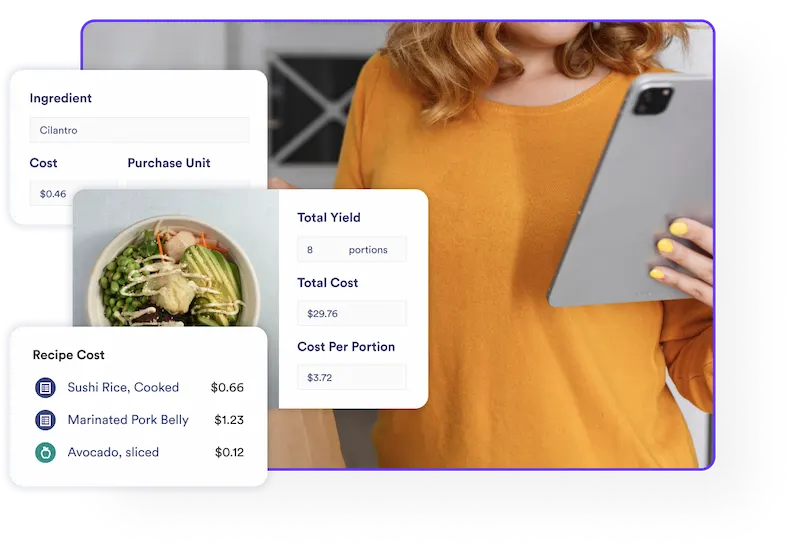
meez's menu engineering tools and food cost calculator give GMs the data they need to make pricing and menu decisions with confidence. Invoice processing keeps ingredient costs current automatically. And the analytics dashboard surfaces the metrics that matter — so GMs are never operating on stale information when it's time to make a call.
For operators managing multiple locations, meez provides the consistency layer that makes scaling possible: standardized recipes, shared ingredient costs, and centralized reporting across all sites. See how it works at getmeez.com/ops-leaders.
Frequently Asked Questions About the Restaurant General Manager Role
What are the main responsibilities of a restaurant general manager?
A restaurant GM is responsible for the overall performance of the restaurant — including leading and developing staff, overseeing daily FOH and BOH operations, managing labor and food costs, ensuring compliance with health and safety regulations, maintaining guest satisfaction, and driving financial results. The role is accountable for both the experience guests have and the financial outcomes the restaurant achieves.
What skills does a restaurant general manager need?
The most critical skills include leadership and people management, financial literacy (particularly around food and labor cost), operational knowledge of FOH and BOH functions, clear communication, scheduling and forecasting ability, and emotional intelligence. Strong GMs are also data-literate — comfortable reading reports, identifying variances, and acting on what the numbers reveal.
How is a restaurant general manager different from an assistant manager?
A GM owns overall performance, including financial results, long-term strategy, and team culture. Assistant managers typically focus on specific shifts or operational areas and report to the GM. The key distinction is accountability: the GM is responsible for what happens across all shifts, not just the ones they're present for.
What metrics does a restaurant general manager track?
Key metrics include food cost percentage, labor cost percentage, prime cost, sales trends by daypart, average check size, table turn time, guest satisfaction scores, employee turnover rate, and inventory variance. Tracking these consistently allows GMs to identify problems early and make adjustments before small issues become significant losses.
How many hours a week does a restaurant general manager typically work?
Most restaurant GMs work 45–60 hours per week, including evenings, weekends, and holidays. The hours reflect the nature of the business — restaurants operate when most people are off. Strong systems, capable shift leaders, and effective delegation can help GMs manage their time more sustainably over time.
What is the career path to becoming a restaurant general manager?
Most GMs come up through the restaurant, often starting as servers, line cooks, or bartenders, moving into shift supervisor or assistant manager roles, and building toward the GM seat over several years. Some operators also recruit GMs from hospitality management programs. The common thread is accumulated experience across multiple aspects of operations, including both FOH and BOH.
Ready to give your restaurant's general manager the tools to lead more effectively? Get a demo of meez or take a 2-minute interactive tour to see how meez supports restaurant GM operations.
Related resources
- 9 qualities of a great culinary director
- Executive chef: job description, duties, skills & salary
- Front of house vs back of house: FOH/BOH meaning, roles & management guide
- Food cost percentage vs. contribution margin: the definitive guide
- meez for operations leaders
Frequently asked questions about the restaurant general manager role
What does a restaurant general manager do?
A restaurant general manager owns the overall performance of the restaurant — both the guest experience on the floor and the financial results on the P&L. They coordinate FOH and BOH operations, lead and develop staff, manage labor and food costs, oversee inventory and menu engineering, and serve as the bridge between ownership and the frontline team.
What are the main responsibilities of a restaurant general manager?
A restaurant GM is responsible for the overall performance of the restaurant — including leading and developing staff, overseeing daily FOH and BOH operations, managing labor and food costs, ensuring compliance with health and safety regulations, maintaining guest satisfaction, and driving financial results. The role is accountable for both the experience guests have and the financial outcomes the restaurant achieves.
What skills does a restaurant general manager need?
The most critical skills include leadership and people management, financial literacy (particularly around food and labor cost), operational knowledge of FOH and BOH functions, clear communication, scheduling and forecasting ability, and emotional intelligence. Strong GMs are also data-literate — comfortable reading reports, identifying variances, and acting on what the numbers reveal.
How is a restaurant general manager different from a restaurant manager?
A general manager owns overall performance, including financial results, long-term strategy, and team culture. A restaurant manager — also called an assistant manager or shift manager — typically focuses on specific shifts or operational areas and reports to the GM. The key distinction is accountability: the GM is responsible for what happens across all shifts, not just the ones they're present for.
What metrics does a restaurant general manager track?
Key metrics include food cost percentage, labor cost percentage, prime cost, sales trends by daypart, average check size, table turn time, guest satisfaction scores, employee turnover rate, and inventory variance. Tracking these consistently allows GMs to identify problems early and make adjustments before small issues become significant losses.
How much does a restaurant general manager make?
Restaurant general manager salaries in the U.S. typically range from $55,000–$90,000+ annually for full-service and casual dining concepts, with higher-volume or multi-location roles often paying above $100,000. Variable compensation — performance bonuses tied to P&L results — is increasingly common at the GM level.
How many hours a week does a restaurant general manager typically work?
Most restaurant GMs work 45–60 hours per week, including evenings, weekends, and holidays. The hours reflect the nature of the business — restaurants operate when most people are off. Strong systems, capable shift leaders, and effective delegation can help GMs manage their time more sustainably over time.
What is the career path to becoming a restaurant general manager?
Most GMs come up through the restaurant, often starting as servers, line cooks, or bartenders, moving into shift supervisor or assistant manager roles, and building toward the GM seat over several years. Some operators also recruit GMs from hospitality management programs. The common thread is accumulated experience across multiple aspects of operations, including both FOH and BOH.