Quick Summary: SB-68 Compliance Checklist
California's SB-68, also known as the ADDE Act (Allergen Disclosure for Dining Experiences Act), requires qualifying restaurant chains to disclose the nine major food allergens on all customer-facing menus and ordering channels. Enforcement begins July 1, 2026.
If you're a culinary leader, operations director, or menu management team at a multi-unit restaurant group, here are the eight steps to take before the deadline:
- Establish a single source of truth for recipes
- Standardize ingredient specifications
- Track allergens at the ingredient level
- Verify supplier and vendor documentation
- Create a recipe change management process
- Audit all guest-facing ordering channels
- Train front-of-house teams
- Build an ongoing compliance review program
The biggest SB-68 compliance risk isn't creating allergen disclosures. The real challenge is keeping them accurate as recipes, ingredients, vendors, and menus change.
Is This SB-68 Checklist Relevant to My Restaurant?
This guide is designed for:
- Directors of Culinary and VPs of Culinary
- Corporate Executive Chefs
- Multi-unit restaurant operators and Food & Beverage leaders
- Menu management teams
- Restaurant groups with 20 or more locations that operate at least one location in California
If your organization meets those criteria, the July 1, 2026 enforcement date applies to you, and this checklist will help you prepare.
What Is SB-68? (The ADDE Act Explained)
SB-68, officially titled the Allergen Disclosure for Dining Experiences Act (ADDE Act), is California's new restaurant allergen disclosure law. It is the first law in the United States to require restaurants to display written allergen information for all nine major allergens, including sesame.
Beginning July 1, 2026, qualifying restaurant chains must disclose the presence of those allergens in standard menu items across every customer-facing ordering channel.
The law is designed to improve guest safety and help diners make more informed food choices.
For restaurant operators, however, SB-68 compliance is much more than a menu labeling project. It requires a repeatable operational process for maintaining accurate allergen information as recipes, ingredients, and menus evolve.
What Are the SB-68 Requirements?
The primary SB-68 requirements include disclosing the presence of the nine major FDA-recognized allergens:
Disclosures must be available anywhere guests interact with your menu, including:
- Printed menus
- Websites
- Mobile apps
- Online ordering systems
- Digital menu boards
- Kiosks
- Drive-thru menus
- Third-party delivery platforms
For multi-unit restaurant groups, maintaining accurate allergen disclosures across every ordering channel is one of the biggest compliance challenges.
Which Restaurants Must Comply With SB-68?
The California allergen law applies to restaurant chains that:
- Operate 20 or more locations nationwide (not just in California)
- Operate under the same brand name
- Offer substantially similar menu items
- Have at least one California location
A key nuance: the 20-location count is national, not limited to California. If your brand has 200 locations and only one in Los Angeles, that single California location still triggers SB-68 compliance requirements for the entire chain.
Franchised brands, corporate groups, delivery-only kitchens, and virtual brands operating under a consistent name and menu are all in scope.
SB-68 Applicability at a Glance
Why SB-68 Is a Culinary Operations Challenge
Most legal alerts explain the California restaurant compliance requirements.
Few explain what culinary leaders actually need to do.
If you're a VP of Culinary or Corporate Executive Chef, you're already managing menu innovation, food cost control, training, recipe consistency, supplier changes, new location openings, and seasonal rollouts. SB-68 doesn't live outside that work. It runs directly through it.
The challenge with SB-68 compliance isn't identifying allergens. The challenge is maintaining accurate allergen information every time a recipe changes.
That's why successful allergen disclosure compliance starts with culinary operations, not legal documentation.
The SB-68 Compliance Checklist for Multi-Unit Restaurant Groups
Step 1: Establish a Single Source of Truth for Recipes
Ask yourself:
- Where do recipes live today?
- How many versions exist across your locations?
- How are updates communicated?
- Are all locations working from the exact same specifications?
If recipes are scattered across spreadsheets, PDFs, shared drives, emails, and binders, maintaining allergen disclosure compliance becomes significantly harder. Every version gap is a compliance gap.
Why it matters: Accurate allergen disclosures begin with accurate recipes. Platforms like meez help culinary teams centralize recipes, ingredient specifications, nutrition information, and allergen data in one place, creating a single source of truth that supports both operational consistency and SB-68 compliance.
Step 2: Standardize Ingredient Specifications
Review:
- Vendor specifications and product documentation
- Approved substitutions
- Regional ingredient variations
Different suppliers introducing different ingredients can silently change the allergen profile of a dish. Standardizing specifications before compliance audits start is essential.
Why it matters: A supplier change can impact allergen disclosures immediately. Without a documented specification process, those changes may not surface until after a guest is already affected.
Step 3: Track Allergens at the Ingredient Level
Rather than manually assigning allergens to finished menu items, connect allergen information directly to ingredients. When a recipe uses an ingredient, its allergen data follows automatically.
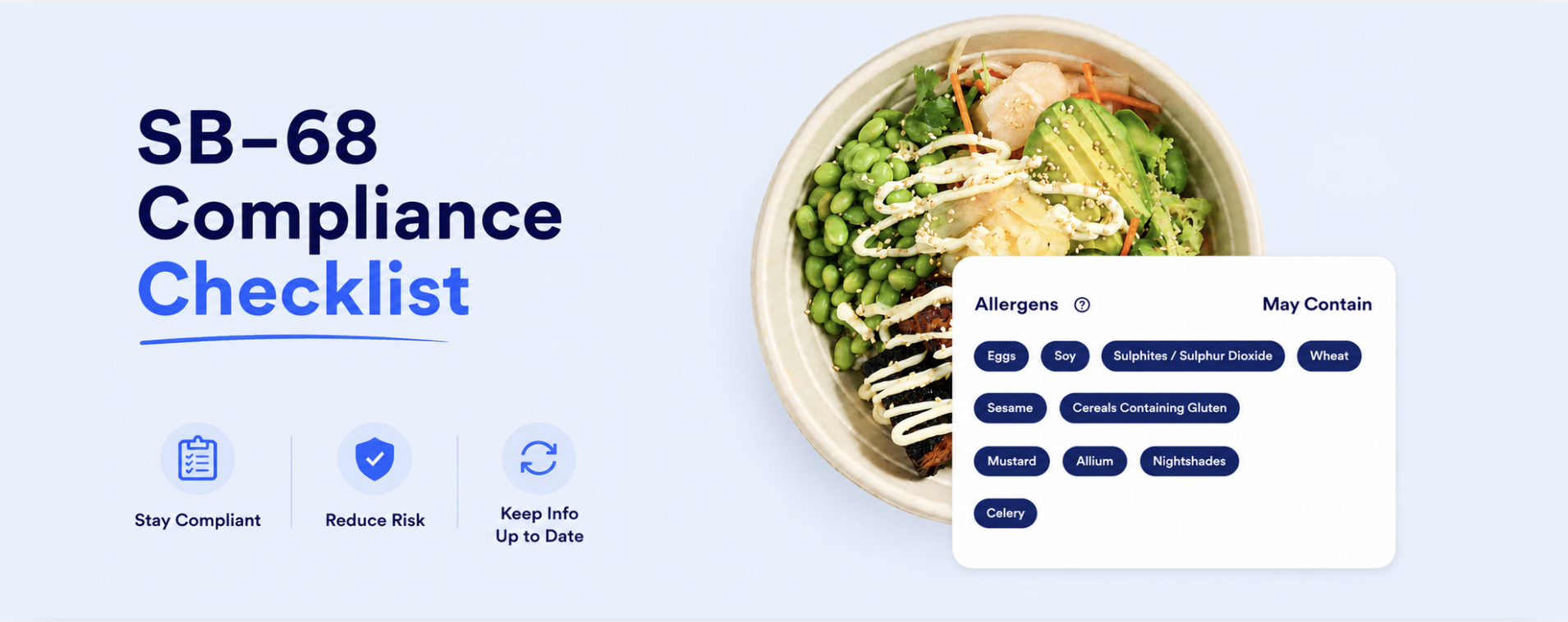
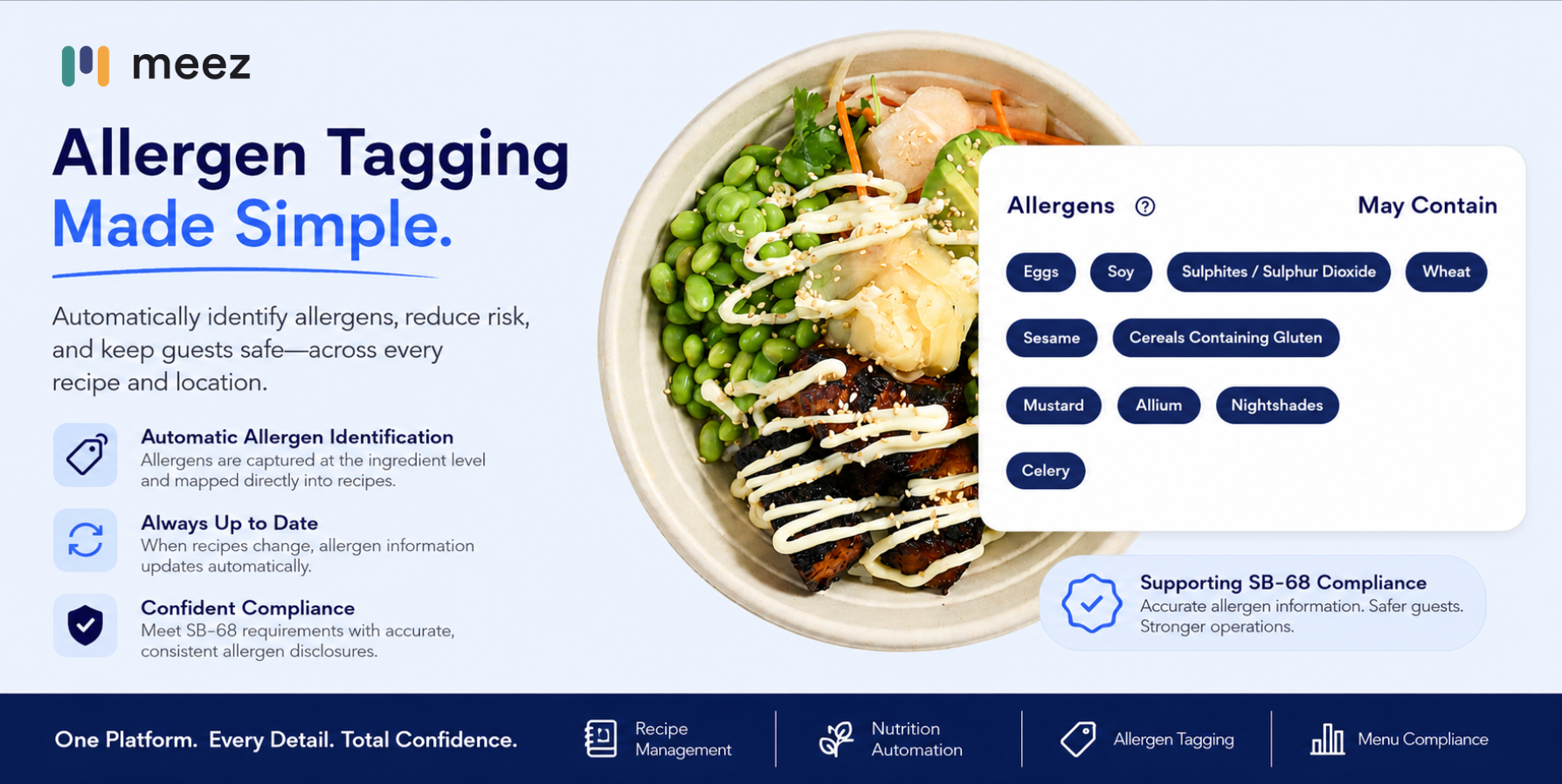
meez automatically identifies major allergens, including milk, eggs, fish, shellfish, peanuts, tree nuts, wheat, soy, and sesame, and maps them directly into recipes. Operators can also customize allergen tags and identify potential cross-contact or "may contain" situations.
Why it matters: Ingredient-level allergen tracking creates a more scalable and accurate compliance process. As recipes evolve, allergen information stays connected to the ingredients driving those disclosures, without manual re-entry.
Step 4: Verify Supplier Documentation
Build a master allergen database by collecting:
- Ingredient statements and product specifications from all vendors and broadliners
- Documentation of supplier updates and reformulations
- Written allergen declarations from approved substitutes
Allergen experts recommend auditing vendor and broadliner data on a regular quarterly cycle and linking your master allergen file to all menu outputs for seamless updates.
Why it matters: A supplier reformulation that introduces a new allergen is invisible unless you're actively monitoring supplier documentation. This is one of the most underestimated ongoing compliance risks.
Step 5: Create a Recipe Change Management Process
Every recipe update should trigger a review of:
- Allergen information
- Nutrition information
- Menu descriptions
- Training materials
- Digital ordering systems
For many restaurant groups, this is exactly where manual processes break down. A simple ingredient swap can require updates across nutrition disclosures, allergen tags, training docs, and ordering platforms, all at once.
Because meez generates nutrition and allergen data directly from recipes, updates can flow automatically alongside recipe changes, reducing duplicate work and helping teams maintain compliance as menus evolve.
Why it matters: Most compliance failures occur after menu changes, not before initial launch.
Step 6: Audit Every Guest-Facing Ordering Channel
Before enforcement begins, verify allergen disclosures are consistent and current across:
- Websites and mobile apps
- Online ordering and third-party delivery platforms
- Kiosks and digital menu boards
- Drive-thru menus
- Printed menus
Why it matters: Guests should receive consistent allergen information regardless of where they order. A disclosure that's accurate on your printed menu but outdated on your app creates both a compliance gap and a guest safety risk.
Step 7: Train Front-of-House Teams
Staff should understand:
- Where allergen information is located (menu, app, reference guide)
- How to answer guest questions accurately
- Escalation procedures for complex allergy requests
- Common allergen concerns relevant to your menu
meez makes allergen information filterable directly from the homepage, giving front-of-house staff a fast, reliable way to look up allergen data and answer guest questions confidently.
Why it matters: Guests frequently ask team members before reviewing menu disclosures. Front-of-house training is the last line of guest safety, not a compliance afterthought.
Step 8: Build an Ongoing Compliance Program
Allergen disclosure compliance is not a one-time project. Create recurring review cycles for:
- Menu launches and seasonal promotions
- Supplier changes and ingredient reformulations
- Recipe updates
- Team training refreshers
Designate an Allergen Champion internally: someone responsible for team coordination, audit readiness, and system ownership over time.
Why it matters: SB-68 compliance doesn't end at the launch date. The operators that stay compliant are those who treat allergen management as a living operational process.
The Hidden SB-68 Risk: Menu Rollouts
Many restaurant groups focus on creating allergen disclosures. The greater risk often emerges during menu changes.
Every rollout introduces new ingredients, new recipes, new suppliers, and new potential allergen exposures. This is also where disconnected systems become most visible. When recipes live in one system, nutrition data in another, and allergen information in spreadsheets, every menu launch creates new opportunities for outdated information to reach guests.
Before launching any menu update, culinary leaders should verify:
- Recipe specifications
- Ingredient data and allergen tags
- Nutrition calculations
- Staff training materials
- Ordering platform updates across all channels
For multi-unit restaurant groups, rollout discipline is often the key to sustained allergen disclosure compliance.

How meez Helps Restaurants Comply With SB-68
meez helps restaurants comply with SB-68 by centralizing recipes, ingredient specifications, allergen information, and nutrition data in a single platform, eliminating the double and triple data entry that most multi-unit operators currently deal with.
Built-In Allergen Identification
meez automatically captures allergen information at the ingredient level and maps it directly into recipes. All nine major allergens are identified automatically, and operators can customize tags to include cross-contact or "may contain" disclosures where appropriate.
Because allergen data is connected directly to ingredients and recipes, culinary teams can maintain accurate allergen disclosures without building separate workflows.
Nutrition and Recipe Data Stay Connected
One of the most overlooked aspects of SB-68 compliance is the operational burden of maintaining nutrition and allergen information separately from recipes.
Many restaurant groups currently rely on outsourced nutrition services or secondary software, creating duplicate work every time a recipe changes. meez automatically generates nutrition information directly from recipe data. When a chef adjusts an ingredient or changes a quantity, calories, macronutrients, and allergen tags update alongside the recipe automatically.
This creates a single source of truth for recipes, nutrition information, menu compliance, and ingredient data.
Reduced Administrative Work and Fewer Errors
Instead of updating recipes, nutrition information, and allergen data across multiple systems, culinary and operations teams work from one platform. This reduces:
- Manual data entry and duplicate work
- Risk of mislabeling from version inconsistencies
- Dependence on outsourced nutrition services
- Compliance gaps during menu rollouts
Better Front-of-House Visibility
SB-68 is ultimately about protecting guests.
meez makes allergen information accessible beyond compliance reporting. Teams can filter recipes and menu items by allergen, giving front-of-house staff a faster and more reliable resource for answering guest questions and supporting allergy-aware service.
Compliance Is Just the Beginning
SB-68 introduces new legal requirements, but it also surfaces a broader operational challenge facing restaurant groups: maintaining accurate recipe data at scale.
Restaurants that rely on spreadsheets, disconnected systems, and manual updates will continue to face challenges keeping allergen and nutrition information current as menus evolve.
The most successful operators will treat allergen disclosure compliance as an extension of recipe management rather than a separate project.
meez connects recipes, nutrition information, allergen tracking, and training resources into a single workflow so compliance happens as a natural byproduct of how culinary teams already work.
One recipe system. One source of truth. Automatic nutrition updates. Automatic allergen tracking. Continuous compliance.
SB-68 Compliance Checklist: Final Takeaways
For most multi-unit restaurant groups, the challenge isn't understanding SB-68 requirements. The challenge is maintaining accurate allergen information as operations change.
The restaurant groups that succeed will treat allergen disclosure compliance as a culinary operations initiative, not simply a legal requirement.
Ready for SB-68 Compliance?
See how meez helps multi-unit restaurant groups centralize recipes, automatically generate nutrition information, track allergens at the ingredient level, and simplify SB-68 compliance before July 1, 2026.
Visit getmeez.com/sb68 to learn more or take a tour of meez's nutrition and allergen management capabilities.
Frequently Asked Questions
What is SB-68?
SB-68, known as the Allergen Disclosure for Dining Experiences Act (ADDE Act), is California's restaurant allergen disclosure law effective July 1, 2026. It requires chains with 20 or more U.S. locations (including at least one in California) to disclose all nine major allergens on every customer-facing menu and ordering channel.
Who does SB-68 apply to?
The law applies to restaurant chains operating 20 or more U.S. locations under the same brand name with a largely consistent menu. At least one location must be in California. Franchised brands, corporate groups, ghost kitchens, and virtual brands all fall in scope if they meet these criteria.
What are the nine allergens restaurants must disclose under SB-68?
The nine major FDA-recognized allergens are: milk, eggs, fish, shellfish, peanuts, tree nuts, wheat, soy, and sesame.
Where must allergen disclosures appear?
Disclosures must appear on all customer-facing channels: printed menus, websites, mobile apps, online ordering systems, kiosks, digital menu boards, and drive-thru menus.
What is the biggest operational challenge with SB-68 compliance?
The biggest challenge isn't creating initial allergen disclosures. The real challenge is keeping them accurate after recipes, ingredients, and suppliers change. Most compliance failures occur during menu rollouts, not at the initial launch.
Can spreadsheets support SB-68 compliance?
Spreadsheets may work initially but become difficult to maintain accurately across multiple locations, frequent menu changes, and supplier updates. They also create duplicate entry risk when recipes and allergen data live separately.
Do I need to disclose allergens on third-party delivery platforms?
Yes. SB-68 requires allergen disclosure anywhere a guest can view your menu and place an order, which includes third-party delivery platforms.
What department should own SB-68 compliance?
SB-68 compliance is cross-functional, typically involving culinary, operations, food safety, menu management, and compliance teams. Experts recommend designating an internal Allergen Champion to coordinate across departments and own ongoing audit readiness.
Does SB-68 require nutrition labeling?
SB-68 focuses on allergen disclosure, not full nutrition labeling. However, many restaurant groups use the same recipe infrastructure, like meez, to manage both simultaneously, reducing redundant work.
What is the penalty for not complying with SB-68?
Specific enforcement penalties should be verified with legal counsel. Operationally, non-compliance creates significant guest safety risk and associated liability exposure for restaurant groups.