Julia Child didn't get a TV show by pitching a format. She got one by making an omelet.
She walked into a book critic's studio, lit a burner, and cooked a loose, perfectly rolled omelet in under 60 seconds. The host, skeptical that anyone would want to watch someone cook on television, was charmed on the spot. The show got made. And 40 years later, she's still the gold standard for culinary education in America.
That story came up in a recent episode of the The meez Podcast with Tony Award-winning actress Julie White, an Iron Chef America judge, Chopped competitor, and one of the most devoted food TV fans you'll ever meet. It unlocked something worth sitting with: the reason Julia Child worked wasn't her recipes. It was that she showed you the technique.
That's a distinction most restaurant training programs still get wrong.
Culinary Training Started as Demonstration, Not Documentation
Before food television became competition, drama, and celebrity, it was purely educational. The Frugal Gourmet. Ming Tsai's East Meets West. Early Food Network. The whole premise was simple: watch someone cook something, learn how to do it yourself.
Julia Child understood this more deeply than anyone. Her philosophy was built around technique transfer. She didn't describe a dish. She demonstrated it. Every time.
The best illustration is her late-career show with Jacques Pépin, where both masters cooked the same dishes side by side. Same hamburger. Same omelet. Same chicken.
Two different approaches, both valid, both demonstrable, and crucially, both repeatable by anyone watching carefully enough.
As Julie White put it:
"You see them both cook a hamburger and how they do it differently. You see them both take a chicken apart, both make an omelet, which is just glorious because they're just geniuses. And they've been doing what they do for so long to watch him take apart a chicken. It takes him 40 seconds."
Forty seconds. Not because Jacques Pépin is magic. Because he's broken down thousands of chickens, and that technique has been demonstrated, practiced, and perfected over decades.
The show worked as kitchen training because it showed you the motion, not just the finished plate.
When Restaurant Training Stopped Teaching Technique
Somewhere in the early 2000s, food TV producers figured out that drama moved more eyeballs than technique. Iron Chef, Top Chef, Hell's Kitchen: the format shifted from "here's how to cook this" to "let's see who survives." As Julie White put it, reflecting on how the genre evolved:
"Top Chef always has the same thing where you're on a deadline. So you were kind of watching a reality show and a cooking show. You didn't really, you didn't learn anything from it."
Restaurant training programs followed the same arc. The industry moved from hands-on apprenticeship toward compliance checklists, printed operations manuals, and shadow-a-senior-staffer-for-two-days onboarding.
The assumption became: if we write it down and hand it over, they'll execute it correctly.
They don't. Not consistently. Not across locations. Not when turnover hits 75% annually, and you're breaking in a new line cook every few weeks.
The data backs this up.
According to a 2025 midyear survey of operators representing over 5,000 U.S. locations, 42% of respondents reported turnover rates between 11% and 25%, with better training programs cited as a top retention driver.
A separate Restaurant Dive analysis found that the average frontline restaurant employee costs nearly $5,900 to replace, with Cornell's Center for Hospitality Research putting additional training costs at $821 per new hire on top of that.
For a restaurant cycling through 60 hourly employees a year, that adds up to over $138,000 in hard costs before you account for lost productivity and inconsistent plates going out.
FSR Magazine's 2025 State of Restaurants report found that 58% of operators said their staff receive only one to two hours of formal training per week. Eleven percent said their staff receives no formal training at all.
The Real Problem: Showing vs. Telling in the Kitchen
Julie White's Chopped story is the best illustration of why this matters.
She went into the competition having watched a Chef's Table episode about Magnus Nilsson cooking aged dairy cow. She saw Nilsson take a steak, place it in a screaming-hot iron skillet, and repeatedly baste it with butter. It's a classical French technique called arrosée, and she watched it demonstrated precisely, visually, until it stuck.
When a beautiful steak landed in her Chopped basket, she knew exactly what to do:
"I arrosée'd the shit out of it. And they were all like, wait a minute, this is the best steak I've ever had. It came out absolutely perfect."
She didn't read a recipe card. She didn't Google the technique. She watched it in motion, retained it, and replicated it under pressure in a competition kitchen, against professional chefs, on a timer.
That's the entire argument for visual, step-by-step recipe training, delivered by someone who has never worked a line in her life.
FSR Magazine's piece on best practices for training new restaurant employees identifies the same pattern: the biggest mistake operators make is telling new hires to "just follow this person around for a few days." Shadowing is passive. A new hire observes someone doing the task but doesn't learn the why behind each step, and has no reference point when they forget.
Restaurant Dive's research reinforces this: 28% of restaurant employees cite training videos as a preferred training method, far ahead of written manuals.
Yet most kitchens still default to a laminated card and a verbal walkthrough.
Kitchen SOPs and Recipe Documentation Aren't Enough on Their Own
There's a reason Jacques Pépin can break down a chicken in 40 seconds, and it's the same reason a new line cook given only a written recipe will produce an inconsistent result for their first 30 shifts.
Cooking technique doesn't transfer through description. It transfers through demonstration, repetition, and reference. In most restaurants, the demonstration lives only in a senior cook's hands. When that cook leaves, the technique leaves with them, regardless of how thorough your kitchen SOPs or recipe procedures are on paper.
Julie put a finer point on it when describing what made the Jacques and Julia show so valuable as a teaching tool:
"It's just the simplest stuff. Maybe a salad niçoise, they make an omelet, they make a hamburger. And they just love it so much. And it's so simple too, like he doesn't fuck around, you know, like they're gonna make it exactly the way it's supposed to be."
That's the standard. Make it exactly the way it's supposed to be, and make that demonstrable, every time, to anyone who needs to learn it.
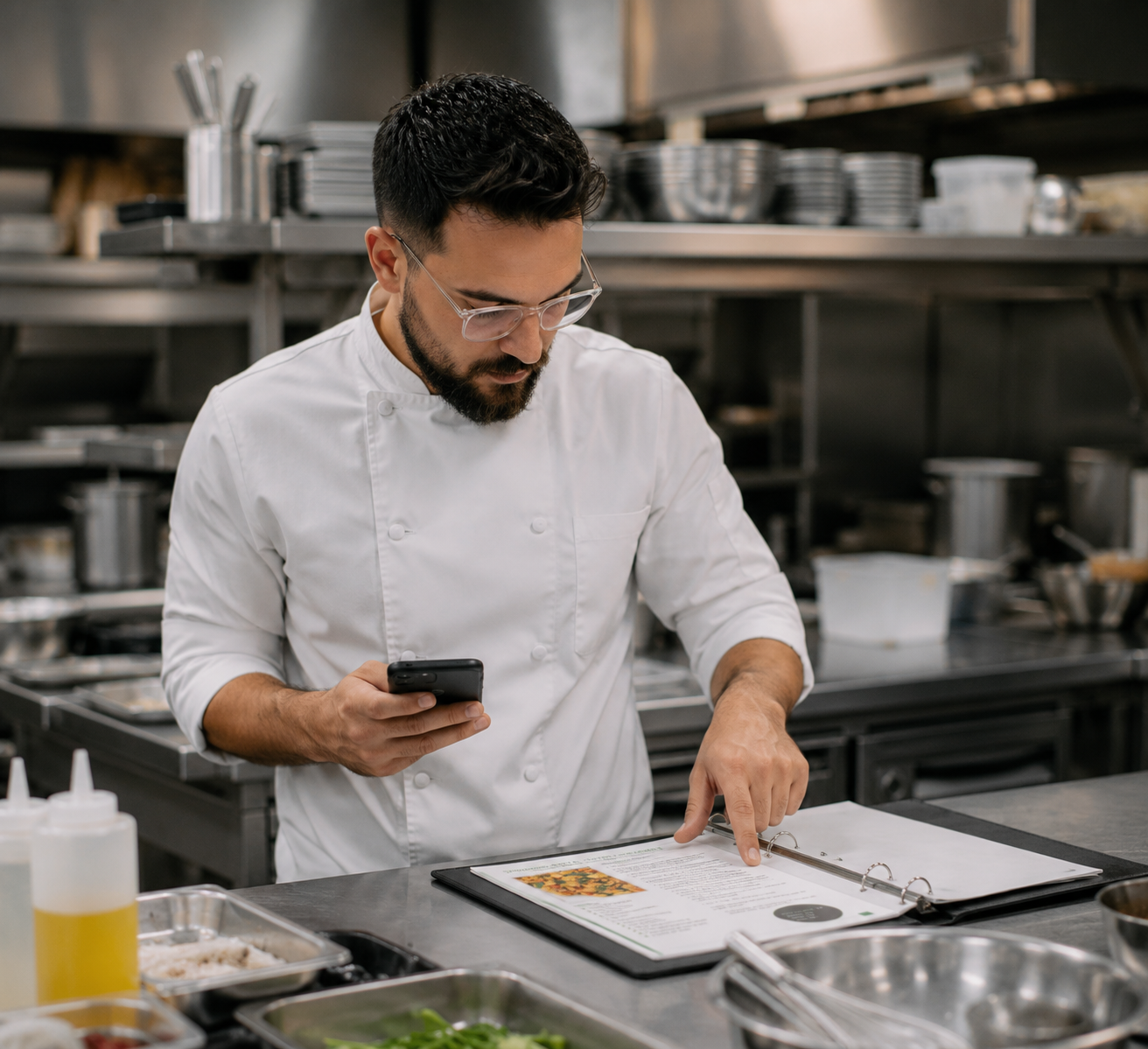
Standard operating procedures for restaurants are necessary, but they're not sufficient. A written SOP tells someone what to do. A visual, step-by-step recipe with video at every stage shows them how it actually looks when it's done right. That's the gap most restaurant knowledge bases don't close. Culinary documentation that lives in PDFs and shared drives describes the technique. It doesn't transfer it.
The operators who have closed this gap have moved their recipe documentation into systems where technique is visible, not just written down. That means recipe training built directly into the recipe itself, with video on every prep step, photos at every plating stage, and the motion captured and accessible from any device in any kitchen.
Multi-Location Training, Brand Standards, and the Rollout Problem
For single-location operators, inconsistent training is expensive. For multi-unit restaurant groups, it's an existential risk to brand standards.
When a recipe changes, whether it's a new protein, a seasonal swap, or an allergen update, it either pushes instantly to every kitchen with visual steps intact or it travels by email thread and printed cards that may or may not reach every station. The first approach maintains training consistency. The second relies on hope.
This is the core challenge of multi-location training and restaurant rollouts: the technique that a culinary director demonstrates in the test kitchen needs to arrive at location twelve exactly as intended, interpreted by a cook who may have started last week. That's not a people problem. It's a culinary documentation and knowledge management problem.
Tortazo, Rick Bayless's fast-casual restaurant group, solved it by centralizing their recipe library and saw 15 to 20 minutes saved per staff member per day, with fewer recipe errors and miscommunications across all four locations. The time savings were a byproduct of staff not having to track down a senior cook to ask how something was supposed to be executed. The answer was already there, visual and precise, in the recipe itself.
“meez has played a pivotal role in ensuring recipe uniformity and staff accountability. The ease of use and real-time recipe updates have eliminated errors and have been a significant time saver.” - Heather Terhune, Director of Culinary Operations
For restaurant onboarding and new location openings, this matters even more. When your operational playbooks, kitchen procedures, and recipe SOPs all live in one structured, searchable system, every new team member, at every location, starts from the same foundation.
Brand standards training doesn't depend on institutional memory. It's built into the system.
This is why recipe standardization isn't just a culinary decision. It's an operational and financial one. When your culinary onboarding is built on top of your recipe system, a new hire at location four gets the same visual walkthrough as a veteran at location one.
The Throughline
Julia Child got a show because she demonstrated that technique could be taught, visually, clearly, and in real time. She didn't describe cooking. She cooked. And she made it legible to anyone watching.
The restaurants winning on training consistency have figured out the same thing: the recipe isn't just a list of ingredients and steps. It's the foundation of your restaurant's knowledge base, a version-controlled, demonstrable system for passing technique from one cook to the next, even when the original cook is long gone.
If your team is relearning how to execute dishes from scratch every time someone new walks in the door, the problem isn't turnover. The problem is that the technique isn't documented in a way that actually transfers.
Julia would have fixed that. She'd have made the omelet.
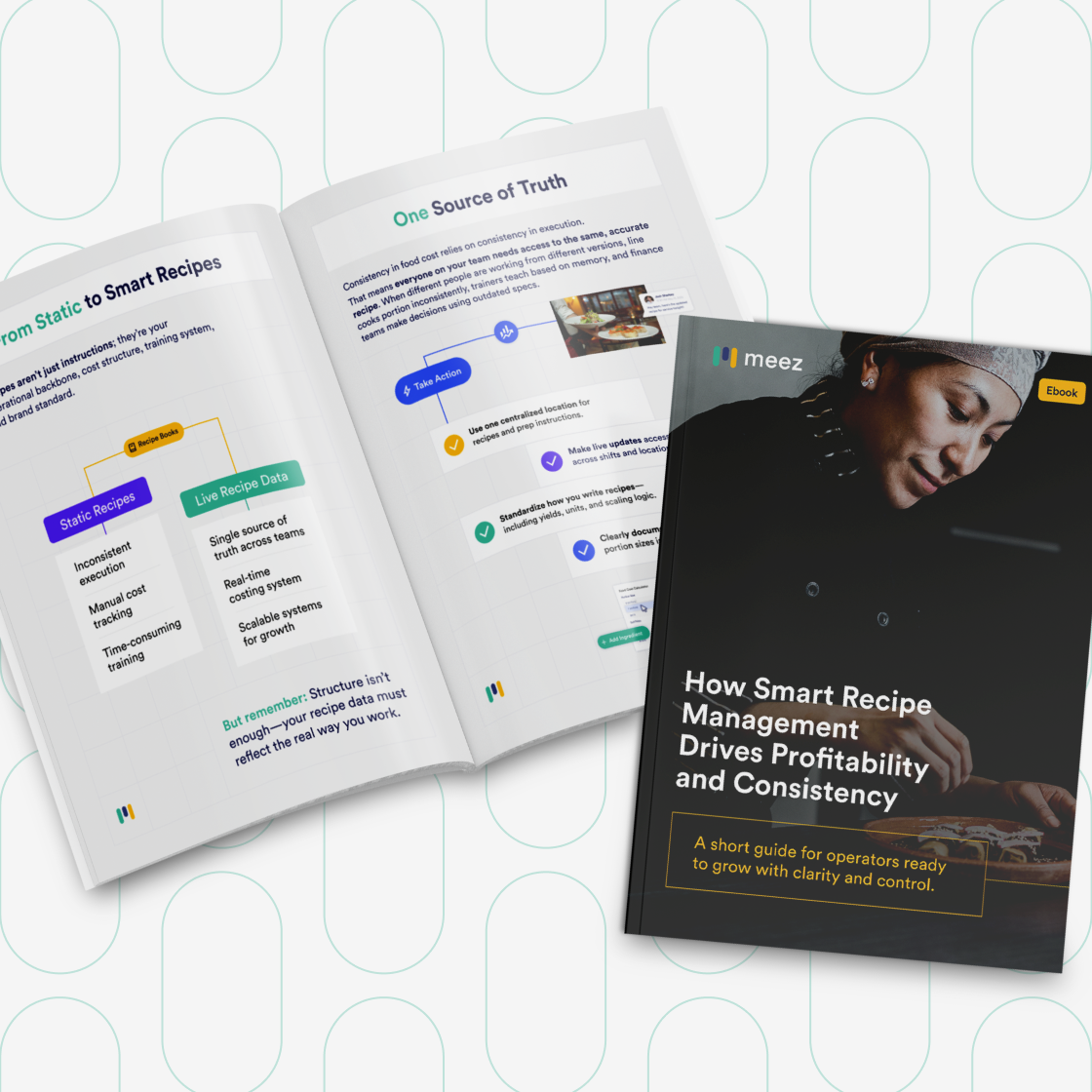
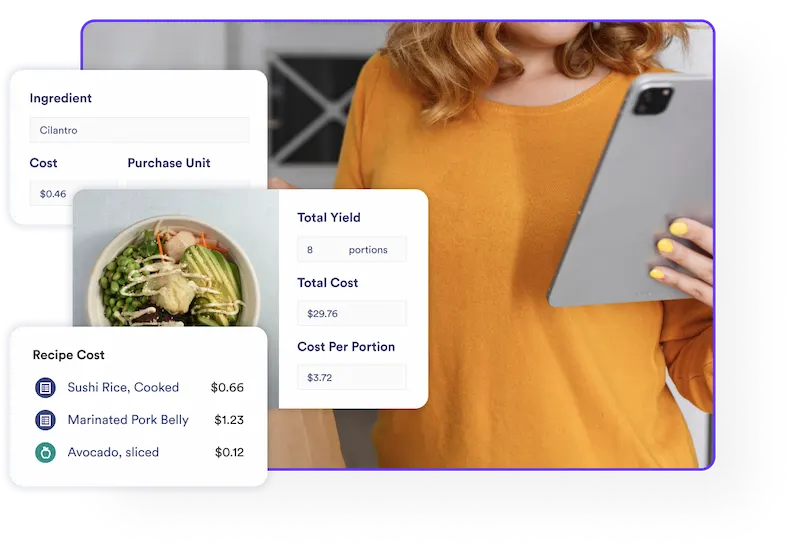
meez helps thousands of restaurants replace scattered recipe docs, PDFs, and binders with a centralized, visual recipe training and knowledge management system. Most customers are live with costed, trainable recipes in three days or less. See how it works →
Frequently Asked Questions
What is recipe training in a restaurant?
Recipe training is the process of teaching kitchen staff how to prepare every dish to brand standard, not just what the ingredients are, but how to execute each step correctly and consistently. Effective recipe training combines written recipe procedures with visual references like photos and videos, so technique can be demonstrated and repeated regardless of who is on shift.
What's the difference between kitchen SOPs and recipe SOPs?
Kitchen SOPs (standard operating procedures) typically cover broader operational tasks: opening and closing procedures, cleaning schedules, food safety protocols, and station setup. Recipe SOPs are specific to dish execution: prep steps, cook times, plating standards, and portioning. Both are essential, but recipe SOPs need visual documentation to be truly effective as training tools, since technique is hard to convey through text alone.
How do restaurants maintain training consistency across multiple locations?
Multi-location training consistency depends on having a centralized, version-controlled recipe and documentation system that every kitchen can access in real time. When recipe updates, menu changes, or new kitchen procedures push simultaneously to all locations with visual steps intact, training consistency follows. When changes travel by email or printed materials, standards drift.
What is culinary onboarding?
Culinary onboarding is the process of ramping a new kitchen employee from zero to full execution of your menu, at standard. Strong culinary onboarding goes beyond a first-day orientation and embeds technique transfer into the recipe system itself, so new hires can reference visual, step-by-step instructions for every dish without relying solely on a senior cook to show them.
What should a restaurant knowledge base include?
A restaurant knowledge base should centralize everything a kitchen team needs to execute at standard: costed recipes with photo and video steps, kitchen SOPs and recipe procedures, allergen and nutrition data, prep lists, training materials, and version history so teams always know they're working from the current spec. The best restaurant knowledge bases are searchable, accessible from any device, and live inside the recipe management system itself rather than scattered across shared drives and PDFs.