
Your supplier just switched your burger bun. Same price. Same lead time. The driver dropped the new cases without a word.
By Tuesday morning, your servers are answering allergen questions about a dish that now contains sesame, but your printed menus, website, ordering app, and third-party delivery listings still show the old allergen profile.
Nobody meant for this to happen. But it happened.
This is not a hypothetical. It is one of the most common allergen compliance failures in multi-unit restaurant operations, and it becomes more dangerous and more frequent as your location count grows.
With California's SB-68 (the Allergen Disclosure for Dining Experiences Act) enforcement beginning July 1, 2026, the cost of this gap is no longer just a food safety risk. It is a legal exposure.
The regulatory environment is only tightening. Compliance specialists interviewed by Modern Restaurant Management are direct about it: entering 2026, "regulatory expectations are tightening at every level, and consumer awareness has never been higher."
Their guidance to operators is to conduct thorough internal reviews of every ingredient across every product line as an ongoing operational practice, not just during health inspections. Allergen risk no longer waits for audit season.
Understanding why supplier substitutions break your allergen compliance, and what it takes to build a system that actually catches them, is one of the most important operational investments a multi-unit restaurant group can make right now.
Why Allergen Compliance Is an Operational Problem, Not a Menu Problem
Most restaurant teams treat allergen compliance as something that lives on the menu. Label the items, brief the servers, move on. That framing misses where the actual risk is.
Allergen compliance is a data chain. It starts with your ingredients, flows through your recipes, and reaches the guest as a disclosure. Every link in that chain has to stay current.
If ingredient data changes and recipe data does not update, your disclosures are wrong, even if your menus look perfectly formatted.
The challenge is that restaurants are operationally dynamic in a way that packaged food manufacturers are not. A packaged product is manufactured, labeled, and sold in a fixed form.
A restaurant serves hundreds of recipes across dozens of channels, with ingredients that can shift any week based on supplier availability, pricing, or sourcing decisions. Every one of those shifts is a potential allergen compliance event.
As the restaurant allergen compliance guide from ADDE makes clear, restaurants cannot rely on the packaged-food model of compliance. They need an operating model that can cope with change.
Good restaurant allergen management means your operation can reliably do four things:
- Know what allergens are present in every recipe
- Communicate that accurately to every guest
- Control cross-contact risk in the kitchen
- Update all of that in real time when something changes.
Ingredient-level visibility is the foundation. Without it, accurate allergen tracking is not maintainable at scale.
There is also a meaningful business case beyond compliance. Research cited by Restaurant Business found that guests with food allergies are excellent restaurant customers, and that restaurants effectively catering to them can increase profit margins by roughly a quarter.
About 10% of Americans live with a food allergy, and the number of guests proactively disclosing dietary needs continues to grow. The infrastructure you build to protect those guests is the same infrastructure that unlocks a loyal, underserved customer segment.
The Specific Risk: How Supplier Substitutions Break Allergen Compliance
The most common allergen failures are not dramatic errors. They are quiet ones. A reformulated dressing. A new spice blend that includes wheat. A replacement sauce with milk powder. A bun supplier switch, and now sesame is present where it was not before.
These changes often happen back-of-house. Purchasing knows. The receiving team knows. The kitchen adapts. But the front-of-house materials, including menus, digital boards, apps, and delivery platforms, do not update because there is no system connecting the supplier change to the guest-facing disclosure.
This is what makes ingredient substitutions such a high-risk category in allergen compliance. The ingredient has already changed by the time a guest asks the question. If your team is answering from outdated information, the answer is wrong.
Nation's Restaurant News flagged exactly this dynamic in their 2026 restaurant risk roundup: when a menu update omits a key allergen and goes unnoticed, the result can be a serious health incident and a major liability claim. The same logic applies to any unreviewed ingredient change. The source of the error does not change the guest's exposure.The pattern compounds at scale.
A restaurant group with fifteen locations and three ordering channels per site is effectively managing 45 separate menu surfaces. A single ingredient change that is not systematically propagated can create 45 incorrect allergen disclosures simultaneously, all confidently answering the wrong question.
What Most Restaurant Groups Are Actually Using Today
The typical allergen management workflow at a multi-unit group looks something like this: recipes live in spreadsheets or shared Google Docs, allergen information is manually maintained in a separate tracker, menu updates happen through a chain of emails and print requests, and training is handled through PDFs and verbal briefings.
This approach has a single point of failure: every update is manual.
When a supplier changes an ingredient, someone has to notice, communicate it to culinary leadership, update the recipe, update the allergen tracker, update every channel where the menu appears, and then retrain or re-brief the floor team.
That chain breaks, not because people are not trying, but because the volume of changes makes it structurally impossible to maintain without a connected system.
The absence of version control makes the problem worse. When recipes exist in shared folders or binders, there is no reliable way to know which version is current, which locations have received the update, or when the last change was made. You cannot audit what you cannot track, and you cannot defend a compliance claim without a documented allergen audit trail.
What a Real Allergen Compliance System Needs to Do
Genuine allergen compliance infrastructure, the kind that holds up when ingredients change, has several defining characteristics that go well beyond spreadsheet-based tracking.
Ingredient-level allergen tracking
Allergen data must be attached at the ingredient level, not the finished dish level. When an ingredient's allergen profile changes, every recipe containing that ingredient should reflect the update automatically.
This is the only architecture that makes an allergen compliance system maintainable as menus and suppliers evolve. An allergen database that auto-calculates dish-level allergens from individual ingredients eliminates the reliance on manual flags that inevitably drift.
Recipe-to-menu traceability
Allergen disclosures on menus should be derived from the recipe, not created independently. When a recipe changes, guest-facing materials need to update from that same source of truth.
Any system where recipe data and menu data are maintained separately will eventually produce contradictions.
An allergen audit trail
Allergen compliance documentation is not just about having accurate disclosures today. It is about being able to demonstrate accuracy at any point in time, and that changes were tracked and propagated appropriately.
An audit trail shows what changed, when, and why. That is the difference between being defensible and being exposed when something goes wrong.
Supplier change integration
Allergen compliance can only be as current as your ingredient data. Your allergen compliance system needs to connect to the same data stream as your purchasing and supplier management.
When a vendor change is logged, it should trigger a review of every recipe affected, not a manual memo that may or may not reach the right people.
A consistent allergy compliance workflow
Compliance cannot depend on institutional memory or individual vigilance. It needs a documented process: how changes are flagged, how recipes are reviewed, how disclosures are updated, and how teams are notified.
That workflow must be identical across every location.
The incorporation of technology in food operations is an investment that offsets costs by improving efficiency and accuracy. For allergen management specifically, technology is not optional. It is the only architecture that holds at scale.
The Multi-Location Multiplication Problem
For a single-location restaurant, allergen management is hard but manageable. A head chef can maintain awareness of what is in every dish and communicate changes to a small, stable team.
The moment you add a second location, the problem changes shape. Each new site introduces new staff, new local supplier relationships, and new opportunities for allergen data to drift. By the time you are operating ten or twenty locations, what looks like a food safety protocol becomes a food data problem.
As one analysis on managing allergens across multiple locations describes it: a supplier swap gets logged by purchasing but does not reach location C before the next delivery. A recipe change is made at head office, but printed allergen cards still show the old version. A new item launches on the delivery app before allergen data is confirmed. These are not hypotheticals. They are the daily friction of managing food data at scale.
More menus mean more surfaces for allergen information to fall out of date: printed menus, websites, apps, delivery platforms, digital boards, and kiosks are each a separate exposure point. More staff means more inconsistency in knowledge and training. Allergen risk lives in the gap between corporate knowledge and floor-level knowledge, and that gap widens as you scale.
Training alone does not close that gap. The only durable solution is a system where the data itself is current and consistent, and every guest-facing channel draws from the same live source. Consider The Little Beet's operations model: running 19 locations with zero dietary compliance incidents is not the result of exceptional training effort. It is the result of systems where the right ingredient information is always in the right place.

How meez Handles Allergen Compliance at the Recipe Level
This is where the architecture of your recipe system matters more than most operators realize.
meez is built around the principle that the recipe is the source of truth for everything downstream, including allergen compliance. When your ingredient data lives in a centralized, version-controlled recipe hub, every downstream output, including food cost, training materials, and allergen disclosures, is calculated from that same foundation.
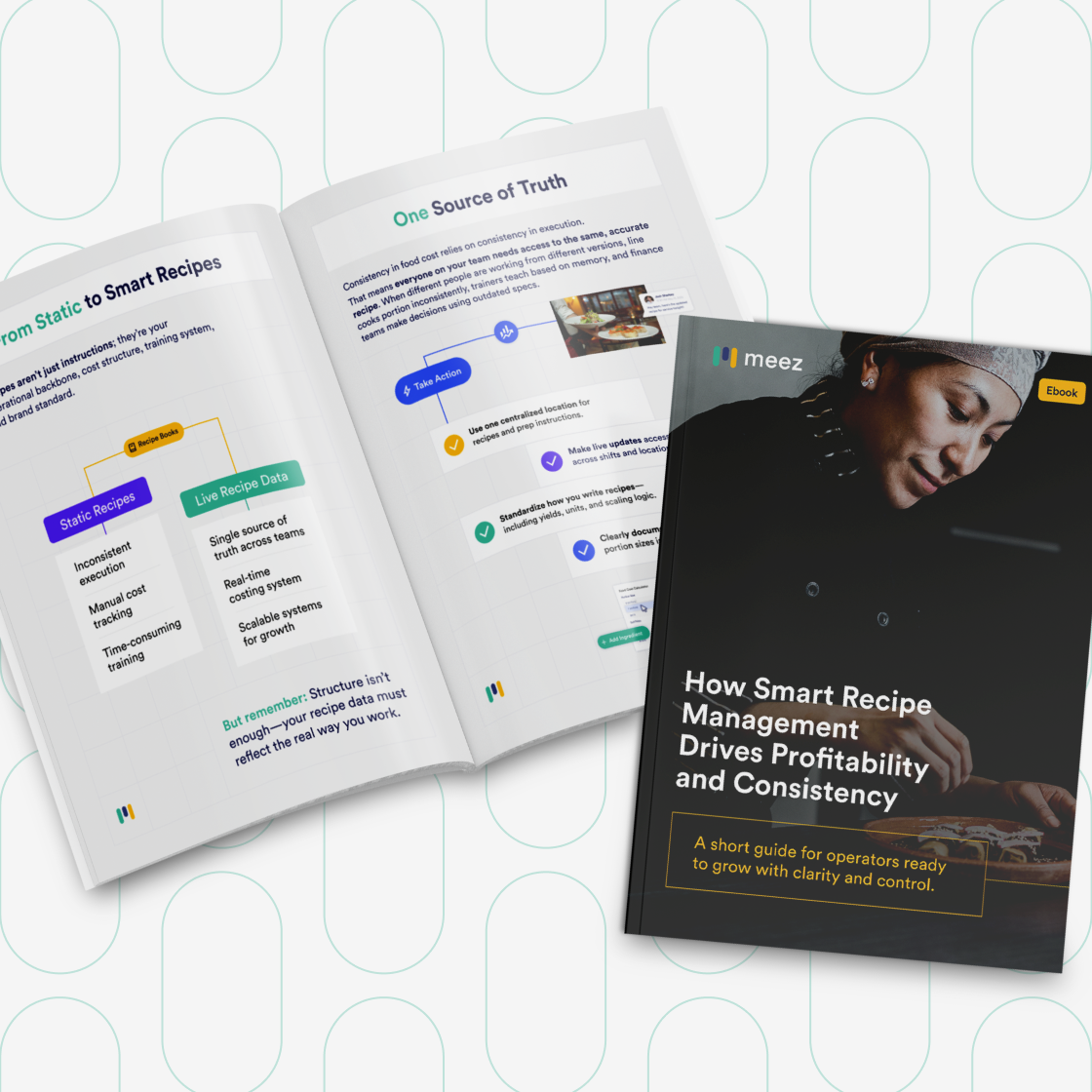
When a chef changes a spec in meez, it flows everywhere: costing, training materials, allergen info, and FOH menu details. There is no more chasing down outdated versions and no more manual syncing across departments. The meez recipe organization system lets you organize recipes by menu, station, allergen, location, or concept, so the structure of your compliance workflow is built into how the platform works.
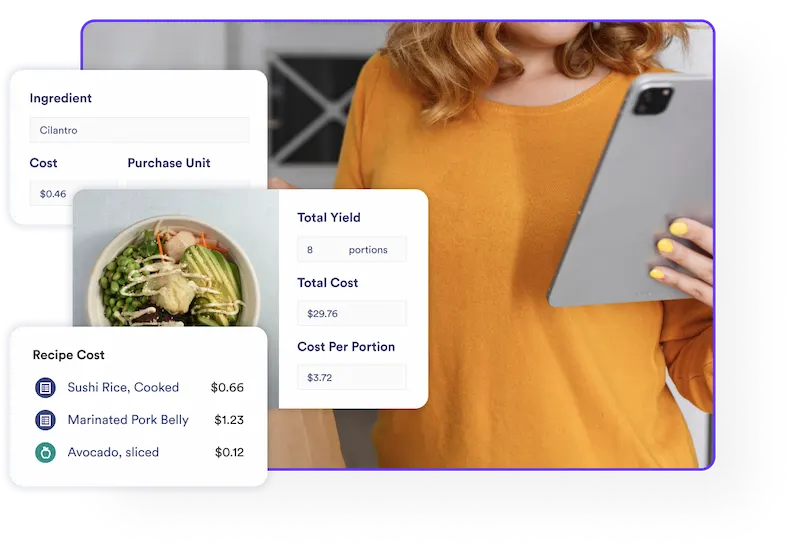
meez's nutrition labeling and allergen management capability uses a built-in database of 2,500+ ingredients, each mapped to the nine major FDA-recognized allergens. When you build or update a recipe in meez, allergen tags are automatically generated from the ingredient-level data, not assigned manually at the dish level. When an ingredient changes, the allergen profile of every recipe using it recalculates accordingly.
This matters specifically for the supplier substitution problem. If a vendor ingredient is swapped or updated in the system, the allergen output recalculates. The recipe reflects the new reality, and that change propagates through your menu data rather than sitting silently in a purchasing note that never reaches guest-facing channels.
meez also creates the version control infrastructure that makes allergen compliance auditable. Changes to recipes are tracked. Teams across all locations work from the same recipe version at all times. When a culinary director updates a recipe, it is live instantly across every location. The meez kitchen training system builds allergen information directly into the recipe itself, so front-of-house staff can access the current spec without tracking down a manager mid-service.
You can explore how this works end-to-end in the meez nutrition and allergen product tour. The platform also supports custom nutrition information for ingredients not in the built-in database and generates nutrition labels directly from recipes for both menu items and retail grab-and-go products, with allergen and nutrition data maintained as part of the same recipe infrastructure.
For multi-unit groups subject to SB-68, the meez SB-68 compliance checklist walks through how this architecture maps to each of the eight steps required for ongoing compliance, including what it takes to keep disclosures accurate as recipes, ingredients, and menus change over time.
A Practical Checklist: Building Supplier-Substitution-Proof Allergen Compliance
The following steps cover both the architecture and operational process your group needs.
1. Establish ingredient-level allergen data. Every ingredient in your operation needs its allergen profile defined and maintained in a single, authoritative system. This is the foundation everything else depends on.
2. Connect supplier changes to the recipe system. Ingredient substitutions, vendor changes, and reformulations need to trigger a recipe review. That review should be systematic, not dependent on whether the right person happened to see the purchasing email.
3. Build recipe-to-menu traceability. Your menu allergen disclosures should be outputs of your recipe system, not independent records. When the recipe updates, the menu should update from the same data.
4. Document the change trail. Every modification to a recipe's ingredient list, and the allergen changes that resulted, should be timestamped and logged. This is your allergen compliance documentation and your first line of defense if a compliance question arises.
5. Standardize the allergy compliance workflow across every location. The process for handling ingredient changes and menu updates should be identical at location 1 and location 20. If it is inconsistent, your compliance is only as strong as your weakest site.
6. Verify all guest-facing channels on every update. Printed menus, digital boards, websites, mobile apps, online ordering systems, and third-party delivery platforms all need to reflect the current allergen data. This verification step should be a non-optional part of any menu update process, and ideally automated rather than manual.
SB-68 and the Urgency of Getting This Right Now
California's SB-68 requires restaurant chains with 20 or more locations to provide written allergen disclosures for all nine major FDA-recognized allergens, including sesame, across every customer-facing ordering channel beginning July 1, 2026.
After Gov. Gavin Newsom signed the bill, it became the first law in the United States to mandate written allergen disclosure from restaurant chains. The spirit of the law is exactly the problem described in this post: providing an accurate disclosure once is relatively straightforward. Keeping that disclosure accurate as your supply chain shifts is the operational challenge, and it is the challenge that requires systematic infrastructure, not just a menu labeling project.
The 20-location count is national, not limited to California. A brand with 200 locations and a single California restaurant has SB-68 obligations for the whole chain. That scope makes ingredient change tracking a board-level concern, not just a kitchen one.
Even for groups not subject to SB-68, the underlying logic applies. Guests with food allergies are making trust decisions every time they order. An inaccurate allergen disclosure is not a minor inconvenience. It is a health and safety event. The operational infrastructure for getting it right is the same regardless of which state you operate in.
Ready to close the supplier substitution gap in your allergen compliance workflow? Take the meez nutrition and allergen tour →
Frequently Asked Questions
When a supplier swaps an ingredient, does my menu update automatically?
Only if your recipe system is connected to your allergen data and your menu data in a live, integrated workflow. In most traditional setups using spreadsheets, shared docs, or manually maintained allergen trackers, the answer is no. The ingredient changes, the kitchen adapts, but the menu and digital channels stay unchanged until someone manually updates each one. meez addresses this by calculating allergen tags automatically from ingredient-level data, so changes propagate through the recipe and into downstream outputs without a separate manual update chain. See how it works in the meez nutrition and allergen tour.
What is an allergen audit trail and why does it matter for restaurants?
An allergen audit trail is a documented, timestamped record of every change made to a recipe's ingredient composition and the allergen impacts of those changes. It matters because compliance is not just about being accurate today. It is about demonstrating accuracy over time. If a guest incident occurs or a regulator asks questions, your audit trail is the evidence that you maintained appropriate ingredient change tracking and allergen compliance documentation throughout.
Is allergen management software the same as nutrition labeling software?
They overlap but are not identical. Allergen management software tracks the presence of major allergens across recipes and menus and supports disclosure management and compliance workflows. Nutrition labeling software generates calorie and nutrient data for menu items and labeled products. The best platforms, including meez, handle both from the same ingredient database so allergen and nutrition data are always aligned and neither requires separate maintenance.
What makes multi-unit allergen compliance so much harder than single-location compliance?
Scale introduces variation. More locations mean more supplier relationships, more menus, more staff, and more channels, each of which can drift from the central source of truth. A change that a head chef at a single location would notice immediately can go undetected across a multi-unit network for days or weeks. The only reliable solution is centralized, connected recipe data that ensures every location is working from the same current version. That is the core principle behind the meez recipe organization and multi-unit management system.
How does meez support allergen compliance for SB-68?
meez provides the recipe-to-menu data infrastructure that SB-68 compliance requires. Allergen tags are generated automatically from ingredient-level data using a built-in database of 2,500+ ingredients. Recipes are version-controlled so every location works from the current source of truth. Nutrition labels can be generated directly from recipes. Because recipe updates propagate instantly across locations, the ongoing maintenance challenge of keeping disclosures accurate as ingredients and menus change is built into how the system works. The full eight-step SB-68 checklist for multi-unit groups is at getmeez.com/blog/sb-68-compliance-checklist.
What are the nine allergens restaurants must disclose under SB-68?
SB-68 requires disclosure of the nine major FDA-recognized allergens: milk, eggs, fish, crustacean shellfish, tree nuts, peanuts, wheat, soybeans, and sesame. Sesame was added as the ninth major allergen through the FASTER Act and is newly required in many disclosure frameworks. These nine allergens must be disclosed on every customer-facing ordering channel, including printed menus, websites, apps, digital boards, kiosks, and third-party delivery platforms.