

Restaurant365 is one of the most widely adopted platforms in multi-unit restaurant finance and operations. If you are on it, you already know what it does well: accounting, inventory, purchasing, and actual food cost reporting all in one place.
What R365 was not designed to do is manage the culinary layer: yield-adjusted recipe costing, prep conversions, and the structured recipe data that theoretical food cost calculations depend on. That is not a gap in the platform. It is simply a division of labor between two different domains, culinary and financial, that most restaurant groups treat as one.
The pressure to get the financial side right has never been higher. Average food costs are now more than 35% above pre-pandemic levels, according to the National Restaurant Association’s 2026 State of the Industry Report.
In 2025, 82% of operators reported higher average food costs, and with little room left to raise menu prices, the NRA says operator success in 2026 will "hinge on their ability to get the math right."
Getting the math right means giving R365 the recipe data it needs to calculate accurately.
When that culinary data layer is missing or incomplete, AvT variance becomes hard to interpret, and the theoretical food cost number that should guide decisions becomes unreliable. That is the gap meez was built to close.
What R365 Is Designed to Do (And Where a Culinary Layer Adds Value)
R365 is purpose-built for restaurant finance and accounting. It handles actual food cost reporting based on real purchasing and inventory data, and does it at a level of sophistication most restaurant groups could not replicate any other way.
The one area where operators consistently find themselves wanting more is theoretical food cost: the calculation of what a dish should cost when every recipe is executed perfectly to spec, with accurate yields and conversions built in.
That calculation depends entirely on the quality of recipe data, and recipe data is the domain of the kitchen, not the accounting department.
When recipe data is built into R365 without proper yields, unit-of-measure conversions, or prep logic, the theoretical food cost output is incomplete. Not because R365 is calculating it wrong, but because the inputs do not reflect kitchen reality.
The most common gaps in recipe data that limit theoretical food cost accuracy:
- Yields estimated rather than measured (what percentage of a purchased ingredient actually makes it into the dish after prep?)
- Missing unit-of-measure conversions between how an ingredient is purchased and how it is used in a recipe
- Recipes built against one location’s pricing that have not been updated to reflect multi-location purchasing differences
- Prep steps and sub-recipes that are not accounted for, leaving cost math incomplete
You can see how closing these gaps changes the numbers in meez’s guide to recipe-driven food cost analytics.
.png)
Why Theoretical Food Cost Requires Kitchen-Level Recipe Data
Every ingredient in a professional kitchen goes through prep before it reaches the plate.
Onions get peeled. Fish gets butchered. Herbs get picked.
Each prep action reduces the usable yield from the purchased quantity, and that yield percentage has to be accurate for theoretical food cost to mean anything.
Building yield and conversion data manually is time-consuming and requires culinary expertise, which is why most ERP implementations either lean on industry-average estimates or skip the process entirely. The result is a theoretical food cost number that is directionally useful but not precise enough to drive decisions.
meez was built specifically to solve this.
Built-In Ingredient Database
It ships with 3,000+ pre-built system ingredients, each carrying accurate prep yields, volume measurements, and unit-of-measure conversions developed and maintained by culinary professionals. When a chef adds parsley to a recipe in meez, the system already knows the yield on picked parsley versus purchased bunch weight, converts from grams to tablespoons, and pulls the cost automatically from the latest invoice.
You can see exactly how this works in the meez recipe costing tour.
That culinary precision is what makes centralized food costing work at scale across multiple locations. The math is built once, correctly, by people who understand kitchen production, and then it flows into R365 as clean, structured data.
Learn more on the meez costing page.
Case Study: How Berg Hospitality Cut Food Costs 21% With meez and R365
Berg Hospitality Group operates restaurants across Texas. They were using R365 for finance and operations, and it was working well on the accounting side. The challenge was on the culinary side: recipe management was inconsistent across locations, costing required ongoing manual maintenance, and the theoretical food cost numbers feeding into R365 were not as precise as the finance team needed.
After implementing meez to handle the culinary layer, with meez pushing clean, yield-adjusted recipe data directly into R365, both teams got what they needed:
- 20+ admin hours saved per month through accurate, centralized recipe and costing management
- 21% overall reduction in food cost across the portfolio
- Average 3% food cost decrease per property, driven by better recipe data and real cost visibility
R365 stayed in place and continued doing what it does best. meez gave the culinary team their own purpose-built layer, and the two systems together delivered results neither could have produced alone.
Case Study: How RMD Group Streamlined R365 Implementations With meez
R365 consultants and resellers face a consistent challenge during implementations: building out the recipe module requires culinary expertise that accounting teams do not always have, and the time investment is significant. RMD Group is an operator, consultant, and R365 reseller managing restaurants, bars, and nightlife concepts across Southern California.
RMD recognized that culinary recipe buildout was a natural fit for meez rather than a task to force through the R365 setup process. By using meez to own the recipe layer of every R365 implementation, RMD was able to:
- Compress average implementation timelines to 2-3 weeks
- Redirect an estimated 40-60+ hours of accounting labor per implementation away from recipe entry and toward higher-value accounting setup work
- Deliver clean, standardized recipe data into R365 from day one, built by culinary teams in a platform designed for how chefs work
RMD’s approach reflects a principle that more finance leaders are arriving at: R365 is the financial engine. meez is the culinary layer. Each platform does what it was built for, and together they give both teams the data they need.
What Is the Difference Between Theoretical and Actual Food Cost?
Theoretical food cost is what you should spend if every recipe is executed perfectly to spec. Actual food cost is what you actually spent, based on inventory and purchasing data.
The difference between the two is your AvT variance, and it is the primary driver of restaurant group profitability decisions.
As one NRN contributor noted in early 2026:
"Operators price menus slowly but absorb costs instantly. That mismatch is where margins erode."
For multi-unit groups, closing that mismatch requires a theoretical number precise enough to trust.
When theoretical food cost is built on complete, yield-adjusted recipe data, AvT variance becomes a genuine operational signal: it tells you where waste is happening, where portioning is off, and where ingredient costs are shifting. When the recipe data is incomplete, AvT variance is harder to interpret because it reflects both operational reality and data gaps at the same time.
Getting that precision right is where the investment pays off. A 1-2% food cost improvement at a group doing $20M in revenue is $200K-$400K to the bottom line.
You can model what that looks like for your operation using meez’s ROI Calculator.

How Does the meez and R365 Connection Work?
The connection is designed around each platform doing what it does best.
R365 pushes real-time ingredient costs into meez as invoice data is processed, keeping recipe costing current as prices change. meez sends fully yield-adjusted, production-ready recipe data back into R365, so R365’s theoretical cost calculations are grounded in accurate kitchen specs rather than estimates. Get the full picture is at getmeez.com/r365.
What each team gets from the combined system:
- Finance leaders get accurate theoretical food cost and AvT variance they can act on
- Culinary teams get a recipe platform built for the way kitchens work, with costing built in
- Both teams work from the same data, eliminating the translation layer between kitchen production and financial reporting
- Recipe costs stay current automatically as ingredient prices change, with no manual reconciliation required
The result is not replacing R365. It is completing the data picture R365 needs to deliver its full value. Explore the meez organization features to see how centralized recipe management works across locations.
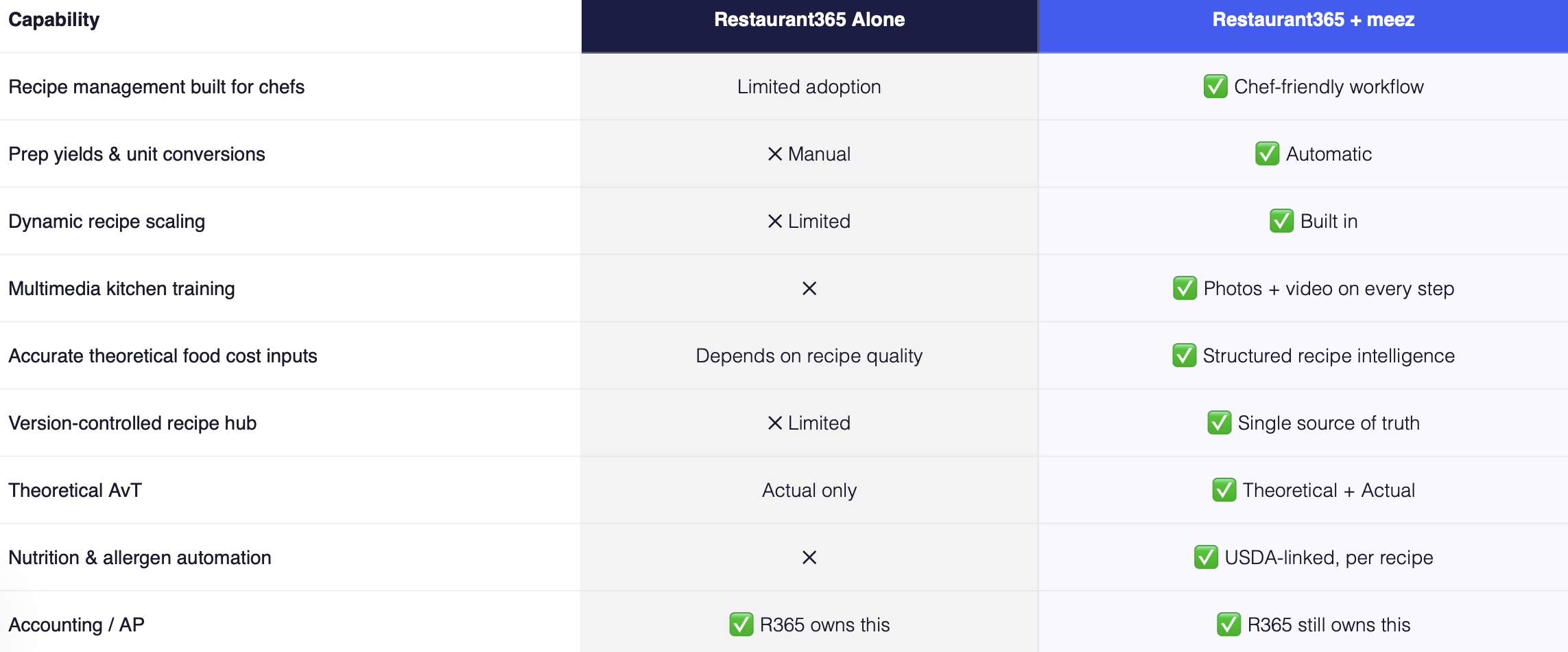
How to Get More From R365 With a Culinary Data Layer: A Practical Checklist
Step 1: Get accurate yields into the system
meez’s built-in database of 3,000+ pre-built ingredients with yields and conversions means most operators do not have to build from scratch. Take the recipe costing tour to see how it works.
Step 2: Connect invoice costs so they update automatically
When ingredient prices change in R365, meez pulls those updates and recalculates recipe costs across every dish automatically. No manual entry, no stale cost cards. This is what separates enterprise food costing software from a one-time setup. Read more on why food cost keeps creeping up and how to stay ahead of it.
Step 3: Create a single version-controlled recipe hub
Every location works from the same recipe, updated in real time. That consistency is the foundation of culinary operations software at scale, and it is what turns back of house software from a repository into a live operational tool.
Step 4: Let each platform do what it was built for
With meez managing the culinary layer and R365 managing the financial layer, theoretical food cost becomes a reliable metric. Finance gets numbers they can trust. Culinary teams get a tool they will actually use. And the AvT variance that R365 surfaces becomes genuinely useful rather than a number that requires constant qualification.
Why AI Investment Makes the Culinary Data Layer More Important
Restaurant AI adoption is accelerating fast. The NRA’s 2026 State of the Industry found that 26% of operators are now using AI tools, with the biggest growth in operations and menu optimization. Demand forecasting, automated purchasing, and AI-driven scheduling are all moving upstream into the operational stack.
Technology executives at the 2026 NRA Show noted that the value of any AI or automation tool is constrained by the quality of the data it operates on. The more sophisticated the downstream system, the more important it becomes to get the foundational data right.
AI multiplies what is already in the data. Accurate recipe data fed into an automated purchasing system produces better orders. Incomplete recipe data fed into the same system produces the same gaps, faster and at greater scale.
For operators investing in restaurant operational intelligence, operations analytics, and operational reporting tools, the culinary data layer is the foundation everything else depends on. Restaurant KPIs and AvT reporting built on complete, yield-adjusted recipe data become genuinely predictive. Built on estimates, they require constant manual interpretation.
The operators getting the most out of R365 are the ones who gave it the best possible inputs to work with.
Bottom Line: R365 and meez Are Stronger Together
R365 is purpose-built for restaurant finance and operations, and it is excellent at what it does. meez is purpose-built for culinary operations: yield-adjusted recipe costing, production-ready recipe management, and structured culinary data that gives R365 the inputs it needs to deliver accurate theoretical food cost reporting.
Berg Hospitality cut food costs by 21%. RMD Group compressed R365 implementations to 2-3 weeks. In both cases, the result came from giving each platform the role it was designed for.
meez does not replace R365. It completes it.
If your AvT variance is hard to interpret, or your theoretical food cost numbers require a lot of manual qualification, a dedicated culinary layer is likely the missing piece.
See how meez and R365 work together: take the recipe costing tour, explore the meez + R365 integration, or book a demo today.
Frequently Asked Questions
1. Why is my R365 theoretical food cost different from what I expect?
Theoretical food cost in R365 is calculated from the recipe data in the system. When yields, unit-of-measure conversions, or prep logic are estimated or incomplete, the theoretical output will not fully reflect kitchen reality. Pairing R365 with a culinary platform like meez gives the system accurate, chef-built recipe data, which makes theoretical food cost calculations more precise and AvT variance easier to act on.
2. What is AvT variance in Restaurant365?
AvT (Actual versus Theoretical) variance in R365 is the difference between your actual food cost, based on purchasing and inventory, and your theoretical food cost, based on recipe data. A high AvT variance can indicate waste, portioning issues, or ingredient cost shifts. Getting the most from AvT reporting requires theoretical food cost to be built on accurate, yield-adjusted recipe data.
3. Does meez replace Restaurant365?
No. meez and R365 are complementary platforms. R365 handles accounting, inventory, and actual food cost reporting. meez provides the culinary layer: yield-adjusted recipes, accurate costing, and structured recipe data that syncs directly into R365. Together, they give finance teams accurate theoretical food cost data and give culinary teams a recipe system built for how kitchens actually operate.
4. How long does it take to implement meez alongside R365?
Most operators are live with costed recipes in meez within 3 days. RMD Group, an R365 reseller and consultant, uses meez to accelerate full R365 implementations to 2-3 weeks, and redirects 40-60+ hours of accounting labor per implementation toward higher-value setup work by having culinary teams build recipes in meez rather than through the R365 recipe module.
5. What is theoretical food cost and why does it matter for R365 users?
Theoretical food cost is what a restaurant should spend on food if every recipe is executed to spec, with correct portion sizes, accurate yields, and no unplanned waste. It is the benchmark that makes AvT variance actionable. R365 users get the most from AvT reporting when theoretical food cost is built on complete, yield-adjusted recipe data rather than estimates, because it allows them to distinguish between an operational issue and a data gap.

.webp)