Every restaurant wants to be consistent. Most go looking for it in the wrong place: a stricter checklist, a longer training manual, one more SOP.
Those are tools. The real work starts earlier, the moment you decide what your restaurant is actually protecting.
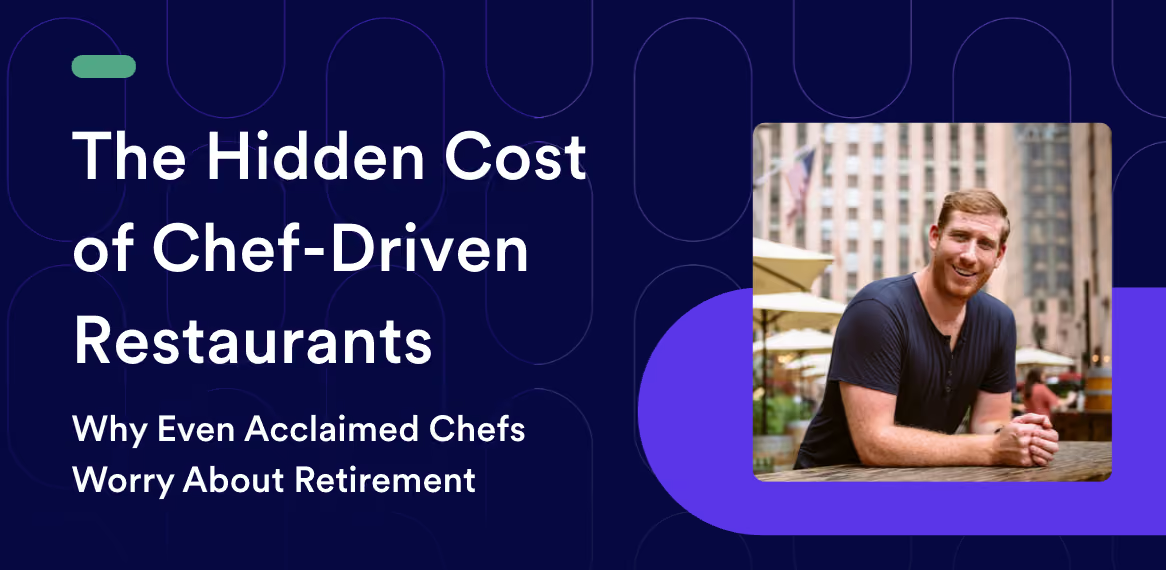
That idea runs through nearly every chapter of chef and sommelier Sandia Chang's career.
Four years in the dining room at Thomas Keller's Per Se. A front-of-house role at René Redzepi's Noma in Copenhagen, where she had followed the chef she would later marry, James Knappett. Then her own two-Michelin-star Kitchen Table and the cult-favorite Bubble Dogs, a Champagne and hot dog bar, both in London.
Along the way she saw two world-class restaurants take opposite approaches to hospitality and be equally consistent at it. One believed every guest request deserved a yes. The other believed protecting the experience sometimes meant no. Neither was better. Both knew exactly what they were guarding.
If they can't make something good, why make it?
It is the same conviction that made Chang one of the restaurant world's loudest advocates for grower Champagne: the small producers who grow their own grapes and make their own wine instead of buying fruit to blend into a house style. They win by leaning into identity, not by chasing scale.
The best restaurants operate the same way. They become memorable not by trying to do everything, but by being clear about what they do best.
Per Se Said Yes. Noma Said No. Both Were Right.
Working at Per Se meant learning that hospitality had almost no ceiling. Thomas Keller’s methods was clear: "It's not only yes, it's yes, and you take it beyond yes."
When Mick Jagger dined there, the kitchen sent out a different potato with every course, because he loved potatoes. The goal was not efficiency. It was an unforgettable moment.
Then Chang moved to Copenhagen, where the philosophy could not have been more different. Noma stocked a fully equipped bar. If a guest asked for a cocktail, the answer was still no, because cocktails were not what Noma did best. The team redirected guests toward the wines, juices, and pairings that reflected the restaurant's vision.
One filter, not a hundred judgment calls
At first glance the two philosophies look incompatible. They were solving the same problem. Every request ran through a single filter instead of a case-by-case debate:
- Does this make the experience better?
- Or does it pull us away from what we are trying to be?
That is a far more useful question than "can we accommodate this," and it is where recipe consistency and service stop being separate problems and start being the same one.
Saying No Isn't Bad Hospitality. It's the Highest Form of It.
For a lot of operators, "no" feels like a failure. Hospitality has trained us to treat every request as something to satisfy. Chang sees it as protection, not refusal. It's not really saying no, it's just telling people this is not the best we can give you.
At Noma, a guest who asked for well done was steered instead toward a perfectly cooked piece of line-caught sea bass. The guest still left with an exceptional meal. The kitchen simply refused to serve something it knew would not represent its standard.
Restaurants earn trust because guests know what to expect. That trust erodes the moment a kitchen compromises it to chase one request or one more menu item.
The stakes are higher now that guests dine out less. OpenTable found 61 percent of Americans expect dining out in 2026 to feel like a special treat rather than a habit, which leaves far less tolerance for an experience that feels off.
Great operators don't say yes to everything. They are unmistakably clear about what they will say yes to.
Standards Start With Identity, Not Documentation
This is where consistency usually gets built backwards. Teams rush to document recipes and write SOPs before they have defined the standard those systems are supposed to protect.
Standards do not begin with paperwork. They begin with conviction. Before a single recipe gets written, the questions that matter are:
- What kind of restaurant are we?
- What experience are we trying to create?
- What are we unwilling to compromise?
Only once those are answered can recipes, service standards, and training reinforce anything.
Without a defined standard, everyone fills the gaps
Without that foundation, every shift becomes a stack of judgment calls. Nobody is being careless. They are just filling in blanks no one ever defined:
- One manager handles a request differently than the next.
- One cook portions six ounces, another portions six and a half.
- One trainer teaches a shortcut the chef never intended.
That problem compounds fast in 2026, with operators leaning on newer, less-experienced teams and reaching for tools that support training for inexperienced staff and hold consistency across shifts.
The most consistent restaurants remove the ambiguity. They make the important decisions once, then teach everyone else to execute them, which is exactly the gap effective kitchen management is built to close.
Good standards do more than raise quality. They remove the decision entirely, so everyone just executes what's already been decided.
Why a Hot Dog Is Harder to Get Right Than a Tasting Menu
When Chang and Knappett opened Bubble Dogs, everyone assumed the hard restaurant would be the Michelin-starred Kitchen Table hidden behind it. The hot dog was harder. Not because a hot dog is technically difficult, but because everyone already knows what a good one tastes like.
The team spent months developing the frankfurter: the grind, the snap of the casing, the length and width, then a bun made to exact dimensions. That precision sounds excessive for a hot dog. It is precisely why it mattered.
An original tasting-menu course gives guests nothing to compare against. A hot dog arrives loaded with decades of expectation, from ballparks and cookouts and roadside stands. The guest instantly clocks a soft bun or a sausage with no snap.
The familiar dishes are the exposed ones
There is nowhere to hide. The same is true of every restaurant's highest-volume items:
- The burger
- The Caesar salad
- The roast chicken
- The house margarita
They are not easier because they are familiar. They are harder because guests notice every inconsistency, and the 2026 American Customer Satisfaction Index found execution has become the dividing line between brands, with poor execution getting exposed quickly.
Ironically, those are the dishes restaurants document the least, because they seem simple.
Sometimes the simplest things are the hardest to keep the standards of.
A Recipe Isn't Just Instructions. It's Your Standard.
That hot dog did not succeed because the team found a good butcher. It succeeded because they defined exactly what "right" was, then captured it. Once the spec and the process were locked, every future hot dog had a blueprint.
That is what recipe standardization actually is. Not paperwork for its own sake, but preserving the decisions that make your restaurant yours.
What "drift" looks like
When those decisions live only in one chef's head, they slip a little at a time:
- A new cook eyeballs the portion.
- A trainer teaches a faster shortcut.
- A cook swaps an ingredient because "that's how we've always done it."
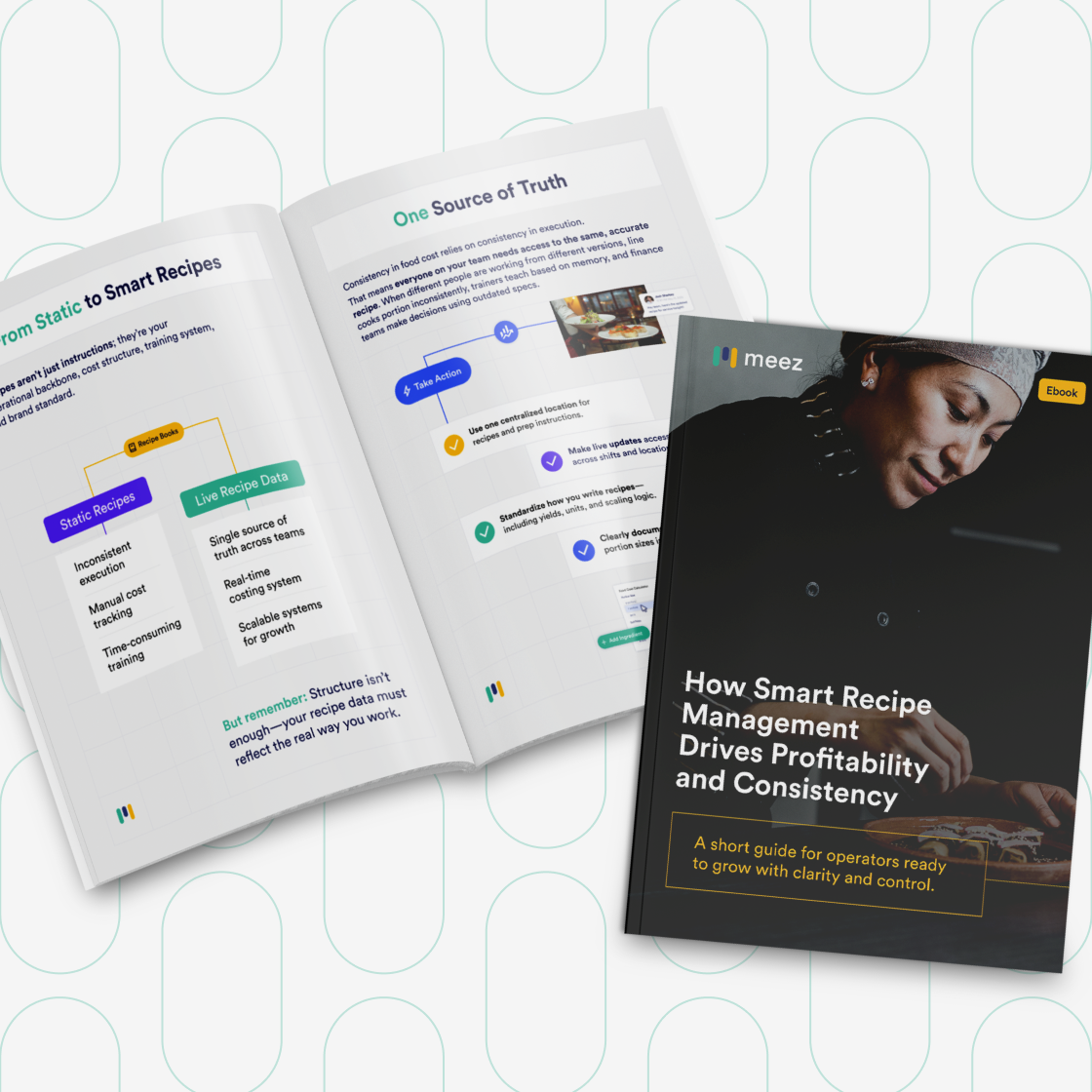
As one meez guide on menu development puts it, a dish that lives only in the head chef's memory is not a menu item, it is a vulnerability. The food changes, and eventually so does the guest experience.
Recipe management isn't really about organization. It's about protecting identity at scale.
React Fast, Then Standardize What Works
Bubble Dogs did not open cleanly. Chang laughs about it now, but the first service felt like chaos.
The team came from fine dining, where every garnish is called and every plate leaves at the right second, and the tickets buried them. By the break between lunch and dinner, they had realized they needed another fryer, so they went and bought one that afternoon.
That is the lesson that stuck with her. The goal is not to predict every problem before you open. It is to catch problems fast, solve them, and fold the fix into the standard so the next service starts from a higher baseline.
Great restaurant systems are not rigid. They are iterative. Every improvement gets documented, every lesson becomes repeatable.
Consistency isn't about never changing. It's about making improvements stick once you find them.
The Best Restaurants Protect What Matters Most
It is tempting to think consistency starts with recipes, or checklists, or a training deck. Those come second. First you decide what you are protecting.
- Per Se protected limitless hospitality.
- Noma protected its culinary philosophy.
- Bubble Dogs protected the perfect hot dog.
Three restaurants that looked nothing alike, each extraordinarily consistent, because each was extraordinarily clear.
So the question every operator should sit with is the one Chang's whole career keeps answering: what experience are we unwilling to compromise? Once you know, the recipes get easier to write, the training gets easier to deliver, and multi-unit growth stops feeling like a threat to quality.
Consistency stops being something you chase and becomes something your systems produce on their own.
Whether you run 5 locations or 50, protecting your standards starts with protecting the recipes behind them. See how meez helps restaurant groups scale without compromising what made them great.
Listen to the full episode: Why the Best Champagne Comes From Growers, Not the Big Houses. Plus Per Se's Yes vs Noma's No, and working with your spouse.
FAQ: Restaurant Consistency and Standardization
What creates consistency in a restaurant?
Consistency starts with clearly defining what "great" looks like before you try to systematize it. Once that standard is captured in recipes, training, and operating procedures, every team member can execute the same experience regardless of shift or location. The 2026 ACSI Restaurant Study found diners now judge value largely on this reliability once prices are similar.
Why are simple menu items often the hardest to execute consistently?
Guests already know exactly how a burger, hot dog, or Caesar salad should taste, so even small inconsistencies are obvious. There is no novelty to hide behind the way there is with an original dish. That is why high-volume staples deserve the most precise recipe standards, not the least attention.
Why should recipes be treated as operational standards?
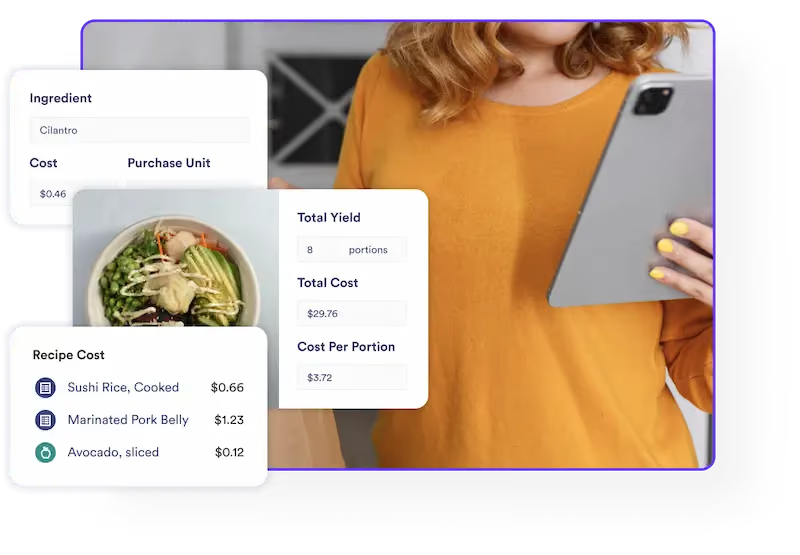
Because a recipe is a record of the decisions that define your restaurant, not just a list of ingredients. It captures portions, yields, prep methods, plating, and allergens so those standards do not vanish when staff turns over. Teams that treat recipes as the backbone of staff training onboard faster and drift less.
How do restaurants maintain consistency across multiple locations?
Successful multi-unit operators build one documented source of truth for recipes and procedures, then push it to every kitchen at once. When a spec changes, the update reaches all locations immediately instead of relying on emails, printed cards, or word of mouth. That single source is what keeps location ten cooking like location one.
Is saying no to a guest bad hospitality?
No. Declining a request that would lower your standard, then offering the guest something the kitchen does brilliantly, protects the experience rather than diminishing it. As Sandia Chang frames it, it is less about saying no and more about steering guests toward the best you can actually give them.
How do you train new staff to hold your standards?
Give them the standard in a form they can see and repeat, not a verbal walkthrough that gets misremembered. Structured recipe training with photos and step-by-step methods lets a new hire execute to spec on day one, which matters more than ever as operators rely on less-experienced teams.
Can consistency improve without becoming rigid?
Yes. The best operators refine constantly: they solve a problem, document what worked, and raise the baseline for the next service. Consistency is not about resisting change. It is about making sure the improvements you find actually stick and reach the whole team.