
Kevin Hochman took over as CEO of Brinker International in June 2022 and did something almost no one in the industry expected: he made Chili's smaller.
Hochman cut 25 percent of the menu. He narrowed the kitchen's focus to five core categories: burgers, crispers, fajitas, margaritas, and ribs.
He eliminated hundreds of SKUs. And within three years, he had engineered one of the most unlikely restaurant comebacks in recent memory. The chain posted a 31 percent same-store sales increase by the end of 2024 and surpassed $5 billion in total revenue for the first time in Brinker's history.
On a recent episode of the meez Podcast, meez founder and CEO Josh Sharkey sat down with Michael Jacober, food industry operator and co-founder of Blanket, to unpack the Chili's story and what it reveals about the operational logic behind menu simplification.
The conversation went deeper than the nostalgia or the viral TikTok moment. It was really a discussion about why menu complexity is a silent profitability killer — and what operators at every scale can do about it.
"The CEO did a ton of process engineering within the kitchen. He looked at skew rationalization, he shrunk the menu down substantially. So the menus, the kitchens just became a lot more efficient. Food was now coming out hot."
The Chili's turnaround is not a marketing story, even though it got painted that way when the cheese pull videos went viral. It is a menu engineering story. And the lesson it teaches applies to every multi-unit operator trying to manage profitability while keeping kitchens running at a consistent level.
Listen to the full episode: How Chili's Got Hot Again, the K-Shaped Economy Debate, and Why Sausage Is the Better Burger Meat
Menu Complexity Is a Profitability Problem Before It Is a Kitchen Problem
When Hochman arrived at Chili's, the brand had been adding menu items for years in hopes of appealing to more guests. It is a pattern most operators will recognize.
Traffic softens, so you add new dishes. New dishes increase kitchen complexity. Complexity erodes execution. Execution problems erode the guest experience, which drives traffic softer still. The cycle compounds.
What Hochman recognized was that complexity was not a symptom of the business's decline. It was the cause. A kitchen running too many SKUs has to split labor and attention across too many preparations, too many supply lines, and too many margin profiles at once.
The result: nothing gets done exceptionally well, food comes out inconsistently, and the dishes that actually generate strong contribution margins get buried under the noise of items nobody orders.
"When you have a certain amount of labor and you have a complex menu, it's very hard to execute that consistently."
According to Restaurant Business, only 42 percent of operators reported profitability in the most recent National Restaurant Association State of the Industry Report. In a margin environment that thin, every SKU that does not pull its weight is not neutral. It is actively costing the operation.
The fix starts with understanding which items are truly earning their place — which requires analyzing contribution margin alongside sales volume, not food cost percentage alone.
What SKU Rationalization Actually Looks Like in Practice
Josh spent a few minutes scrolling Chili's current menu live on the episode, and what he noticed was not what was there. It was the architecture underneath it.
Every section had the same base item in three or four variations. The chips and salsa, the queso, and the beef queso are all the same base chip and dip, differentiated by one or two toppings. The chicken crispers come plain, honey chipotle, and Nashville hot. The burgers are all the same patty with different build variations.
"Their skews are probably way lower now. You know, they got like this steak, they have a ton of burgers, which are probably all the same burger. It's really smart. And I love to see how the downstream effect of simplifying your menu makes it easier for the cooks, right? It makes it easier for finance. It makes it easier for everybody."
That is the structural move most operators miss. They think about removing items. The smarter question is whether the items that remain share a common prep infrastructure.
Cross-utilization means one SKU unlocks multiple menu items. Purchasing volume goes up on a smaller number of ingredients. Yield per purchased unit improves. The prep team builds speed and precision on fewer preparations. And critically, the food cost per recipe becomes more predictable because there are fewer variables moving at once.
According to Restaurant Business, chain CMOs at the 2026 Restaurant Leadership Conference were unanimous: they never bring in a new ingredient for a single menu item. It has to work across multiple platforms.

How Simplification Improves Kitchen Execution Across Locations
The profitability case for menu simplification is compelling on paper. The operational case becomes even more pronounced when you look at it across multiple units.
A complex menu is an execution problem for one kitchen. Across ten or twenty locations, it becomes a consistency problem, a training problem, a food cost variance problem, and a labor efficiency problem — all at once.
Jacober walked through what Hochman's changes did at Chili's. With fewer SKUs, cooks stopped being pulled in too many directions. The kitchen became easier to staff. Turnover improved. Food came out faster and hotter. Guest satisfaction scores — which the company tracks internally as "Food Great Scores" — reached their highest levels in the brand's history.
"With a more simple skew set, it became easier to staff these restaurants because it wasn't as complex for the cooks. They weren't pulling their hair out. The food is coming out faster. The food was coming out hotter."
For multi-unit operators, this is not a side effect. It is the mechanism.
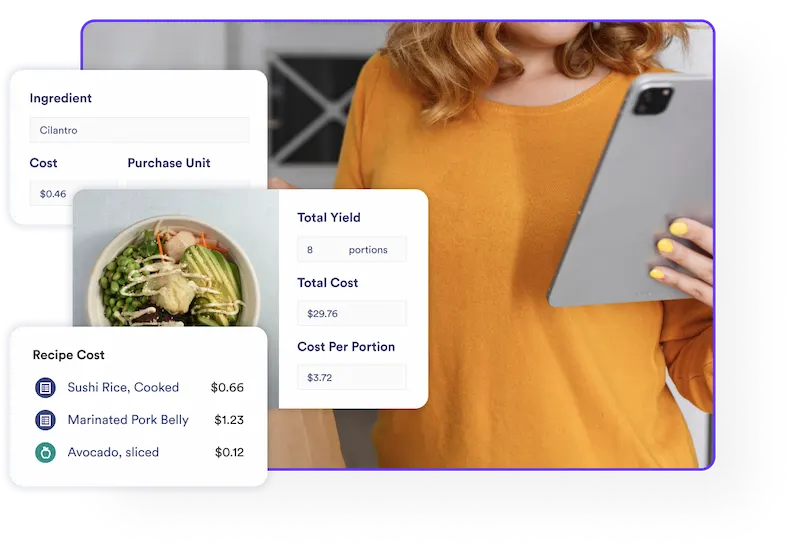
A focused, well-documented menu enables real-time recipe costing and food cost accuracy across every location — not just the flagship. When recipes are standardized around a smaller, more controlled set of ingredients, the theoretical food cost the culinary team built actually matches what is leaving the kitchen at each site. That gap between what should be spent and what is actually being spent? That is where margin goes to die at scale.
The Value Signal: Price Perception and Menu Focus Work Together
Part of what made the Chili's revival so surprising was that the brand did not just cut its menu. It positioned its simplified offering directly against fast food on value.
The $10.99 three-for-me meal — a burger, a starter, and a drink — was openly compared to what a McDonald's or Shake Shack combo was costing at the same time. Josh noted on the podcast that a comparable Shake Shack order was running about $14.
The comparison landed because the Chili's product had genuinely improved through the simplification process. The brand could only make the value claim credibly because it had invested in quality within a narrower range. As Hochman put it: having a more focused menu where you do fewer things a lot better is having a direct impact on guest experience scores, not just kitchen efficiency.
"The brands that win in 2026 are the ones that price strategically and protect margins while clearly communicating value in ways consumers can see and feel."
This creates a virtuous loop that menu engineers know well. When you cut low-margin, low-volume items, the contribution margin from your remaining Stars and Plowhorses improves because those items now receive more kitchen attention, more consistent preparation, and more promotional emphasis. The menu engineering matrix makes this analysis visible before you remove a single item.
Recipe Documentation: The Infrastructure Behind Consistent Execution
There is a step that often gets skipped when operators talk about menu simplification — and it is the one that determines whether the results hold at scale.
Cutting the menu creates the conditions for better execution. But unless the recipes behind the remaining items are precisely documented, standardized, and distributed to every kitchen, the complexity problem does not disappear. It just shifts from the menu board to the back of house.
Chili's invested heavily in this layer. Hochman eliminated pre-portioned shrimp — a change estimated to save the chain 47 years of labor annually. He installed TurboChef ovens in every location to standardize cook times. Every operational change was built on a documented standard that could be replicated across 1,200-plus locations.
"I've seen the industry shift from constant reaction to intentional focus. The operators thriving now are the ones who've learned to simplify — trimming excess, clarifying purpose, and building authentic relationships with both guests and teams."
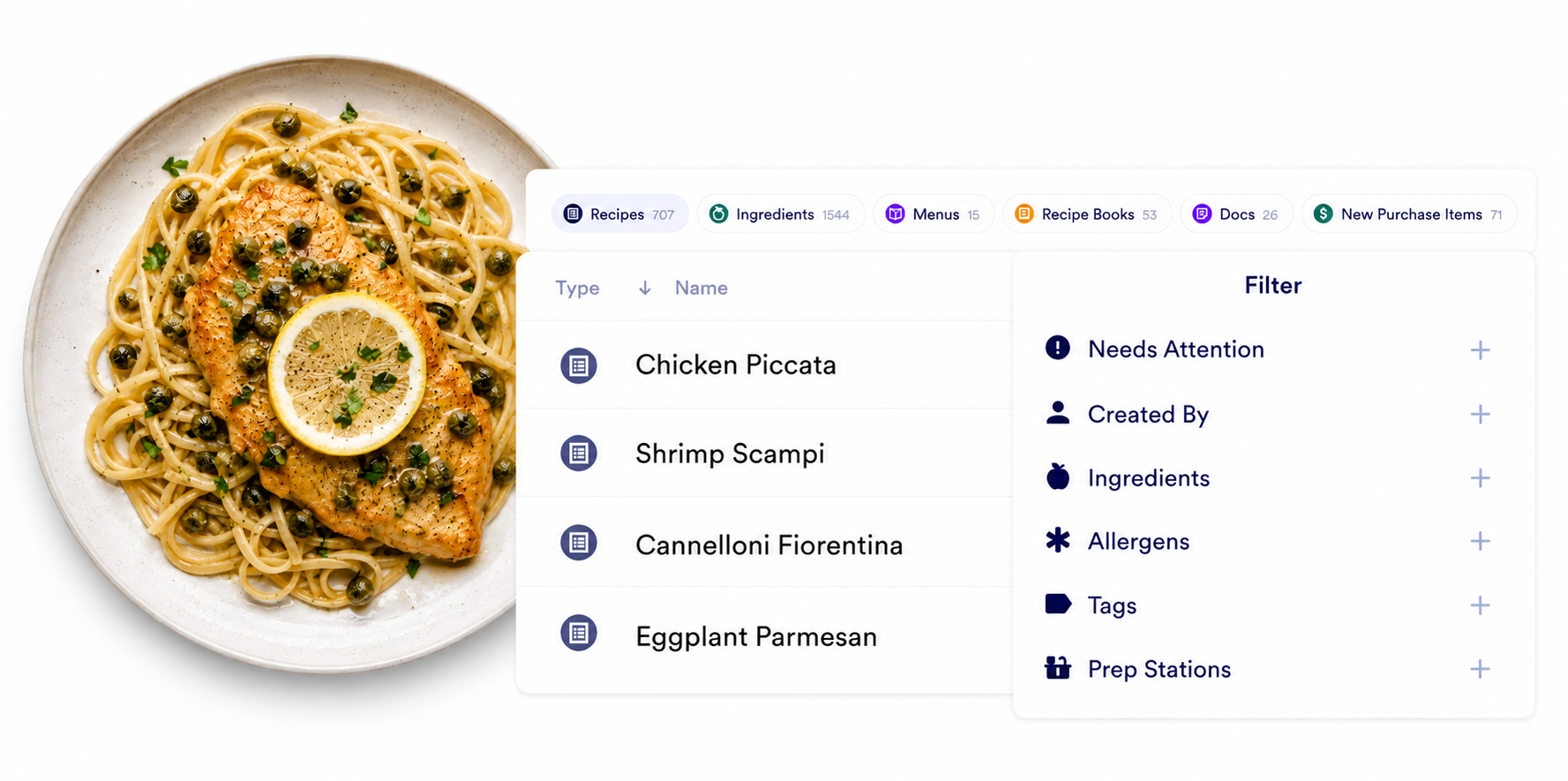
For independent and regional multi-unit operators, the equivalent infrastructure is a culinary operating system where recipes, prep lists, and costing data live in one place. When a menu update happens at the culinary level, it needs to reach every kitchen instantly — already costed, already portioned, already linked to the right purchasing data.
The operators using menu engineering software that integrates recipe costing with sales data are the ones who can sustain the gains from simplification instead of watching them erode over the next 90 days as the kitchen drifts back toward improvisation.
The Cross-Utilization Discipline That Unlocks the Most Margin
One of the more tactical insights from the episode came when Josh described a conversation he has repeatedly with operators. When you look at a kitchen running twelve different oils, or a menu with both a salsa verde and a chimichurri that share no common base, you are looking at margin being left on the table — not through bad pricing, but through purchasing inefficiency and prep redundancy.
Cross-utilization is the discipline of ensuring that every ingredient earns its place across multiple menu entries. In the Chili's context, the same fryer base, the same seasoning profile for the crispers, the same salsa for the appetizer section all feed into a dramatically lower SKU count without reducing perceived variety for the guest.
"Cross-utilize to the max. Never bring in a SKU for just one menu item — it has to work across multiple platforms."
For operators running the menu engineering analysis with real cost data, cross-utilization shows up clearly in the numbers. An ingredient that appears across five recipes has a higher effective yield on every invoice than one that appears in only one. Purchasing volume improves. Waste decreases. And the training burden on new kitchen staff shrinks — because fewer unique preparations need to be learned and repeated to standard.
The Diagnostic Question Every Operator Should Ask Right Now
The question Josh and Jacober kept circling back to was not whether the Chili's comeback would last. It was what the story reveals about the relationship between operational simplicity and financial durability.
A brand that had been adding items for years to chase traffic had to remove items to recover it. That inversion is worth sitting with.
The diagnostic question is not "how many items should we cut?" It is "how many of our current menu items are genuinely earning their place?"
That means looking at contribution margin, not just food cost percentage. It means looking at prep complexity, not just ingredient cost. And it means looking at cross-utilization, not just popularity.
According to Modern Restaurant Management's 2026 restaurant outlook, the operators who win this year are those who move from collecting data to actually using it — simplifying insights and empowering teams to act quickly on what the numbers reveal. Menu simplification without the underlying recipe and cost data to guide it is just subtraction. With the right data infrastructure in place, it becomes the most reliable profitability lever in the business.
"Success for operators this year will hinge on their ability to get the math right in a still-challenging economic environment."
The Chili's story is ultimately about a CEO who trusted the data and made the hard call to take short-term pain for long-term margin. The brands that study that story carefully are the ones most likely to be telling their own version of it in three years.
If you're ready to see which items on your menu are earning their place and which ones are quietly eroding margin, meez's menu engineering tools give you the data to make that call with confidence.
FAQ
What is menu simplification and why does it improve restaurant profitability?
Menu simplification is the practice of intentionally reducing menu items to a focused set that maximizes kitchen efficiency and contribution margin. Fewer SKUs lower purchasing costs, reduce prep complexity, and make it easier to train staff to consistent execution standards. Chili's cut 25 percent of its menu between 2022 and 2025 and saw operating margins improve from 11.9 percent to 17.6 percent over that period.
How many menu items should a restaurant have?
There is no single number, but research and operator experience consistently point to seven items per category as a practical ceiling before guest decision fatigue sets in. The more important question is cross-utilization: every item on a simplified menu should share ingredient and prep infrastructure with other items. A menu with 40 items built on 20 core ingredients is far more manageable than one with 30 items drawing on 30 unique SKUs.
What is SKU rationalization and how does it work?
SKU rationalization is the process of auditing your ingredient list to identify items used in very few recipes and evaluating whether they can be eliminated, replaced, or consolidated. The goal is to maximize purchasing volume on a smaller, higher-utilization set of ingredients. This lowers food costs, reduces waste, and simplifies the prep burden for kitchen teams. Menu engineering software that ties recipe data to ingredient purchasing makes this analysis straightforward.
How does cross-utilization improve food cost?
Cross-utilization means each ingredient works across multiple dishes. When one ingredient base unlocks five menu items, your effective cost per unit drops because purchasing volume increases and waste decreases. It also shortens prep lists and reduces the cognitive load on line cooks. Paris Baguette and Chili's both credit cross-utilization as a key driver of margin improvement during their recent menu reductions.
How do you identify which menu items to cut?
The menu engineering matrix classifies every item by contribution margin and sales volume into Stars, Plowhorses, Puzzles, and Dogs. Dogs are the obvious cut candidates: low margin and low volume. But the more important analysis is looking at Plowhorses and Puzzles, where operational adjustments can recover margin without sacrificing volume. The goal is not just to cut Dogs — it is to build a menu where every remaining item earns its spot through either strong contribution dollars or strategic cross-utilization.
What happened operationally when Chili's simplified its menu?
Cutting the menu made kitchens easier to staff, improved food quality and temperature, and drove "Food Great Scores" to their highest levels in the brand's history. Brinker also invested more than $160 million in additional labor to capitalize on the simpler operation. Employee retention improved because the job became less complex and more repeatable — effects that operators focused only on the cost-side math of menu reduction often underestimate.
Does menu simplification reduce guest satisfaction?
When done correctly, it improves it. The key is focusing simplification on items that overlap in guest appeal and backing each remaining item with tight recipe standards and training. Chili's customers who had not visited in years came back to find food that was faster, hotter, and more consistent. A simplified menu supported by standardized, costed recipes almost always produces a better guest experience than a complex one executed inconsistently.
How does meez help operators execute menu simplification?
meez connects recipe documentation, real-time food costing, and menu engineering in one platform. When you reduce your menu, meez lets you model the contribution margin impact before you remove a single item, see how cross-utilization changes your purchasing exposure, and push updated recipes and prep lists to every kitchen instantly. Operators at multi-unit groups use meez to keep theoretical and actual food cost aligned across locations — so the efficiency gains from simplification don't erode as kitchens drift from standard.